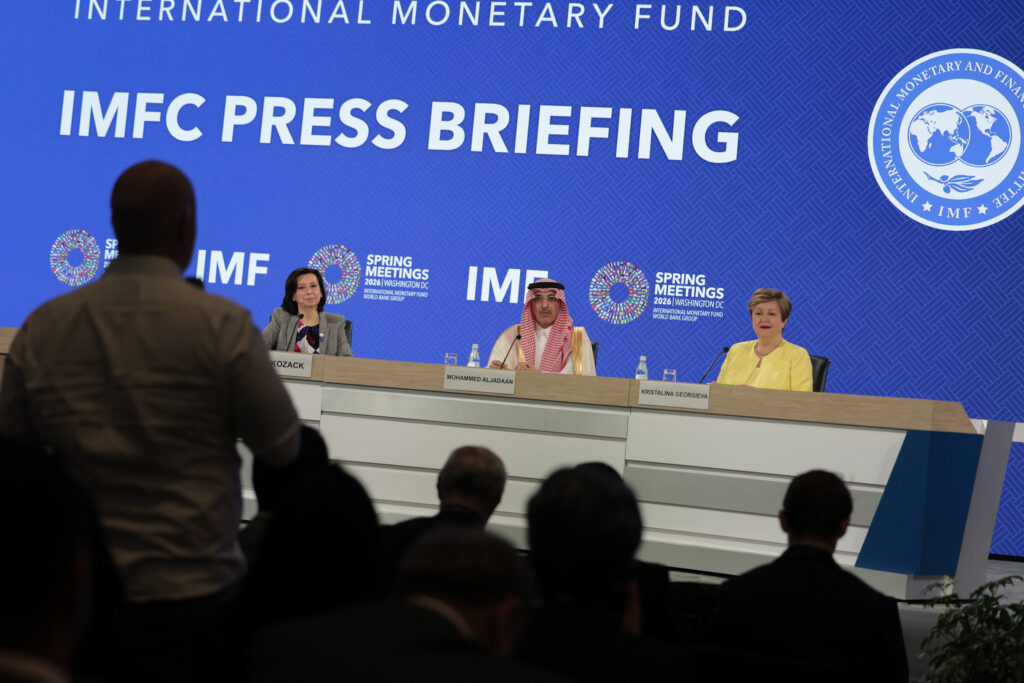
WASHINGTON, D.C.—The war in Iran is overshadowing climate finance commitments set for 2024, as increasing oil prices and defense budgets strain funds needed by developing nations to counter climate change.
The World Bank and IMF’s spring meetings are focused on a coordinated global response to challenges like slow growth and rising debt, issues that worsen global inequalities.
The U.S. conflict in Iran introduces new supply-chain hurdles. In a press briefing, the IMF reduced its growth forecast to 3.1% for the year, down from 3.3% in January, with global inflation rising to 4.4%.
“Our severe scenario anticipates energy supply disruptions extending into next year, causing macro instability. Global growth is projected at 2% this year and next, with inflation exceeding 6%,” said Pierre‑Olivier Gourinchas, IMF director of research.
This situation has sparked concerns about financial support for countries and climate-finance obligations, already strained by donor-country budget cuts and the U.S. abandoning global climate commitments under the Trump administration. President Donald Trump’s early action in office included withdrawing the U.S. from the Paris climate agreement.
Since the COVID-19 pandemic, wealthy nations promising climate finance have faced widening fiscal deficits, according to the OECD’s latest assessment. Aid from these countries dropped 25% in 2025 compared to 2024, with further declines expected.
COP29, held in 2024 in Baku, Azerbaijan, established a $300 billion annual commitment by 2035 with a broader goal of $1.3 trillion annually from public and private sources. This replaced the $100 billion-a-year goal that wealthy nations met belatedly in 2022.
Developing nations criticized the $300 billion figure as inadequate for addressing the climate crisis, which they have contributed least to and are most affected by.
The Iran conflict raises new concerns as top economists assess its impact. “Even before Iran’s conflict, reaching the NCQG target was challenging, particularly with the U.S. withdrawal from the Paris Agreement. The war worsens the outlook,” said Gautam Jain, a senior research scholar at Columbia University’s Center on Global Energy Policy.
He indicated that disruptions in the Strait of Hormuz would worsen the situation, affecting the global economy. Consequently, aid budgets may decline as political pushback on external spending increases.
The conflict heightens the importance of energy security on government agendas, potentially boosting renewables deployment. However, the economic impact of the war might complicate the energy transition.
“In low-income countries, the transition could be significantly delayed due to limited fiscal capacity for absorbing energy price shocks,” Jain stated.
A key priority for the World Bank meetings is to develop a new Climate Change Action Plan to replace the expiring one. But Jain noted that progress seems unlikely given the current geopolitical context.
Jon Sward of the Bretton Woods Project highlighted that donor countries are redirecting climate finance to other needs. The Gulf crisis reveals the fragility of a fossil fuel-dependent economy. Diversifying to renewables is an option many are considering.
Sward emphasized the need for serious discussions on pausing debt repayments for affected countries and mobilizing non-debt finance, highlighting the challenges facing Global South nations.
Experts noted that rising defense spending is reducing funds available for developing countries to tackle climate challenges. Kevin Gallagher from Boston University pointed out that U.S. actions influence multilateral development banks and may lead European NATO nations to focus on defense over climate finance.
Gallagher stated that developing countries are pressured to fund climate initiatives, a challenge exacerbated by the conflict. The $300 billion annual target might be abandoned without new donors like the UAE and China.
The Persian Gulf crisis underscores the case for renewables. “The energy security argument from this conflict is to shift away from fossil fuels,” Gallagher said, citing historical responses to energy crises. He urged the World Bank to accelerate solar and wind programs.
Gaia Larsen from the World Resources Institute noted the increasing prominence of renewables in discussions of long-term energy security. “If we’re considering long-term peace and energy access, renewables are gaining importance,” she said.
Original Story at insideclimatenews.org