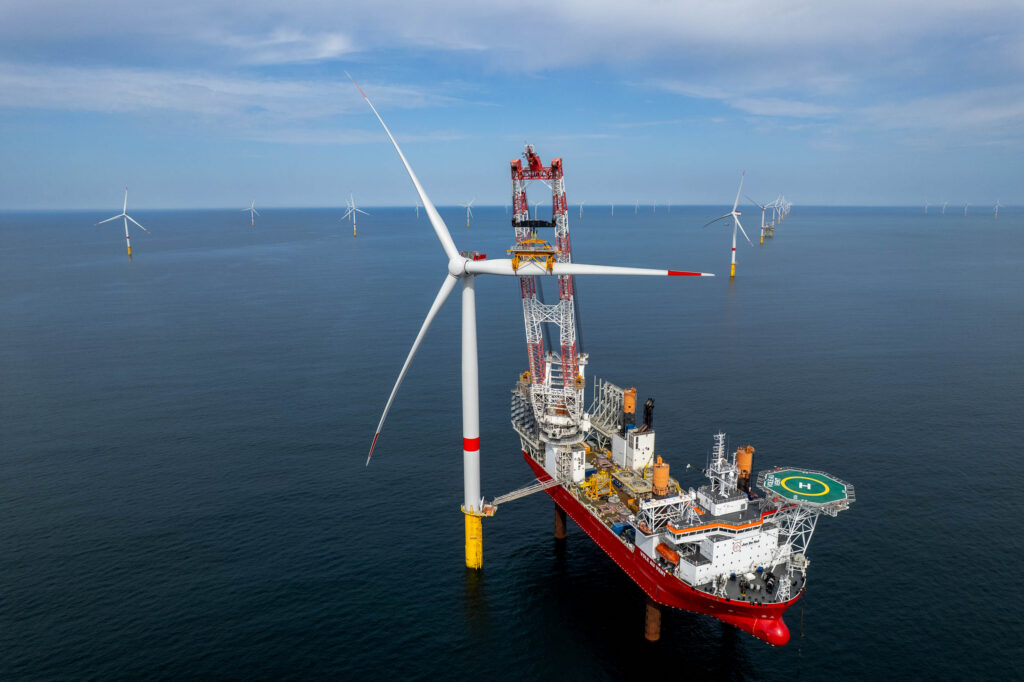
The Global Wind Energy Council (GWEC) urges governments globally to speed up offshore wind deployment, emphasizing the need for offshore wind projects to be considered critical energy infrastructure to boost energy security and mitigate future energy market disruptions.
According to GWEC’s 2026 Global Offshore Wind Report, the industry is on the verge of reaching 100 GW of installed offshore wind capacity worldwide. The report was unveiled on June 9 at the APAC Wind Energy Summit in Hanoi, Vietnam.
In 2025, 9.3 GW of new offshore wind capacity was connected to the grid globally, marking a 16% increase from the prior year, and the third-highest annual total recorded. By the end of 2025, global offshore wind capacity stood at 92.5 GW.
GWEC projects that annual offshore wind installations will double in 2026 and continue rapid growth over the next decade, with over 327 GW of new capacity anticipated by 2035, pushing total global offshore wind capacity to 420 GW.
“Offshore wind is set to become one of the fastest-growing mainstream energy technologies with a compound average annual growth rate of 24% from 2026 to 2030,” GWEC stated in a press release on June 9.
The report highlights that over 50 GW of offshore wind projects are under construction globally, with annual installations expected to surpass 50 GW per year by 2035.
China led the offshore wind market in 2025, commissioning 6.6 GW of new capacity and boosting its total installed capacity to 48.4 GW.
Europe added nearly 2 GW, with the UK, Germany, and France contributing, and the UK accounting for over 1 GW of new installations.
Despite the positive outlook, GWEC noted that project development faces challenges such as permitting delays, grid constraints, supply chain issues, and auction design weaknesses.
Around 25 GW of offshore wind projects outside China have permits and planning approvals but await final investment decisions due to unresolved grid, auction, or subsidy issues.
To tackle these challenges, GWEC proposed an eight-point action plan: streamline permitting processes, boost investment in grid and port infrastructure, enhance auction frameworks, strengthen government-industry collaboration, expand financing options, and bolster supply chains.
The report urges governments to classify offshore wind, along with supporting infrastructure like transmission networks and energy storage facilities, as nationally significant infrastructure projects to reduce regulatory delays and improve investment certainty.
“Built at scale, offshore wind is a strategic asset and one of the best utility-scale renewable power sources for a clean and secure power system,” said Rebecca Williams, GWEC’s Deputy CEO.
Offshore wind now makes up 7.1% of total global wind installations, with China, the UK, Germany, the Netherlands, and Taiwan holding over 90% of the market. The average size of offshore wind turbines installed in 2025 surpassed 10 MW, reaching 10.3 MW.
Follow offshoreWIND.biz on:
Original Story at www.offshorewind.biz