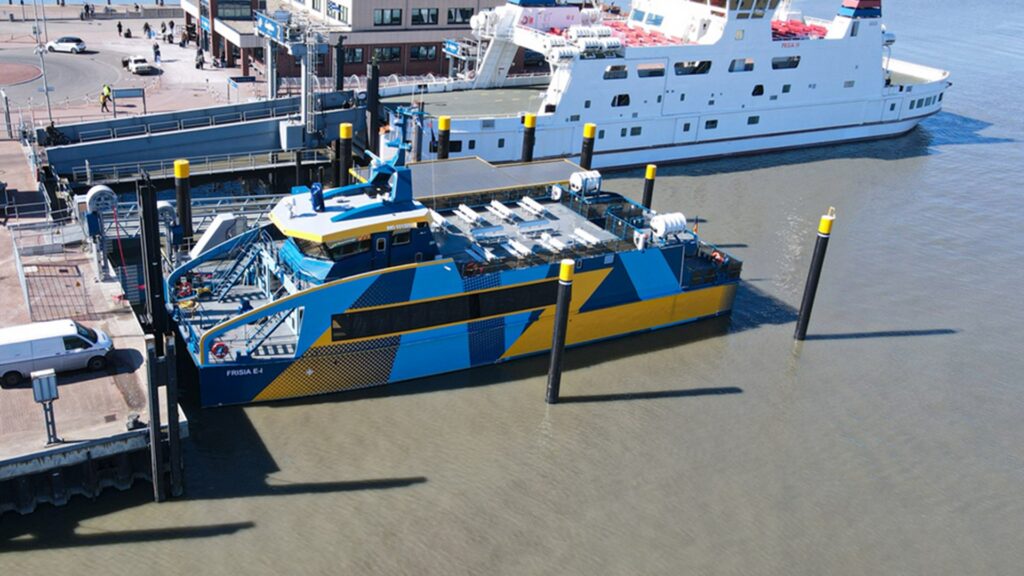
Electric vehicles are being harnessed in Germany as mobile energy storage units to power ferries, offering a novel approach to reducing fossil fuel dependency and alleviating electricity grid pressure.
The initiative, named “Bi-directional Integration of Electric Vehicles” (BIDI-EL), is spearheaded by Osnabrück University of Applied Sciences alongside AG Reederei Norden-Frisia, supported by nearly USD 200,000 from the German Federal Environmental Foundation (DBU).
This project employs a Vehicle-to-Grid (V2G) system, enabling EVs to interact with the energy grid, with the aim of enhancing the sustainability of transportation to the East Frisian Islands in the North Sea.
“The bi-directional integration of EVs not only offers an environmentally friendly alternative to conventional mobility, but can also significantly relieve pressure on the energy supply grid,” noted Hans-Jürgen Pfisterer, PhD, a leading professor on the project.
Exploring V2G Technology
Following the launch of the first fully electric passenger ferry (Frisia E-I) in the German North Sea in 2025, this project takes the next step. The 105-foot (32-meter) catamaran can ferry 150 passengers between Norddeich Mole station and Norderney island in just 30 minutes.
Once docked, the ferry will draw power from parked electric vehicles and on-site solar panels, feeding into the charging infrastructure. Pfisterer emphasized the potential rise in utilizing locally sourced renewable energy.
This approach could also help stabilize the regional electricity grid. “By using vehicles as decentralized energy storage systems, the share of renewable energy can be maximized, the grid stabilized, and vehicle batteries maintained in a kind of ‘wellness operation’,” Pfisterer added.
The ferry terminal already features a photovoltaic (PV) system with a capacity of 1,700 kilowatt-peak (kWp), installed in 2024, and is slated for further expansion. This system will now be augmented by the batteries of stationary EVs.
Utilizing Cars as Power Banks
Under the guidance of Pfisterer and Kai-Michael Griese, PhD, an expert in sustainable business models and circular economy strategies, the project seeks to establish long-term energy solutions and will continue until January 2027.
“The goal of the project is to generate insights that go beyond the initial project outcomes and to establish the foundation for long-term, sustainable business models and energy supply solutions,” Griese emphasized in a press release.
“Innovations such as bi-directional charging are essential for creating future-ready mobility solutions,” Pfisterer concluded. Olaf Weddermann, managing director at Reederei Norden-Frisia, remarked that the project signifies a significant stride toward cleaner maritime transport.
“With this project, we are sending a strong signal for the sustainable transformation of our mobility,” Weddermann elaborated. “The combination of an electric ferry and bi-directional charging for electric vehicles is another important step toward a fossil-free future.
For over 140 years, the company has provided ferry services to the East Frisian Islands, collaborating closely with scientific institutions to pioneer sustainable shipping solutions.
Original Story at interestingengineering.com