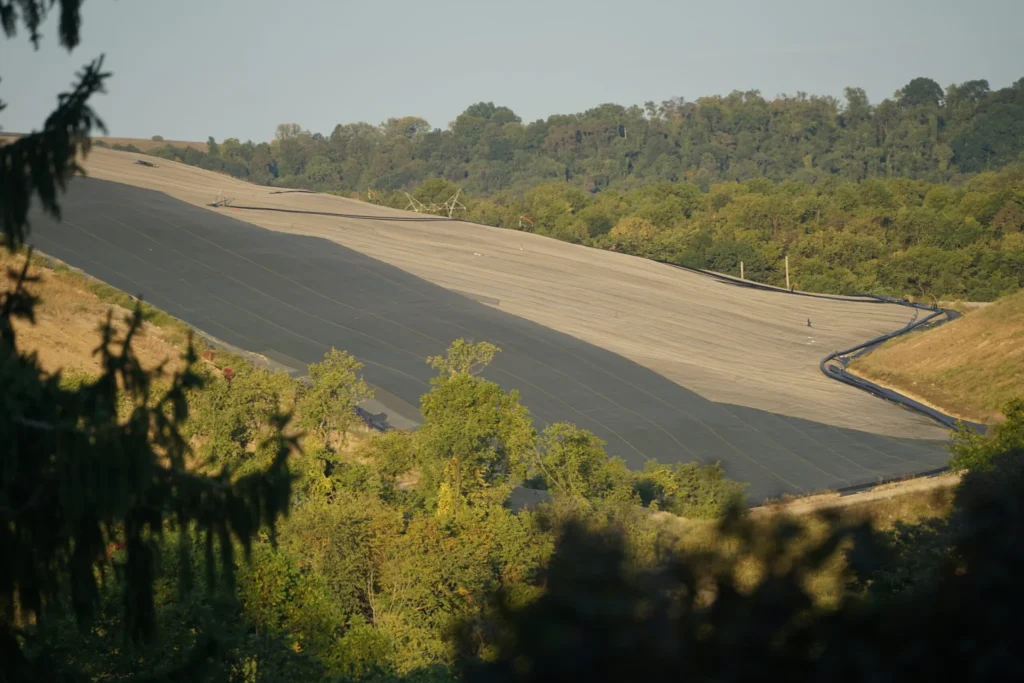
This story was originally published by The Allegheny Front, a public radio program covering environmental issues in Western Pennsylvania.
On a rainy morning, Mike Frederick displayed the Belle Vernon Municipal Authority’s sewage treatment plant, about 30 miles south of Pittsburgh.
“This distribution box is where all the sewage comes in,” said Frederick, an operator at the plant, pointing at a concrete basin where murky liquid flowed through a pipe.
The adjacent tanks were filled with wastewater being treated, concluding with a UV chamber for disinfection.
“That’s what kills your bacteria, your fecal … whatever you want to call it,” Frederick explained, pointing to a pipe discharging clear water into another basin, which flows into the Monongahela River nearby.
Years ago, water from that pipe was not fully treated, leading to increased bacteria and ammonia levels in the discharge.
In 2018, the plant failed water quality tests for the Pennsylvania Department of Environmental Protection (DEP) pollution discharge permit.
“At one point, we weren’t treating anything, and we reported it to the DEP,” Frederick said.
Microorganisms in the plant’s treatment tanks, essential for breaking down sewage, were dying. The cause was traced to wastewater from the nearby Westmoreland Sanitary Landfill.
Frederick noted the landfill’s wastewater smelled like diesel fuel and appeared black.
“The water texture was dark with a lot of foam. It was a mess,” he described.
It emerged that the landfill had been receiving fracking waste from gas drilling and hydraulic fracturing. In 2018, it received 78,000 tons of solid fracking waste, almost a quarter of its yearly intake, according to DEP records compiled by FracTracker Alliance.
The landfill’s wastewater, or leachate, was loaded with fracking waste contaminants.
The Big Question: What to Do With “Landfill Tea”
Leachate, the liquid from the landfill, is termed “landfill tea” by Gillian Graber, executive director of Protect PT.
“The problem is … rain,” said Graber. “Anytime it rains, it soaks through the matter.”
Rainwater accumulates contaminants it contacts in the landfill. This includes drill cuttings high in salts, metals, and radioactive materials like radium, a naturally occurring radioactive element.
A 2011 analysis by federal scientists found Marcellus shale gas wells’ liquid waste had radium concentrations 40 times above what the Nuclear Regulatory Commission classifies as hazardous.
Despite this, Congress exempted oil and gas waste from federal hazardous waste regulations in 1980. By 1988, the EPA decided regulations were unnecessary, allowing fracking waste in municipal landfills.
Annually, Pennsylvania deals with a million tons of fracking waste, as per DEP oil and gas waste records. Graber noted that landfills are not equipped for such waste.
The DEP lists 31 landfills in Pennsylvania accepting oil and gas waste.
A New Plan for the Leachate, but Same Worries
The Westmoreland landfill’s reports to the DEP described its leachate sent to the Belle Vernon plant as having an “oil-like” sheen and exceeding parameters for salts and metals.
In 2019, a judge barred the landfill from sending its leachate, and the sewage plant normalized. DEP fined the landfill $24,000 and required a solution.
Now, leachate is trucked to plants in Ohio and Western Pennsylvania. The landfill proposes on-site treatment and river discharge of treated wastewater.
However, the plan worries locals since the Mon river supplies drinking water to a million people. The DEP issued a draft permit for this project.
At a DEP hearing, Samuel Gibson, an engineer with KLH Engineers, suggested the permit needs more radium discharge limits.
John Stolz, an environmental science professor, warned of radium accumulation in river sediments. “They have taken so much solid and liquid [fracking] waste that their leachate has the chemistry of oil and gas waste,” he said.
Stolz’s study showed radioactive materials build up near plants accepting leachate from such landfills, a risk for Westmoreland.
Noble Environmental, the landfill owner, and the DEP did not comment on protecting the river from contaminants like radium.
“I’m Not Happy About It”
Local residents are uneasy about the landfill’s fracking waste acceptance. Jim Sepesky, living nearby, stated, “I’m not happy about it. You just don’t know the long-term health effects.”
Sepesky opposes releasing treated leachate into the Mon river. He recalled when the landfill was small, serving local needs, but expanded with the oil and gas industry.
“I get it—the oil and gas industry is here to stay,” Sepesky said. “Why not try and find a way to do these things properly?”
Note: Protect PT and FracTracker Alliance receive funding from The Heinz Endowments, which also funds The Allegheny Front. John Stolz’s work has funding from The Heinz Endowments and Park Foundation, both fund The Allegheny Front.
Original Story at insideclimatenews.org