Unprecedented Ocean Temperatures Stir Concerns Along California’s Coast
California’s coastline is experiencing an alarming rise in ocean temperatures due to an extreme marine heat wave. This phenomenon could have significant impacts on local weather patterns and marine ecosystems over the coming months.
According to the Scripps Pier in La Jolla, this marine heat wave, which began forming late last year, has intensified recently. More than 25 daily temperature records have already been shattered this year. On a recent measurement, the surface water temperature hit 68.5 degrees Fahrenheit—7.7 degrees above the typical average. Additionally, the sea bottom recorded an unprecedented 67.6 degrees, marking the highest temperature for April 15 in about a century of records.
Spanning from San Francisco to the Mexican border, this heat wave is both deep and widespread. Daniel Swain, a climate scientist with the University of California’s Agriculture and Natural Resources, noted that these conditions suggest the heat wave may persist for weeks, months, or even seasons, significantly affecting Southern California.
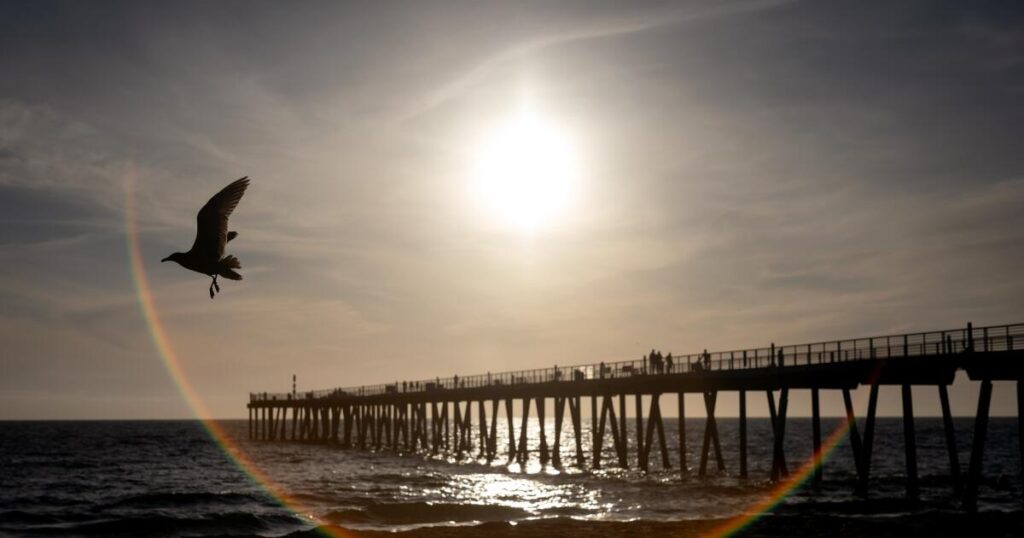
Beachgoers play in the water near the Hermosa Beach Pier.
The unusual warmth is attributed to multiple factors, including a persistent high-pressure ridge over Southern California and weaker coastal winds that normally promote upwelling. Upwelling is a process where cold ocean water rises to the surface, typically cooling the region.
Human-induced climate change is also contributing to these new temperature records. Swain highlighted the dramatic nature of this event, stating, “From an ocean warmth perspective, we are now entering a pretty dramatic period” for the affected region.
Looking ahead, there is a 61% chance of an El Niño event developing between May and June, which could further elevate ocean temperatures. The federal outlook also predicts a potential 25% chance of a particularly strong El Niño, which often brings warm and wet conditions to Southern California.
Record-breaking marine heat wave
Sea surface temperatures are warming along the coast of California.


National Oceanic and Atmospheric Administration, Google Earth
Lorena Iñiguez Elebee LOS ANGELES TIMES
Dillon Amaya from the National Oceanic and Atmospheric Administration’s Physical Sciences Lab explained that the ongoing heat wave is expected to persist off Baja California through December, with models indicating a 70% probability of continuation. He remarked on the rarity of such anomalies in this region, saying, “It is not easy to get an anomaly of this magnitude, so that in my mind makes it even more impressive — and terrifying.”
The current situation evokes memories of “the blob,” a significant marine heat wave from 2014 to 2016 that severely disrupted marine ecosystems along the Pacific coast.

The warming Pacific Ocean could mean less ‘May Gray’ and ‘June Gloom.’
On land, the heat wave could lead to reduced marine layers, resulting in less “May gray” and “June gloom” over Southern California. This change may also increase humidity levels, posing potential health risks for residents unaccustomed to such conditions.
Swain noted that while 90-degree temperatures are not record-breaking, the added humidity could present challenges for Los Angeles residents. Warmer overnight temperatures might also hinder the body’s ability to cool down.
Increased ocean temperatures may also elevate the risk of hurricanes and tropical storms developing off Mexico’s coast. While direct impacts on California are unlikely, remnants of such storms could influence local weather, as seen with Hurricane Hilary in 2023.
Fire season impacts remain uncertain. While increased moisture from storms might suppress fires, dry lightning could ignite them, Swain added.
Art Miller of Scripps Institution of Oceanography referenced a similar marine heat wave in 2019, termed “Blob 2.0,” which disrupted ecosystems off Northern California and Alaska. He suggested these events might be connected to broader changes in the Pacific Ocean due to climate change, though more data is needed to confirm this hypothesis.
Amaya emphasized that while the current heat wave might have occurred without climate change, its intensity is undoubtedly influenced by global warming. “As the world continues to warm, every marine heat wave will be warmer than the last one,” he stated.
Original Story at www.latimes.com