This transcript was created using automated transcription software to enhance accessibility and convenience. Although we aim for precision, the automated process may lead to errors or omissions. For the most accurate representation, please refer to the original audio recording.
Delta Ponds: A Natural Sanctuary Amidst Urbanization
MICHAEL DUNNE: I’m Michael Dunne. Nestled just a stone’s throw away from one of the area’s largest shopping centers and the bustling Interstate 5, Delta Ponds on the Willamette River in Eugene offers a serene escape. Here, bald eagles, great blue herons, and a multitude of birds and waterfowl create a feeling of tranquility that belies its proximity to urban life. However, climate change does not respect these boundaries. Today, I speak with an ecologist from the city of Eugene to explore this unique urban wetland and its challenges, including the ongoing shallowing of Delta Ponds due to drought and climate change.
LAURI HOLTS: You’re very welcome.
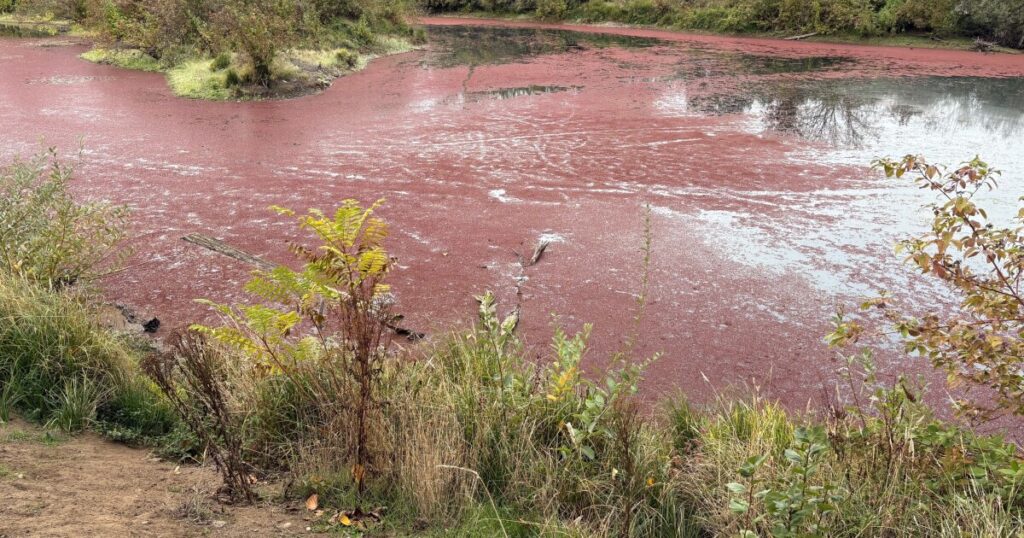
MICHAEL DUNNE: So, delta ponds is turning red. What’s happening?
LAURI HOLTS: We have an aquatic fern on the east side of the pond, east of Delta Highway. This fern, from the genus Azolla, gives the water a pinkish-red hue, resembling a paint spill. It’s made up of tens of thousands of tiny floating ferns, different from the ferns you might find in your garden.
MICHAEL DUNNE: Is the bloom triggered by temperature or something else?
LAURI HOLTS: It can result from a combination of factors such as temperature, full sun, and possibly depleted phosphorus levels. The bloom can signify less than ideal conditions, though it may also help protect the plant from sunburn.
MICHAEL DUNNE: How does this impact the local wildlife?
LAURI HOLTS: Despite its thickness, the fern doesn’t negatively impact the ecosystem. It might even enhance water quality by shading the water column, suppressing more harmful algal blooms, which are actually cyanobacteria blooms.
MICHAEL DUNNE: How long will the red pigmentation last?
LAURI HOLTS: The ferns will likely die off as temperatures drop below freezing, transitioning with the fall weather.
Understanding Delta Ponds’ Historical and Ecological Significance
MICHAEL DUNNE: Can you provide some background on Delta Ponds?
LAURI HOLTS: The area was historically a part of the river’s meandering path until constrained by human development. Gravel mining in the 1950s and 60s reshaped the ponds, and a restoration project from 2004 to 2012 aimed to reconnect the ponds to the Willamette River, benefiting juvenile Chinook salmon.
MICHAEL DUNNE: Is this why birds are drawn to Delta Ponds?
LAURI HOLTS: Yes, the restoration involved enhancing riparian vegetation, planting over 100,000 native trees and shrubs, and removing invasive species. The diverse habitats support a wide range of bird species, from waterfowl to songbirds.
Addressing Invasive Species and Climate Impact
MICHAEL DUNNE: How do invasive species like nutria affect Delta Ponds?
LAURI HOLTS: Introduced for the fur trade, nutria cause erosion and compete with native species, such as muskrats. Despite efforts to control their population, their high reproductive rate makes it challenging.
MICHAEL DUNNE: What about the presence of Canada geese?
LAURI HOLTS: While traditionally migratory, some Canada geese have become year-round residents due to changing climates, reflecting broader shifts in bird populations.
MICHAEL DUNNE: How has climate change affected Delta Ponds?
LAURI HOLTS: The ponds currently face extremely low water levels, the lowest I’ve seen since 2004. Prolonged dry summers impact water availability and stress vegetation, leading to significant ecological changes.
MICHAEL DUNNE: Delta Ponds remains a vital community asset. Thank you for sharing your insights, Lauri Holts.
LAURI HOLTS: You’re welcome.
MICHAEL DUNNE: For more episodes of Oregon On the Record, visit KLCC.org. Join us tomorrow as we discuss seismic threats to the Pacific Northwest with an Oregon State University professor. I’m Michael Dunne, thanks for listening.
Original Story at www.klcc.org