Europe’s electric vehicle (EV) sector is witnessing rapid growth, yet it lags behind China’s quick industrial transition. While Europe’s EV market progresses, it faces challenges that might impede its global leadership aspirations.
Current State of Europe’s BEV Market
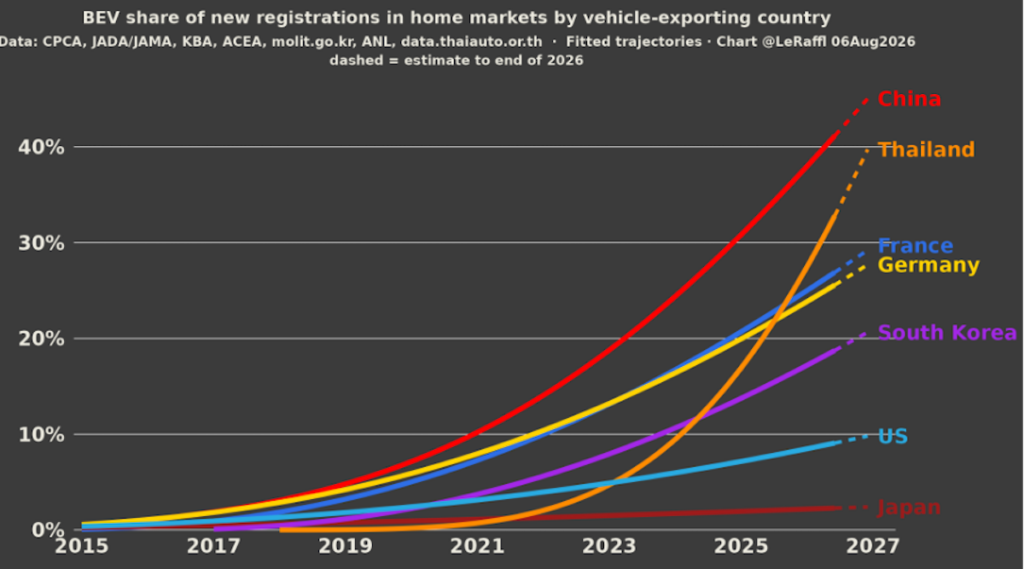
The European Union’s battery-electric vehicle (BEV) registrations reached 20.7% in the first half of 2026, a notable increase from 15.6% the previous year. This growth translates to over 1.24 million units sold, marking a 33.7% rise compared to 2025. However, despite these advancements, BEV sales still trail hybrid vehicles, which maintain a 37.3% market share.
Countries like France have shown significant progress, achieving a record 29.6% market share for BEVs in June, while smaller markets such as Norway and the Netherlands surpassed China’s BEV share. Germany, the birthplace of the automobile, reported that electric cars outsold all other fuel types in June 2026, capturing about 28% of the market.
Comparative Analysis with Global Markets
Europe’s position in the global EV landscape is moderate. It surpasses Japan and the United States in terms of domestic BEV share but remains behind China and Thailand. As of June 2026, China’s domestic BEV share reached approximately 42.8%, while combustion vehicle sales continue to decline rapidly.
Thailand, despite its smaller size, has restructured its policies to favor EV exports, transforming a Japanese-dominated market into a Chinese-led EV hub. In contrast, the United States and Japan continue to lag in domestic BEV adoption.
Challenges and Industrial Shifts
Europe’s car manufacturers are facing significant challenges as Chinese brands enter the market. Chinese BEVs, despite facing EU duties, are gaining traction, holding an estimated 11% share of the European market as of June 2026. This growth is attributed to China’s extensive experience in large-scale BEV production, which provides a competitive advantage.
Stéphane Séjourné, the EU’s industrial policy chief, highlighted the “mortal danger” posed by Chinese imports, emphasizing the need for Europe’s domestic carmakers to adapt more rapidly to the electric transition.
Policy and Economic Implications
The T&E analysis indicates that infrastructure development is not the primary bottleneck for EV adoption in Europe. Instead, industrial and regulatory strategies need to focus on reinforcing CO₂ standards and promoting BEV-specific subsidies over hybrid incentives.
The concept of “technology openness” has been a topic of debate in Germany, where the focus is on preserving existing technologies instead of mandating a shift to full battery-electric systems. However, this approach may delay the transition, impacting long-term competitiveness.
As Europe navigates these industrial challenges, it must prioritize building battery-electric vehicles that appeal to both private and corporate buyers. This strategic focus will determine Europe’s future standing in the global car market.
Original Story at cleantechnica.com