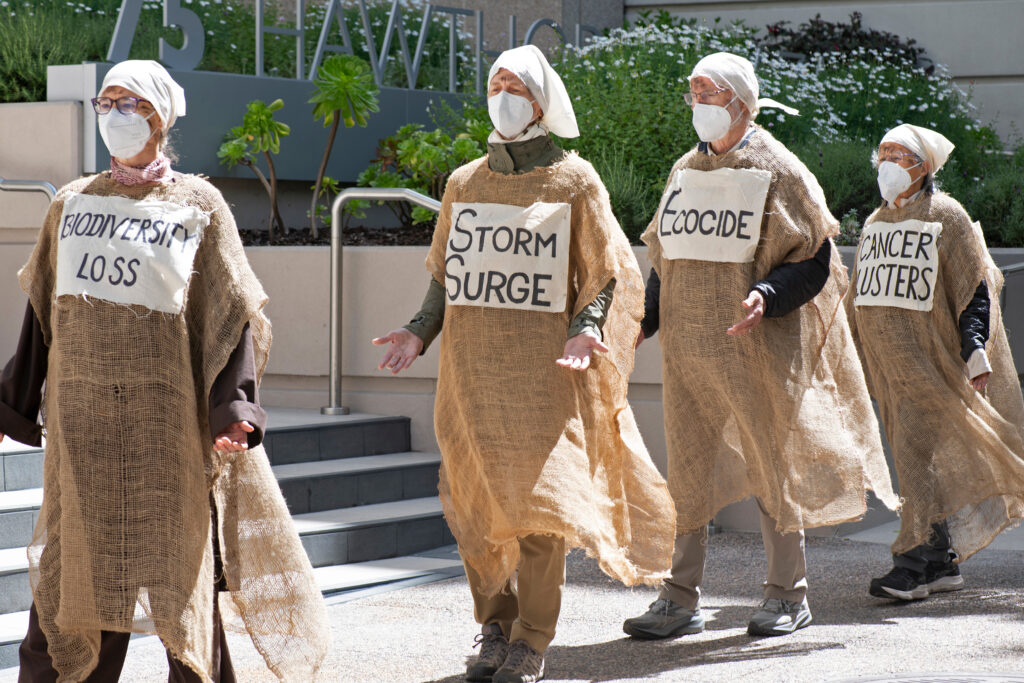
A group of mourners, symbolizing climate concerns like sea level rise and ecocide, gathered outside the EPA’s Region 9 office in San Francisco to mourn the end of a crucial climate regulation on Tuesday.
The mourners donned sackcloth and ash to signify grief over the loss of a vital tool meant to regulate climate pollution.
“We’re here to honor the endangerment finding, taken from us too soon,” stated Michelle Merrill, organizer and evolutionary anthropologist. The event was organized with other climate activists and Scientist Rebellion Turtle Island, a scientific group addressing the climate crisis.
On February 12, the EPA rescinded its 2009 endangerment finding, which acknowledged that emissions from carbon dioxide and other greenhouse gases pose a threat to current and future generations. The repeal of this rule, effective April 20, means the EPA can no longer use it to set emission standards under the Clean Air Act.
Organizers observed a moment of silence, sang dirges, and recited poems to commemorate the finding’s repeal, drawing little attention from passersby. While no EPA employees participated, some expressed gratitude for the public support.
Paul English, an environmental epidemiologist with Scientist Rebellion, stated that repealing the finding removes the government’s ability to regulate greenhouse gases, predicting an escalation in climate issues like heatwaves and habitat loss, impacting public health globally.
The EPA’s initial issuance of the endangerment finding during the Obama era followed a Supreme Court ruling and comprehensive scientific research from prominent climate organizations and public comments.
English criticized the Trump administration for overturning the finding without scientific backing. President Trump directed EPA Administrator Lee Zeldin to revisit the finding’s legality on his first day in office via executive order.
Trump later declared the rollback a major deregulatory action and labeled the finding a “disastrous Obama-era policy” during an event with Zeldin. Despite a 2007 Supreme Court ruling, the Bush administration opted not to enforce climate regulations under the Clean Air Act.
An EPA spokesperson noted the agency is now focusing on its core responsibilities using “gold standard science.” They argued that eliminating all GHG emissions from vehicles would not significantly impact global climate indicators.
Joseph Goffman, a former EPA official under Biden, criticized the repeal as legally and morally indefensible. Greg Spooner, a physicist with Scientist Rebellion, expressed concern over the dismantling of U.S. regulatory capabilities.
Spooner encouraged his peers to campaign for reinstating the endangerment finding’s spirit and power.

Following the repeal, Democrats and public-interest groups swiftly filed lawsuits to contest the decision. States, cities, and counties have challenged the EPA in a lawsuit in the U.S. Court of Appeals for D.C. Circuit.
Spooner emphasized the severe impact of the administration’s actions on American science. Last month, activists distributed condolence cards to EPA staff, showing solidarity and support for their mission to protect the environment.
Michelle Merrill acknowledged the challenges ahead but remained optimistic about future change.
Original Story at insideclimatenews.org