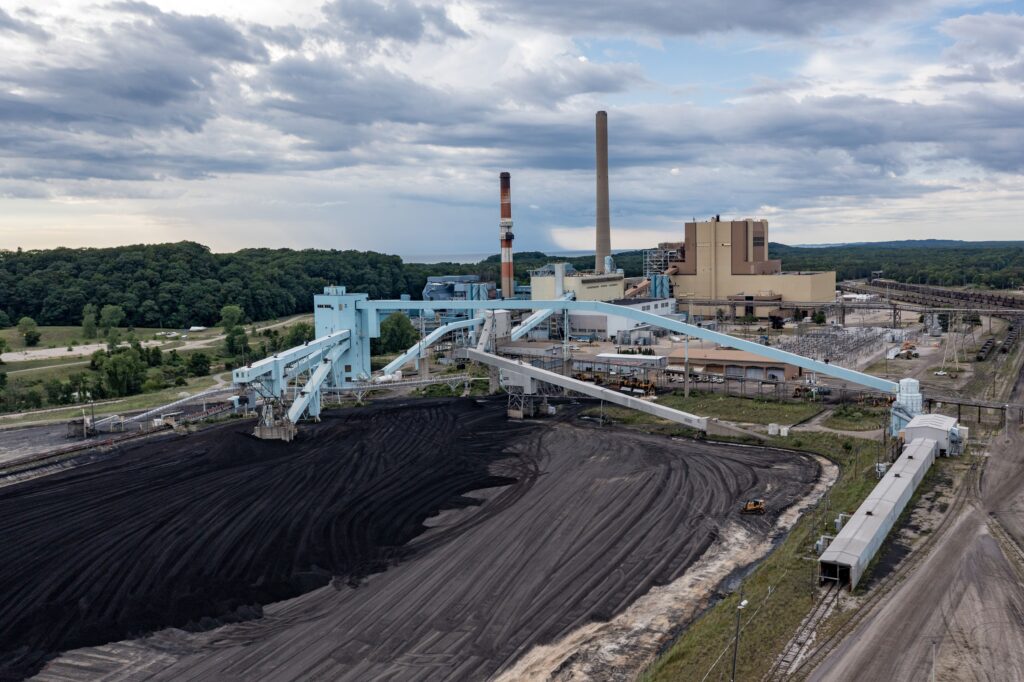
A federal appeals court ruled against the Trump administration’s use of emergency powers to keep a Michigan coal-fired power plant operational, asserting that the U.S. Department of Energy (DOE) exceeded its authority.
The U.S. Court of Appeals for the District of Columbia delivered a 3-0 decision, condemning the administration’s use of wartime policies to prevent plant closures.
DOE officials cited a crisis of potential blackouts as justification. However, state officials, utilities, and environmental groups successfully argued that the DOE’s actions surpassed federal law’s brief and narrow scope, assuring that state energy needs could be met without the plant.
“This ruling confirms our stance: the administration cannot fabricate emergencies to circumvent laws against Michigan residents’ interests,” stated Dana Nessel, Michigan’s attorney general, in a statement.
A DOE spokesperson did not directly comment on a potential appeal but assured that the agency continues to safeguard energy security. The spokesperson highlighted emergency orders at the J.H. Campbell Generating Station in Michigan for preventing blackouts, especially during January’s Winter Storm Fern. Coal generation rose significantly, with the Campbell plant running at over 650 megawatts daily between Jan. 21 and Feb. 1.
DOE can appeal the decision by requesting a full rehearing or appealing to the Supreme Court.
The decision questions Energy Secretary Chris Wright’s strategy to support the coal industry using emergency powers under the Federal Power Act. This authority, mainly for extraordinary events, was used to maintain fossil fuel plants nearing closure.
Starting with the Campbell plant in May 2025, Wright employed Section 202(c) to prevent closures of six coal plants and one gas and oil plant, citing grid reliability. Although limited to 90 days, Wright repeatedly renewed these orders, including a new 90-day order for a Washington state plant after the ruling.
Coal producers welcomed the delays, with Core Natural Resources expressing hopes for continued postponements.
Judge Cornelia Pillard, appointed by President Obama, wrote the court decision, rejecting Wright’s broad interpretation of “emergency” authority.
Located in West Olive, Michigan, the Campbell plant has a summer capacity of 1,331 megawatts. Consumers Energy, the plant owner, planned a May 2025 shutdown, with plans approved by Michigan regulators and the grid operator.
Environmental Defense Fund lead counsel Ted Kelly called the decision a “striking rejection” of the DOE’s emergency orders, urging the withdrawal of these orders to allow plant retirements.
The Campbell plant is costly and one of Michigan’s most polluting facilities, with significant impacts on air and water. The Environmental Defense Fund estimates it emits 10,000 pounds of toxic metals into Lake Michigan annually, causing over 400 asthma attacks, while the Sierra Club links its pollution to 66 deaths per year.
Elizabeth Hauptman, a Michigan field organizer for Moms Clean Air Force, expressed relief over the court’s ruling, highlighting its significance for families dealing with pollution.
“This confirms what families knew: this action was not beneficial for us,” she said.
Despite the ruling, the latest order keeping Campbell open remains effective, with environmental attorneys urging the DOE to comply. DOE faces separate legal challenges for each emergency order.
In addition to Campbell, orders kept open other plants like Eddystone Generating Station in Pennsylvania and several coal plants in various states.
Alexandra Klass, a University of Michigan Law professor, emphasized the decision’s impact on energy planning, noting the difficulty of investing in new resources if old ones can’t close.
Updated Sept. 11, 2026, to include another emergency order for a coal plant.
Original Story at insideclimatenews.org