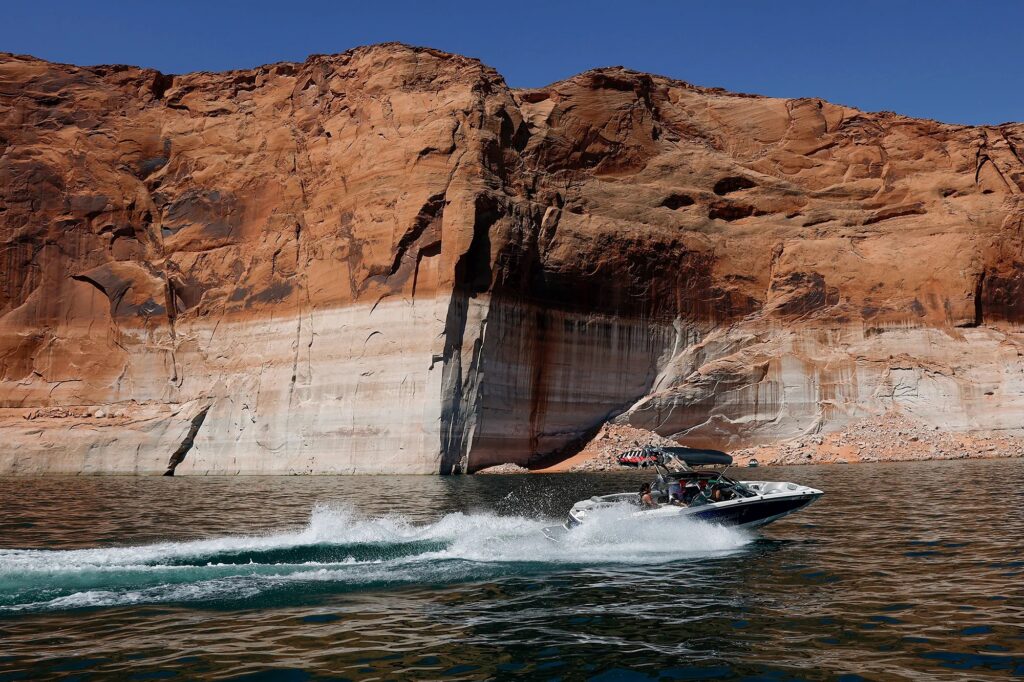
Colorado River Management: Seeking Solutions Amid Expiring Agreements
Critical agreements governing the Colorado River are set to expire by the year’s end, leaving stakeholders scrambling to devise new strategies. The previous agreements, crafted in 2007, took less than three years to finalize and lasted nearly two decades. However, current negotiations have yet to yield a similarly enduring solution.
Recently, the U.S. Bureau of Reclamation, under the Department of the Interior, released a 10-year framework offering broad guidelines for the river’s management. However, it stops short of providing a detailed long-term plan.
The proposal includes potential cuts of up to 40% for California, Arizona, and Nevada in the lower basin, while allowing Lake Powell’s water levels to fall below legally mandated thresholds. These cuts serve as a maximum limit, with the federal government planning biennial updates if no consensus is reached.
Imminent plans will soon be announced, potentially reducing California’s water supply by 10% annually through 2028, equating to approximately 440,000 acre-feet each year. These measures, however, do not mandate reductions for the upper basin states, including Colorado, Wyoming, Utah, and New Mexico, highlighting federal limitations in enforcing cuts.
California’s water suppliers had hoped for more definitive solutions to aid in long-term planning. Bill Hasencamp, manager of Colorado River resources for the Metropolitan Water District, expressed concerns: “We need to plan for our future. And this deal does not let us do that.”
The Role of Southern California’s Water Network
Southern California’s water supply, often reliant on extensive engineering, faces uncertainty with the Colorado River’s future in flux. The Metropolitan Water District plays a crucial role, importing water from both Northern California and the Colorado River to serve 19 million people across six counties.
The district’s reliance on Colorado River water is significant, especially as recent droughts have led to unprecedented water restrictions for millions. While the region isn’t currently experiencing severe shortages, the lack of a secure water source exacerbates risks in future droughts.
Metropolitan Water District is also involved in large-scale projects like the Pure Water Southern California initiative and is assessing the viability of the Sites Reservoir and Delta tunnel projects. Decisions on these projects are critical, as they could either alleviate water scarcity or inadvertently raise water costs.
Agricultural Concerns Amid Water Cuts
California’s extensive agricultural sector, particularly in the Imperial Valley, is heavily reliant on the Colorado River. The Imperial Irrigation District uses a significant portion of the river’s water to sustain half a million acres of crops such as alfalfa and vegetables.
Recent conservation efforts, funded by federal dollars, have aimed to reduce water use temporarily, contributing to water levels in Lake Mead. However, these programs are nearing their end, necessitating future plans and approvals, which could take significant time to secure.
Negotiations continue among California water users to address the upcoming reductions, with the Imperial Irrigation District yet to commit to specific plans. “The district’s perspective is: We’ve done a lot. We’re doing a lot. It’s challenging to do more,” said Tina Shields, the district’s water manager.
Navigating the Complexities of Water Agreements
The U.S. Department of the Interior’s forthcoming plan is expected to call for reductions in the lower basin states, aligning with proposals made in May. However, stakeholders must reach consensus on implementation, including cost-sharing arrangements.
While federal involvement has been limited, Arizona Governor Katie Hobbs has urged for greater intervention to facilitate a deal. Disputes between upper and lower basin states continue, with accusations of insufficient water reduction proposals contributing to the stalemate.
As negotiations persist, the need for a sustainable and comprehensive plan becomes increasingly urgent, with potential impacts on millions of residents and critical agricultural operations across the region.
Original Story at www.kqed.org