Record Low Water Levels in Lake Mead and Lake Powell Signal Growing Crisis
In a stark indication of a worsening water crisis, Lake Mead and Lake Powell, the two largest reservoirs in the United States, have plummeted to their lowest combined levels ever recorded. These reservoirs, crucial to seven states reliant on the Colorado River, are now lower than their previous record in 2023, according to researchers.
“It’s a hell of a milestone,” remarked Jack Schmidt, director of Utah State University’s Center for Colorado River Studies. “Really a teaching moment to all of us of the severity of the crisis.”
U.S. Interior Secretary Doug Burgum convened with governors from the seven affected states via video conference, announcing that his agency will unveil a plan to tackle the water shortages in the coming week.
Reservoir Levels and Implications
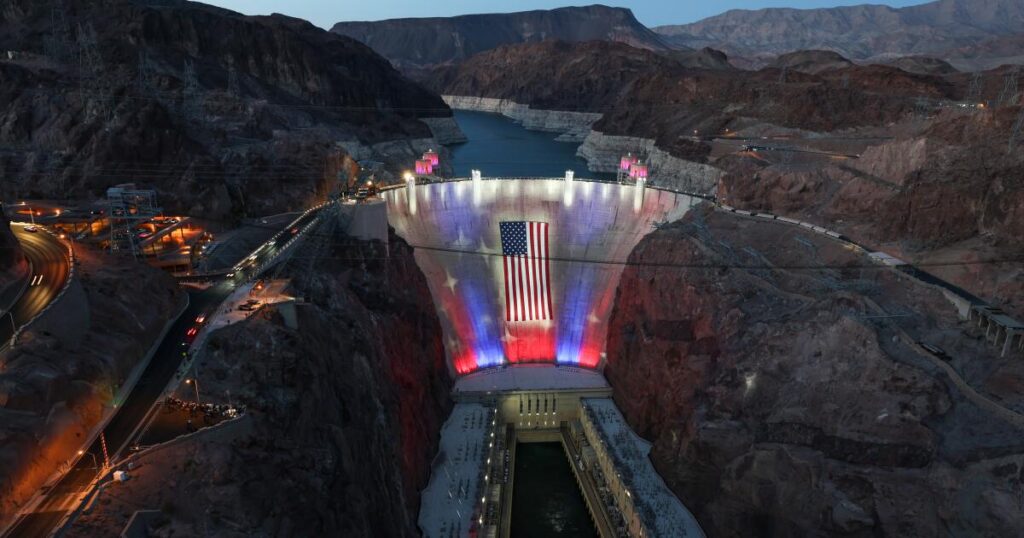
Lake Mead, situated near Las Vegas and recognized as the nation’s largest reservoir, is currently at 27% capacity. Meanwhile, Lake Powell, straddling the Utah-Arizona border, holds a mere 23% of its potential volume. A further drop of 33 feet in Lake Powell would prevent water from reaching its intakes to generate hydroelectric power.
Schmidt, along with five other researchers, emphasized in a white paper the critical need to reduce water usage, forecasting that the reservoirs will continue to hit new lows daily until the next seasonal runoff from snows occurs.
The uncertainty surrounding whether the current strong El Niño conditions might bring relief is palpable. The three-month forecast by the National Weather Service suggests above-average rainfall may occur along the river and throughout much of the Southwest until October.
Impact and Historical Context
The Colorado River serves as a vital water source for approximately 35 million people and irrigates 5 million acres of farmland. The 1922 agreement that divided the river’s water among the states initially overestimated the river’s capacity.
The remains of a boat sit on a dry shore at Lake Mead National Recreation Area.
(Ty ONeil / Associated Press)
The river’s diminished flow over the past 27 years is largely attributed to global warming, which has exacerbated drought conditions. Since 2020, the river’s flow has averaged 32% less than in the prior century.
This year, the upper watershed of the river in the Rocky Mountains recorded its lowest snow levels ever. “If you need any more evidence that we have a five-alarm fire, here it is,” Schmidt stated.
Schmidt warned that the necessary changes to adapt to reduced runoff would be significant. “We need to get seven states to agree together, or accept a mandate from the federal government, that major reductions have to be implemented right now,” he continued.
Steps Toward Resolution
Following the meeting, Burgum expressed gratitude to the governors for their “leadership and commitment to finding solutions to address drought conditions in the Colorado River Basin.”
The Trump administration is focused on “establishing a new operating framework and continues to work with the states and 30 tribes to get closer to consensus,” he said.
Negotiations among the seven states have stalled, with disagreements between the downstream states of California, Arizona, and Nevada, and the upstream states of Colorado, Wyoming, Utah, and New Mexico.
Representatives from California, Arizona, and Nevada have proposed substantial cuts, suggesting using 1.6 million acre-feet less annually over the next two years. However, officials indicated that the Trump administration might impose mandatory cuts of up to double that amount, potentially affecting 40% of their combined water allocations.
Jennifer Pitt, director of the National Audubon Society’s Colorado River program, mentioned that federal officials seem to be “trying to put some structure in place that pushes the states to try again, maybe with a slightly different playing field, to see if the states can come to some sort of agreement.”
Consensus is crucial to avoid a court battle, which Pitt noted carries significant unpredictability.
Over the past five years, Southern California cities have sourced nearly a quarter of their water from the Colorado River, striving to reduce dependency. Recent efforts, along with water from Northern California, enabled the Metropolitan Water District of Southern California to accept $65 million from the U.S. Bureau of Reclamation. In return, they agreed to leave up to 200,000 acre-feet of water in Lake Mead, temporarily raising its level by about 3 feet.
Lake Mead was previously lower in 2022, but Lake Powell held more water then, resulting in a higher combined volume.
In the past three years, California, Arizona, and Nevada have employed voluntary water cutbacks and federal compensation to farmers who agree to leave fields dry part of the year.
The Bureau of Reclamation now intends to allocate an additional $100 million for water conservation programs in the four upstream states, compensating farmers and ranchers who commit to using less water. The conserved water will remain in the reservoirs, helping to slow their relentless decline.
Original Story at www.latimes.com