Climate Change Threatens Global Grasslands and Food Security
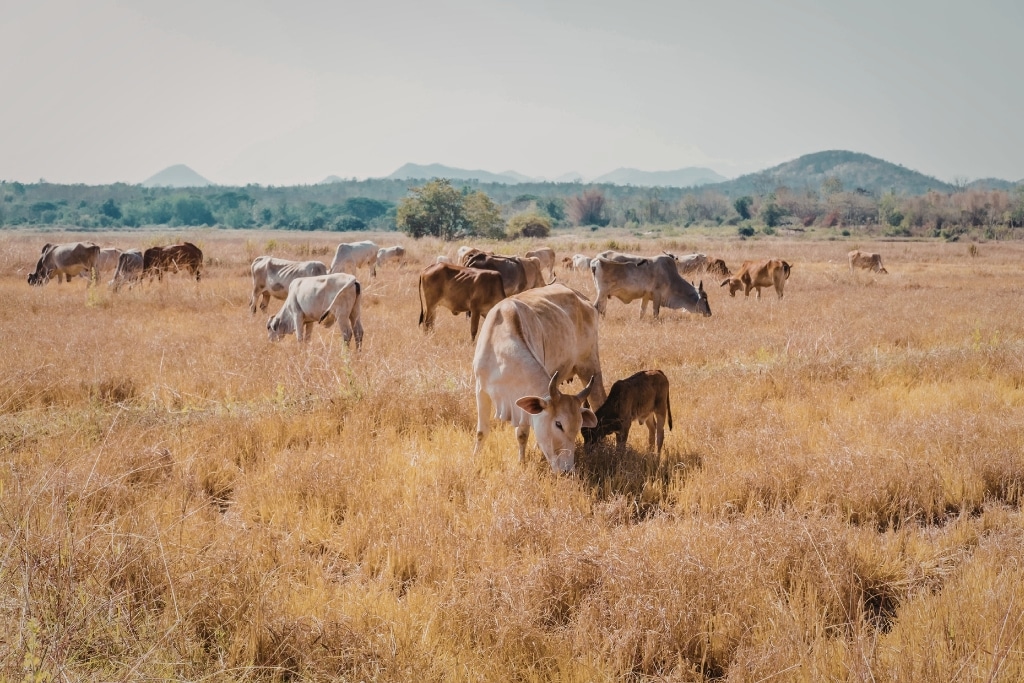
Grasslands that sustain over a billion grazing animals globally face a drastic reduction due to climate change, posing a significant threat to food systems, particularly in low-income countries across Africa.
—
A recent analysis predicts that, by the close of the century, grasslands accommodating 1.5 billion livestock, including cattle, sheep, and goats, could decrease between 36% and 50% because of climate change impacts.
The study by the Potsdam Institute for Climate Impact Research (PIK) highlights the alarming situation in African grasslands. Given that Africa’s current climate conditions are already near the upper limits of what grasslands can endure, a significant reduction in global emissions may limit grassland contraction to 16%. Conversely, if emissions continue to rise unchecked, losses could reach up to 65%.
Lead author Chaohui Li emphasized in a press release, “Climate change will shift and significantly contract these spaces globally, leaving fewer spaces for animals to graze. Importantly, much of these changes will be felt in countries that already experience hunger, economic and political instability, and higher levels of gender inequity.”
Animal agriculture contributes to climate change while also being threatened by it. The UN Food and Agricultural Organization reports that meat and dairy production is responsible for approximately 14.5% of global greenhouse gas emissions. The second EAT-Lancet Report in 2025 noted that food production is the leading cause of planetary boundary transgressions, affecting five of the six boundaries surpassed.
Published earlier this month, the study uses a “safe climatic space” framework to define the environmental conditions necessary for grassland viability. This framework considers suitable temperature, rainfall, humidity, and wind speed ranges. Researchers foresee a global reduction in grazing-suitable areas by 36% to 50% by 2100, with significant shifts in suitability across and within continents.
The analysis estimates that 51% to 81% of affected populations live in low-income regions with serious hunger, gender inequality, and political instability. It warns that “future climate change will threaten grazing suitability across large portions of Earth, endangering the livelihoods of numerous communities and potentially triggering widespread socioeconomic consequences.”
Some grazing lands are expected to move south from areas such as the Ethiopian highlands and the Kalahari Basin, although coastal regions face constraints on relocation. PIK researcher and study co-author Prajal Pradhan stated in a statement, “This shift away from what we’re identifying as the safe climatic space really challenges the efficacy of adaptation strategies that have been used in places such as Africa in times of hardship, such as switching species or migrating herds. The changes are just too big for that.”
Pradhan and his team view these findings as evidence that climate change will exacerbate existing inequalities and risk destabilizing global food production systems and the communities that rely on them.
Original Story at earth.org