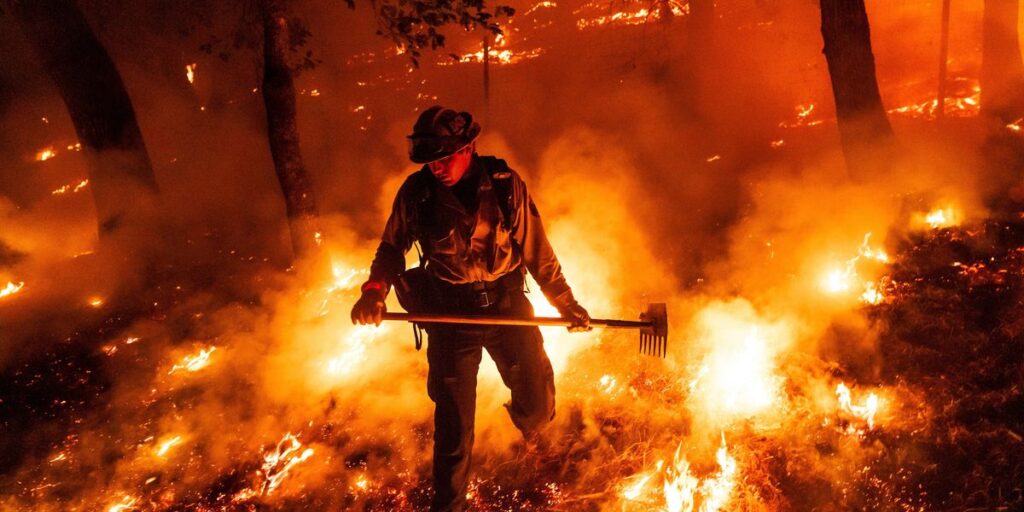
In a significant shift in wildfire behavior, flames in North America are burning later into the night and igniting earlier in the morning. This change is attributed to human-induced climate change, which is prolonging the hot and dry conditions that fuel these fires, according to a recent study.
Traditionally, wildfires would subside as night fell due to cooler temperatures and increased humidity. However, such natural fire suppressing conditions are becoming less frequent. Over the past five decades, the hours conducive to wildfires in North America have increased by 36%, as reported in Science Advances.
Regions like California have witnessed an additional 550 hours per year suitable for fire outbreaks compared to the mid-1970s. Even more striking, southwestern New Mexico and central Arizona have experienced an increase of up to 2,000 hours annually. This study, which encompassed both the United States and Canada, identified periods favorable for wildfires without necessarily indicating that fires occurred continuously during those times.
Notable Nighttime Wildfires
Recent nighttime wildfires, such as the 2023 Lahaina fire in Hawaii, the 2024 Jasper fire in Alberta, and the 2025 Los Angeles fires, have posed significant challenges for firefighting efforts. For instance, the Maui fire was reported to have started at 12:22 a.m.
The study indicates that not only have nighttime hours conducive to fire increased, but the calendar has also shifted, with a 44% rise in fire-prone days, equating to an additional 26 days over the last 50 years. This extension is primarily due to warmer, drier nighttime weather conditions, sometimes accompanied by increased wind.
“Fires normally slow down during the night, or they just stop,” explained study co-author Xianli Wang from the Canadian Forest Service. “But under extreme fire hazard conditions, fire actually burns through the night or later into the night.” Wang further noted that the situation is expected to deteriorate due to the warming atmosphere.
Challenges of Nighttime Firefighting
University of California Merced fire scientist John Abatzoglou, who was not involved in the study, highlighted the difficulty of combating fires that continue through the night. “Nights aren’t what they used to be — that is, more reliable breaks for wildfire,” he stated. “Widespread warming and lack of humidity is keeping fires up at night.”
Wildland firefighter Nicholai Allen, who also heads a company specializing in home fire prevention, described the complexity of nighttime firefighting. “You have to understand that you have snakes and bears and mountain lions and all the stuff you have in daytime,” Allen remarked, recounting an instance where a colleague was bitten by a bear. “But at night, they’re really scared and they’re running away from the fire.”
The Canadian research team examined nearly 9,000 significant fires from 2017 to 2023, utilizing a weather satellite and other instruments to gather hourly data on atmospheric conditions during these events, including humidity, temperature, wind, and fuel moisture levels. They developed a computer model correlating weather conditions with fire status, applying it to historical data from 1975 to 2106 in Canada and the United States.
Impact of Warmer Nights
Scientific consensus suggests that heat-trapping gases from burning fossil fuels result in nights warming faster than days due to increased cloud cover that retains heat. Since 1975, nighttime summer temperatures in the contiguous U.S. have risen by 2.6 degrees Fahrenheit (1.4 degrees Celsius), compared to a 2.2 degrees Fahrenheit (1.2 degrees Celsius) increase during the day, as reported by the National Oceanic and Atmospheric Administration.
“Humidity at night ‘doesn’t rebound’ from its daytime dryness like it used to,” said lead study author Kaiwei Luo from the University of Alberta. Wang detailed that wildfires often coincide with drought, which not only reduces air humidity but also increases the flammability of ground and plant materials. In extreme drought conditions, the cycle of drying intensifies, and the warmer atmosphere draws more moisture from fuels.
According to Wang, warmer nights prevent forests from recovering, much like how human bodies struggle to recuperate during heatwaves. It can take weeks for dead fuel to regain moisture and become less flammable. “It’s just a stress to the plants,” Wang noted. “That also increases fuel load and makes fire-burning more easily.”
Data from 2016 to 2025 indicates that wildfires in the United States have annually consumed an area comparable to Massachusetts, averaging over 11,000 square miles (28,500 square kilometers), which is 2.6 times the average burn area of the 1980s, according to the National Interagency Fire Center. In Canada, the average land burned over the past decade is 2.8 times more than in the 1980s, as reported by the Canadian Interagency Forest Fire Centre.
Syracuse University fire scientist Jacob Bendix, who was not part of the research, described the study as a sobering reminder of climate change’s role in elevating the potential for fires across nearly all fire-prone regions in North America.
Original Story at www.audacy.com