China’s Automotive Market Sees Electric Vehicles Surge Amidst Decline in Traditional Engines
The Chinese automotive market is witnessing a dramatic shift as electric vehicles (EVs) continue to dominate, setting a new record in August with a 65% market share. This surge is attributed not to an increase in EV sales, but rather to a significant drop in internal combustion engine (ICE) vehicle sales.
Overall vehicle sales in China saw a 24% year-over-year decline to approximately 1.5 million units. While plugin hybrid electric vehicles (PHEVs) and extended-range electric vehicles (EREVs) saw declines of 30% and 22%, respectively, battery electric vehicles (BEVs) rose by 1% year-over-year. This resulted in BEVs capturing a 45% market share, complemented by a 20% share for PHEVs, propelling the total EV market share to a record 65% in August.
If this trend persists, analysts predict full electrification of the Chinese market before 2030, with a complete transition to BEVs by 2035. The 2026 market share for EVs is already at 57%, surpassing the 2025 full-year result by 3%. BEVs alone have achieved a 38% share, an increase from 33% in 2025.
The ongoing shift from PHEVs to BEVs is also noteworthy, with BEVs capturing 69% of the market compared to PHEVs’ 31% in August. This trend suggests a return to the early market dynamics where BEVs dominated with an 80% share.
Adding to the momentum, Chinese automotive exports reached 888,000 units in August, marking a 78% year-over-year increase. The exported vehicles closely matched the domestic EV market share, with 58% being electric, up from 40% in the previous year.
The rise of local players like Vietnam’s Vinfast, Turkiye’s Togg, and India’s Tata and Mahindra, along with substantial Chinese exports, is challenging legacy automakers both in China and globally. Chinese exports are heavily electrified, contributing to the electrification of international markets as well.
In August, the top ten vehicle rankings in China were entirely dominated by EVs, with eight being pure electric models. This significant EV presence indicates the declining relevance of ICE vehicles in the market.
The breakdown of best-selling models by size categories also highlights the dominance of EVs, with all podium finishes being EVs, and only three models not being 100% BEV.
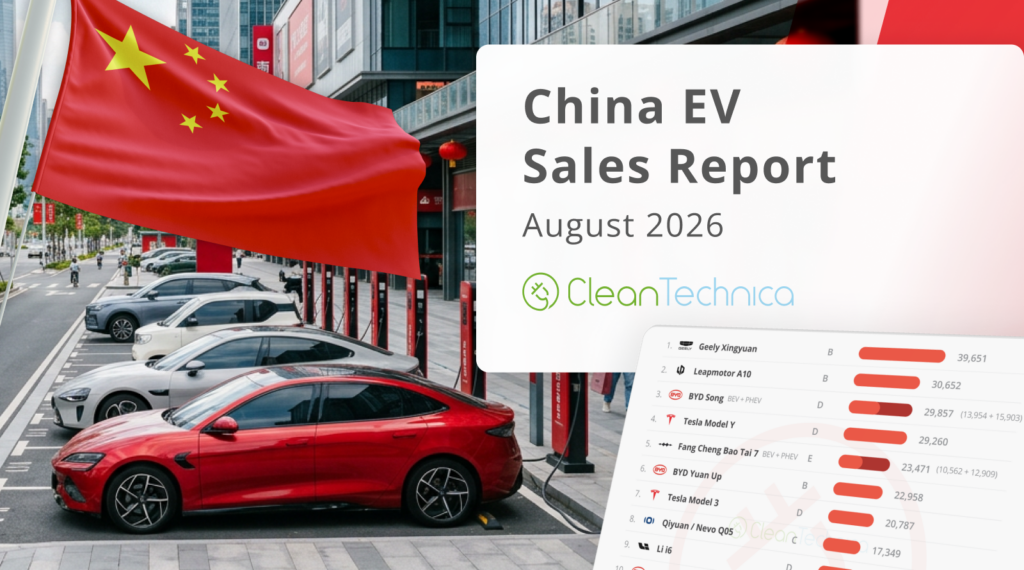
Among the best sellers, the Geely Xingyuan led with 39,651 registrations, followed by Leapmotor A10 with 30,652 registrations, and BYD Song (BEV+PHEV) with 29,857 registrations. Tesla’s Model Y and Fang Cheng Bao Tai 7 rounded out the top five.
Geely’s Xingyuan, a small hatchback, continues to maintain its position despite increasing competition from new models like Leapmotor’s A10 and A05, as well as BYD’s new-generation Seagull. The subcompact category is now the most competitive segment in the Chinese EV market.
Despite subsidy cuts affecting city car sales, models like the Wuling Mini EV and Changan Lumin continue to perform well, indicating a slow recovery in this category. The market eagerly anticipates new entries like the BYD Racco to rejuvenate interest.
In the manufacturer’s ranking, BYD retains its lead with a 21.7% market share, while Geely holds the second position at 11.9%. Leapmotor, with a focus on a broad yet focused lineup, is rapidly climbing the ranks, posing a potential threat to its competitors.
The Chinese automotive market is currently a tale of two segments: a shrinking ICE market where foreign brands still hold sway, and a burgeoning EV market dominated by local manufacturers. This dynamic underscores the challenges and opportunities within the global automotive industry.
Original Story at cleantechnica.com