Munich, Gasgoo- The automotive industry’s profitability is undergoing significant changes, no longer serving as the lucrative “cash cow” it once was.
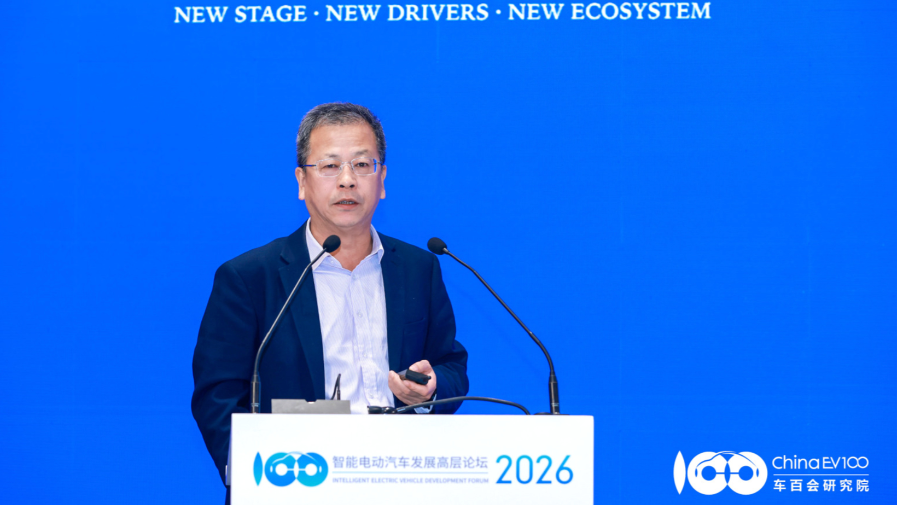
At the Smart Electric Vehicle Development High-Level Forum (2026) on April 12, Cui Dongshu, secretary-general of the China Passenger Car Association (CPCA), shared this assessment. He highlighted the industry’s diminishing profit margins, which have fallen to 2.9% in the first two months of the year, a sharp decline from 8% in 2017. In stark contrast, profit margins for upstream sectors like non-ferrous metals and oil have surged, with non-ferrous metals climbing to 39.4% and the oil sector soaring to 30%.
Export Growth vs. Domestic Market Challenges
The domestic automotive market is experiencing a downturn. From January to March, sales of internal combustion engine vehicles declined by 9%, and new energy vehicles (NEVs) are also under pressure. This trend began in the last quarter of the previous year, as noted by Cui. While NEV retail sales typically rise in the fourth quarter, last year saw stagnation.
Despite the intense competition, the industry has maintained stable incentive levels, with overall discounts around 10% and discounts on internal combustion vehicles at approximately 22%. Prices have largely remained stable, according to Cui.
Adjustments to the 2026 purchase tax exemption policy, which will change to 5%, are impacting product structures. March data indicates a 0.5 percentage point increase in the share of standard hybrids (HEV), while plug-in hybrids (PHEV) have decreased by 1.4 points. This suggests a “transition from plug-in to standard hybrids.”
Image source: China EV 100 Institute
This year, consumption policies have shifted to subsidies based on a percentage of the vehicle price, replacing previous fixed-amount incentives. Without a minimum subsidy floor, “mini and micro electric vehicles are facing growth pressure,” Cui explained. The A00 segment, which expanded significantly last year, is now under substantial strain.
The Chinese market has entered a phase where “scrappage and replacement drive development,” according to Cui. Statistics from the Ministry of Public Security reveal that 21.69 million vehicles were registered in 2025, with 13.19 million being replacements, resulting in a net increase of just 13 million. Scrappage and trade-ins are becoming primary market drivers.
In contrast, exports are thriving. First-quarter exports have surged by 124%, prompting Cui to revise his 2026 export growth forecast from 18–25% to 35%. The CPCA forecasts that while domestic sales may decline, rapid export growth will offset this, leaving overall wholesale volumes roughly unchanged year-on-year.
“The total volume looks passable, but domestic consumption is under immense growth pressure and remains highly volatile,” Cui stated.
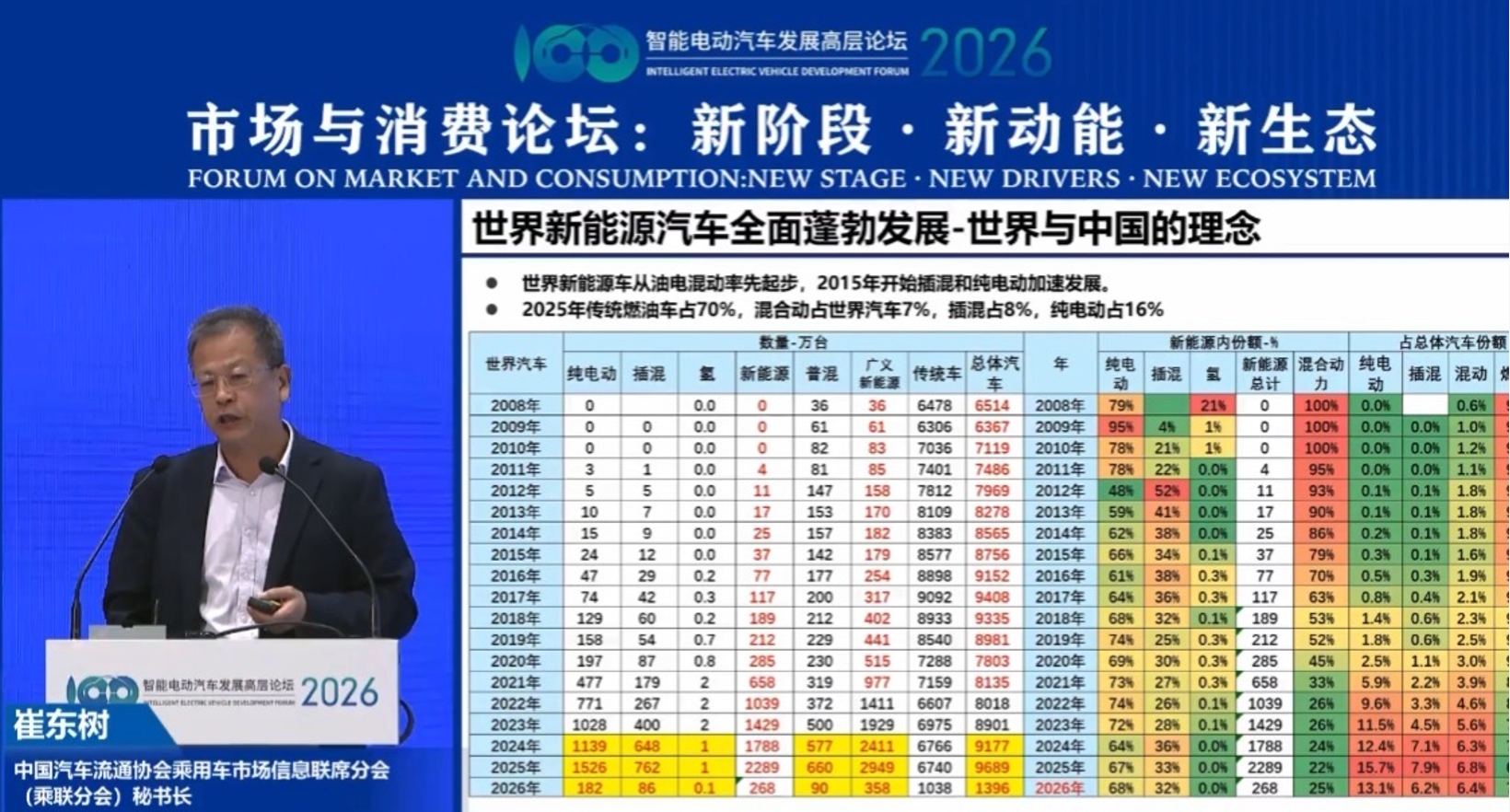
Image source: China EV 100 Institute
Global Position and Market Shifts
Export prices for lithium batteries are on the decline. The average export price has decreased from $17,000 per ton last year to about $15,000 this year—a 12% drop. This, combined with a shift in the exchange rate from 7.3 to 6.8, is facilitating the entry of Chinese products into global markets.
On a global scale, Cui sees Chinese automakers in a comprehensive ascent. China now holds a 60% share of the pure electric vehicle market worldwide and commands a 75% share of the plug-in hybrid segment. In contrast, Europe’s PHEV share has dropped significantly from 65% in 2020 to just 18% today, a decline Cui attributes to the region’s internal combustion engine ban timelines.
Demographic Shifts and Policy Recommendations
A critical demographic shift is underway, with the car-buying demographic moving toward middle-aged and older adults. While in markets like Africa and India, young consumers are predominant, in China and Europe, the primary buyers are from the 1965–1980 generation. “If you’re counting on 20-to-30-year-olds, they only make up 10% of the population, whereas those aged 60 to 70 account for 13%,” Cui noted.
Vehicle ownership is uneven across regions in China, being high in cities like Beijing and Shanghai but low in remote areas. Many middle-aged and elderly individuals lack driver’s licenses, turning instead to low-speed electric vehicles, which pose safety concerns. Cui proposed lowering the barrier to obtaining a driver’s license to create a compliant space for small and micro vehicles.
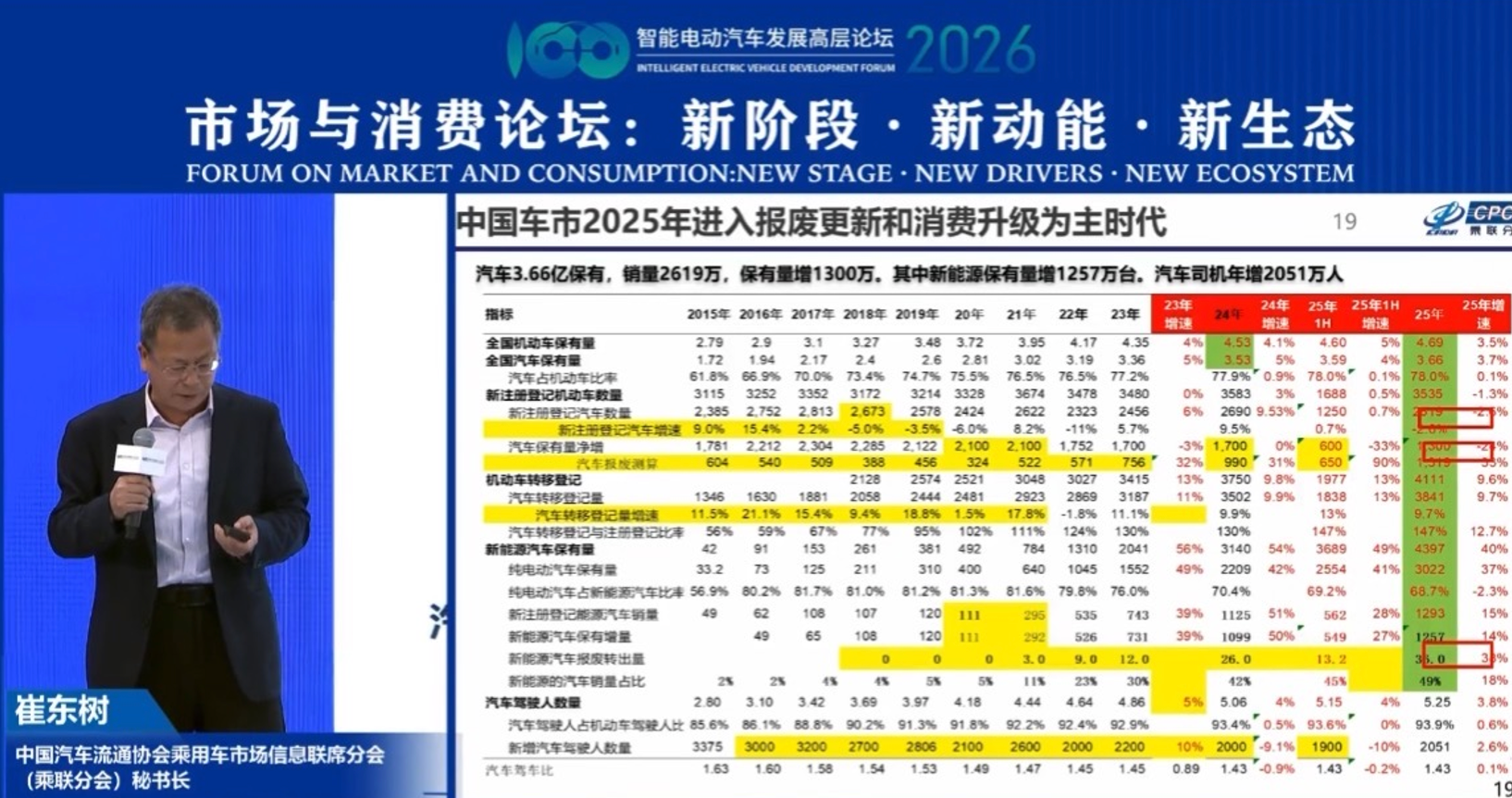
Image source: China EV 100 Institute
Despite China’s population decline from 1.42 billion, the number of drivers is increasing by 20 million annually, indicating potential for auto consumption growth.
On financial matters, Cui highlighted a shift in household loan structures. Household loans have decreased since last year’s second quarter, leaving banks searching for new lending opportunities. “Auto loans will be the most critical area of development moving forward,” he suggested.
Cui also proposed leveraging vehicle-to-grid (V2G) interactions for NEVs. By employing peak-valley pricing policies, parked EVs could supply power back to the grid, transforming cars from consumer goods into “resource assets.” Citing statistics from the power battery alliance, Cui noted that 80% of batteries are becoming energy storage, a potential avenue worth exploring.
Relying solely on short-term stimulus is unsustainable, Cui emphasized, advocating for long-term policy support. He outlined four recommendations:
First, consider vehicle purchases in special individual income tax deductions. Encouraging consumers to replace cars every five years instead of seven could boost consumption frequency.
Second, allow pre-tax deduction of interest on auto loans. As banks struggle with mortgage profits, auto lending offers growth potential, and interest deductions could lower ownership costs.
Third, offer guaranteed trade-in support for multi-child families, especially for large and high-end vehicles. Families with two or more children now constitute over half the total, driving demand for larger vehicles.
Fourth, support car purchases among middle-aged and elderly groups. The core buying demographic is now Generation X and older adults, and encouraging purchases among the 50-to-70 age group would significantly impact the market.
Cui concluded by reiterating his key points: tax deductions for purchases and loan interest, support for multi-child families, relaxed licensing for older adults, and unlocking the value of vehicle-grid interaction. If fully developed, these areas could lead China’s future domestic auto consumption to reach 40 million units, presenting “immense potential and opportunity.”
Original Story at autonews.gasgoo.com