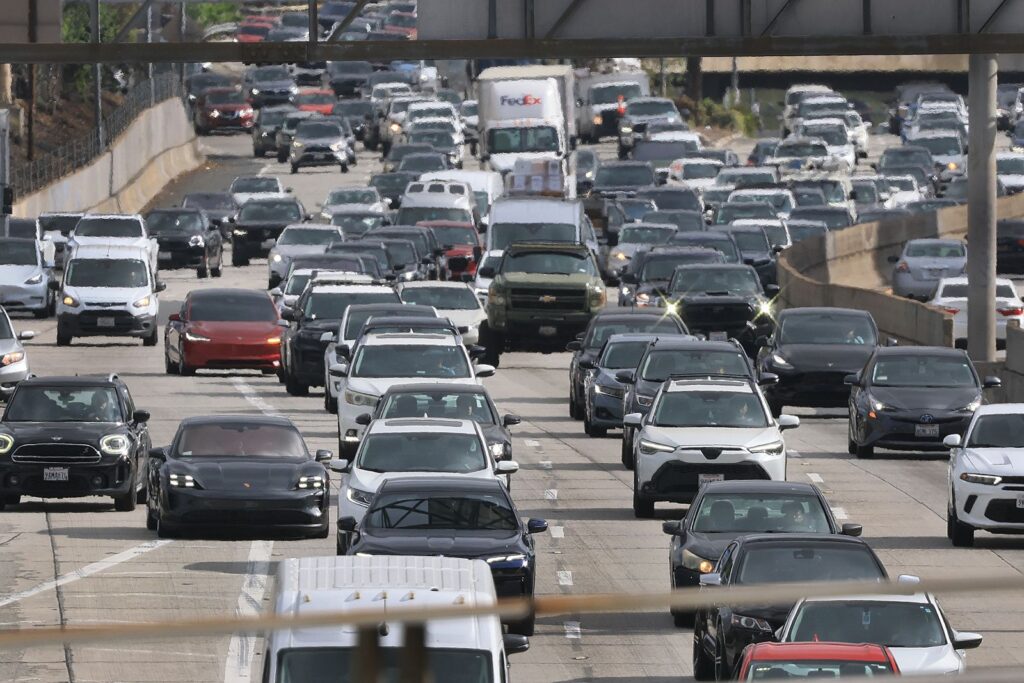
California’s Emission Standards: A Crucial Battle in the Fight Against Climate Change
In a significant move, the Trump administration has moved to dismantle federal regulations on greenhouse gas emissions from vehicles, effectively relaxing fuel-efficiency standards as Congress had previously eliminated penalties for automakers not meeting these requirements. This step, alongside other reductions in climate authority, has left federal oversight on vehicle emissions, which constitute about 16% of U.S. greenhouse gas emissions, nearly nonexistent. Read more.
However, California remains a pivotal player in regulating vehicle emissions, maintaining standards that car manufacturers must adhere to avoid penalties. Despite the Trump administration’s attempts to curb California’s authority, the state’s emissions regulations, established due to its historical smog issues and supported by a unique federal exemption, continue to set a critical baseline for vehicle emissions in the U.S. Learn more.
California’s influence extends beyond its borders, with 19 states and the District of Columbia adopting its emissions standards. This collective makes up 40% of all new car sales in the nation, encouraging automakers to produce vehicles compliant with these more stringent standards rather than creating different models for different states. More details.
Efforts to phase out gas-powered vehicles by 2035, a plan facilitated by California’s unique regulatory authority, faced setbacks when Congress, at the Trump administration’s request, voted to block it. California has responded by suing the administration, with Attorney General Rob Bonta stating, “What we’re seeing is a thinly veiled attempt by the president to retaliate against California for choosing progress over regression.” Full story.
Despite the legal and political challenges, California continues to enforce its emissions standards, which are crucial for preventing automakers from reversing improvements in vehicle emissions. Although the Trump administration has attempted to have these standards overturned, a federal judge has blocked such efforts as of early September. Read the ruling.
Automakers, accustomed to shifting policies, have been largely noncommittal about their plans under the current regulatory uncertainty, but market forces, including rising gasoline prices and increasing hybrid vehicle sales, could push them towards greater fuel efficiency. Hybrid vehicles accounted for 16% of passenger vehicle sales by mid-2026, underscoring a shift in consumer preferences. See the data.
Nonetheless, market dynamics alone may not achieve the emission reductions necessary for combating climate change. California’s phased-out plan for gasoline vehicles represents a bold push towards more sustainable transportation, and its future may hinge on upcoming legal decisions and political shifts. Explore the issue.
The Trump administration is also challenging California’s ability to regulate emissions indirectly through fuel efficiency, a case that may eventually reach the Supreme Court. Experts like Rebecca Higgins note that this could redefine the regulatory landscape, saying, “That one feels like it could have the potential to sort of reset the authorities going forward.” More insights.
Original Story at grist.org