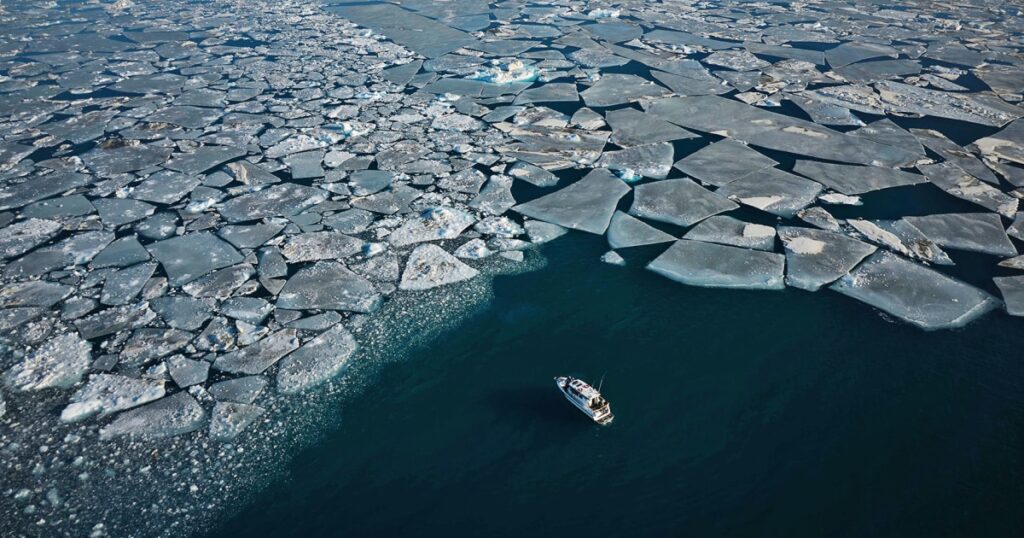
As the planet warms, the Arctic region is witnessing a significant reduction in sea ice, with current levels tying the record low for winter. This phenomenon is occurring amidst unprecedented temperature records across various continents, highlighting a global climatic shift.
Arctic sea ice plays a pivotal role in regulating Earth’s climate. By reflecting sunlight, it helps keep ocean temperatures in check. The absence of this ice not only intensifies ocean warming but also threatens biodiversity. Species like polar bears and seals are heavily reliant on sea ice for their survival. Additionally, the reduction in ice has opened up new shipping routes, causing geopolitical shifts and increasing interest in regions like Greenland.
Recent data highlights a concerning trend. The announcement of diminishing Arctic sea ice coincided with record-breaking March temperatures across the United States, Mexico, Australia, Northern Africa, and parts of Northern Europe. Maximiliano Herrera, a climatologist and weather historian, described the current heatwave as “by far the most extreme heat event in world climatic history.” He warned of even more intense conditions in the coming days.
In just the past week, sixteen U.S. states have recorded their highest March temperatures. St. Louis, among twenty-seven other locations, experienced temperatures surpassing or matching the highest recorded in April. Mexico has witnessed a surge in temperature records, some even exceeding typical May temperatures. However, Asia has seen an even more dramatic rise, with “dozens of thousands of monthly records” being shattered by margins of 30 to 35 degrees (17 to 19 degrees Celsius), according to Herrera.
Conversely, Antarctica recorded its coldest March day ever at minus 105.5 degrees (minus 76.4 degrees Celsius), showcasing the planet’s diverse climatic conditions.
Steady decline of sea ice
Arctic sea ice undergoes a natural cycle of expansion in winter and contraction in summer. This year’s peak, measured at 5.52 million square miles (14.29 million square kilometers), is marginally less than last year’s 5.53 million square miles (14.31 million square kilometers). The National Snow and Ice Data Center considers this difference negligible. However, the current sea ice area is about 525,000 square miles (1.36 million square kilometers) below the 1981 to 2010 winter average, a size roughly double that of Texas.
“As temperatures have warmed and are continuing to warm, especially in the polar region, there is less opportunity to grow ice and it’s gonna tend to, on average, be less,” stated Walt Meier, a senior scientist at the data center. He emphasized that this represents a gradual decline rather than a sudden shift, adding that it sets the stage for the summer melt season, starting from a lower baseline.
Summer sea ice is key
The summer melt season, culminating in September’s Arctic sea ice minimum, is critical. With reduced ice, less sunlight is reflected, leading to increased ocean heat absorption. This warming brings Arctic temperatures closer to southern levels and can alter atmospheric pressure. A controversial theory suggests these changes influence the jet stream’s movement and shape, potentially exacerbating extreme weather events.
While melting sea ice does not raise sea levels, the winter growth’s variability means a record low in March doesn’t necessarily predict a summer low. “The winter maximum is certainly interesting,” Meier commented, noting it as a global warming signal.
In contrast, Antarctic sea ice is predominantly affected by local weather and ocean conditions. Although February saw a lower-than-average annual low, it was not as severe as the record lows of the previous three years, according to Meier.
Original Story at www.nbcnews.com