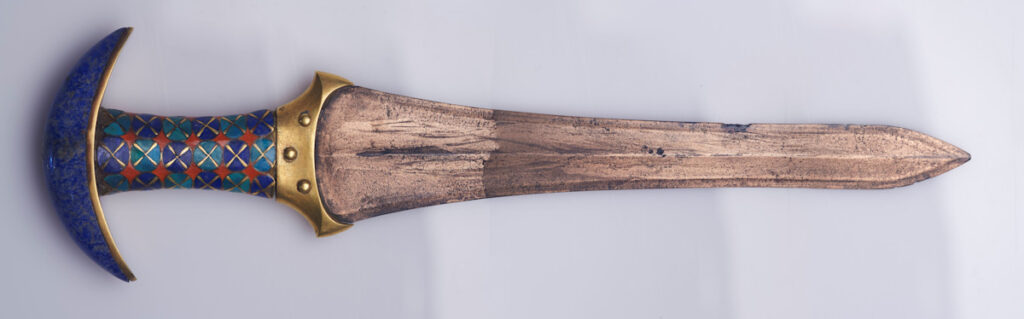
Once lost to history, the rediscovery of six ancient Egyptian mummies in 2020 has sparked renewed interest in understanding the lives of royal women during the Middle Kingdom. Among these mummies are five princesses and King Hor, whose resting places were adorned with weaponry, suggesting a life of physical prowess and skill.
The mummies, unearthed in the Dahshur funerary complex during the 1890s, were found again during a curation project at the Egyptian Museum. These remains belonged to four sisters—Khenmet, Itaweret, Ita, and Sathathormeryt—and Princess Noub-Hotep, all daughters of Pharaoh Amenemhat II. The reassessment of these royal women has provided insights into their possible roles beyond ceremonial duties.
Reviving Ancient Insights
Dr. Zeinab Hashesh from Beni-Suef University, the lead researcher, highlights that the physical evidence suggests these princesses were not just passive figureheads. “Members of the royal family, especially the women, were active participants in skilled, physically demanding activities such as archery and hunting,” said Hashesh in an article published in Frontiers in Environmental Archaeology. The study indicates that the princesses’ bones bore signs of muscle development consistent with the use of weapons.
The researchers discovered pronounced muscle attachments on the bones, suggesting habitual use of bows, arrows, and daggers found in their tombs. Princess Ita, for instance, exhibited strong upper-body muscle attachments, indicative of weapon use. Princess Khenmet, despite signs of thinning bones, had robust ligament attachments, while Princess Itaweret’s skeleton showed evidence of surviving injuries and proficiency in archery.
Revelations from the Past
Despite being carefully mummified, the skulls of these princesses were lost in the early 1900s, limiting the scope of analysis. However, the surviving bones permitted estimates of age, height, and sex. The injuries, such as Princess Itaweret’s healed broken ribs, suggest an active lifestyle that included potential hunting or military training.
Hashesh noted, “We found pronounced development in the upper limbs of these individuals, which correlates to repetitive, high-intensity actions like pulling a bowstring or stabilizing a weapon, proving these activities were habitual throughout their lives.” The study further revealed common infections and nutritional deficiencies among the sisters, alongside rare spinal abnormalities suggesting close familial relations.
The researchers aim to expand their analysis, potentially using stable isotope techniques to delve deeper into the princesses’ nutritional histories. Hashesh expressed a desire to narrate the complete life stories of these royals, preserving their remains and crafting 3D models for educational purposes.
Emphasizing the significance of these findings, Hashesh stated, “Their objects and jewelry are truly fascinating, breathtaking in their craftsmanship. Yet, while archaeologists have long focused on preserving these treasures, the people themselves were often forgotten. Our study seeks to change that.”
Read and download original article
REPUBLISHING GUIDELINES: Open access and sharing research is part of Frontiers’ mission. Unless otherwise noted, you can republish articles posted in the Frontiers news site — as long as you include a link back to the original research. Selling the articles is not allowed.
Original Story at www.frontiersin.org