
Key takeaways:
- About six-in-ten Americans say countries around the world, including the U.S., will not do enough to avoid the worst effects of climate change. Among Democrats, this share has increased from 51% in 2022 to 69% in 2026.
- About half of U.S. adults say tech companies can do a lot to address climate change, but few expect technology to actually solve problems caused by climate change in the future.
- A majority of Americans, especially Democrats, say the federal government is doing too little on climate change. This overall share is slightly higher than it was during the Biden administration.
A significant portion of the American public perceives climate change as a major concern, with near-universal agreement among Democrats and those leaning Democratic. However, only a quarter of adults believe that global efforts will be sufficient to mitigate the worst impacts of climate change, with most expressing doubt. This growing pessimism is driven by Democrats.
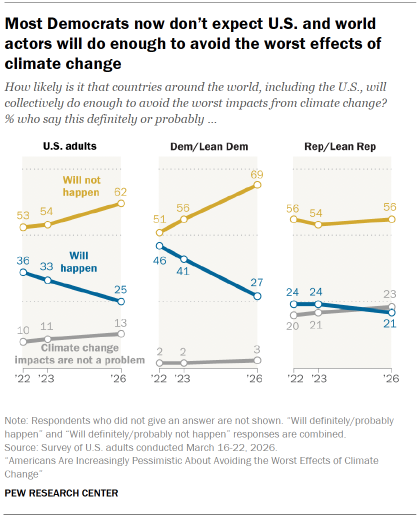
During the Biden administration, Democrats were nearly evenly divided on whether the U.S. and other nations would take sufficient action against climate change (46% optimistic, 51% pessimistic). Currently, a notable 69% of Democrats expect that the U.S. and other countries will fall short.
This growing concern arises as the Trump administration has significantly altered federal climate policies, including withdrawing from global climate accords, relaxing restrictions on emissions from power plants and fuel efficiency standards.
These insights stem from a Pew Research Center survey of 3,524 U.S. adults conducted between March 16-22, 2026. This research is part of our ongoing examination of American perspectives on climate change and related environmental issues.
How big of a problem is climate change, and what should be done about it?
There remains a significant divide between Republicans and Democrats regarding the severity of climate change, its impacts, and the necessary actions to address it.
Most Democrats and Democratic-leaning individuals (68%) believe climate change is causing significant or considerable harm in the U.S. Approximately six-in-ten also view it as a major issue confronting the nation today.
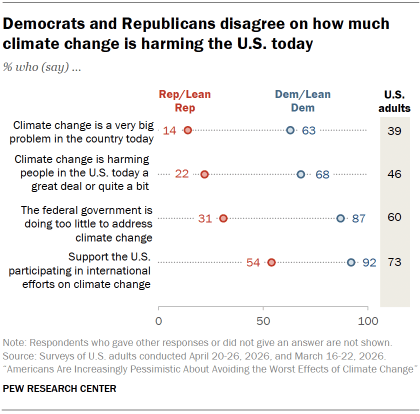
Conversely, only about 22% of Republicans and those leaning GOP believe climate change is causing significant harm in the U.S., with the majority perceiving it as a minor problem at most.
There is also a stark partisan divide in perceptions of federal government action on climate change: 87% of Democrats believe it is insufficient, compared to 31% of Republicans. This disparity has been consistent, showing a gap of at least 51 percentage points since 2018 when the question first arose.
Despite some Republicans showing less concern about climate change, a portion is open to international collaboration. For instance, 54% of Republicans support U.S. involvement in global climate initiatives, aligning with previous survey results.
Younger and older Republicans differ on climate change
Age influences Republicans’ perceptions of climate change, with younger members more likely to acknowledge its harm and support remedial actions.
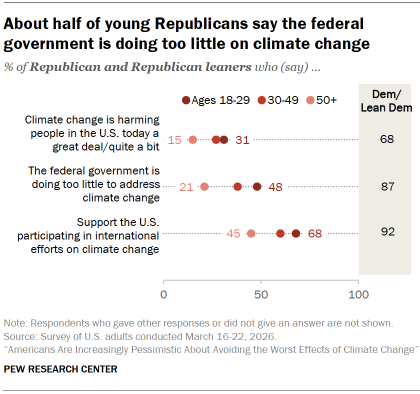
- 31% of Republicans under 30 believe climate change significantly harms the U.S., with another 37% acknowledging some harm. In contrast, 57% of Republicans aged 50 and older perceive little to no impact.
- 48% of young Republicans think the federal government is insufficiently addressing climate change, compared with 21% of their older counterparts.
These generational differences align with earlier findings showing younger Republicans’ reduced support for fossil fuels compared to older members.
Who can do the most to address climate change?
The survey queried the three-quarters of U.S. adults acknowledging at least some harm from climate change on which entities could best mitigate its effects.
Most respondents believe large businesses, especially in the energy and technology sectors, alongside the federal government, have significant potential to effect change. In contrast, fewer see ordinary Americans as capable of making a substantial impact.
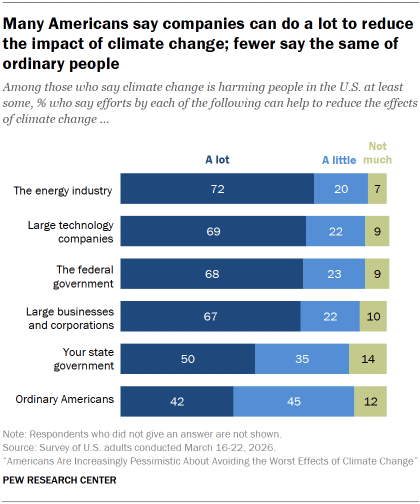
Among those acknowledging climate change’s impact, Democrats are more inclined than Republicans to believe each group can significantly reduce climate change effects.
The most pronounced partisan discrepancy is regarding the federal government’s role (80% of Democrats vs. 48% of Republicans).
Despite these divisions, over half of Republicans recognizing climate change’s harm believe the energy and large tech sectors can contribute significantly.
Can new technology address problems caused by climate change?
While experts increasingly discuss technological solutions to climate-related challenges, Americans envision a future reliant more on lifestyle changes than technological advances within the next 30 years.
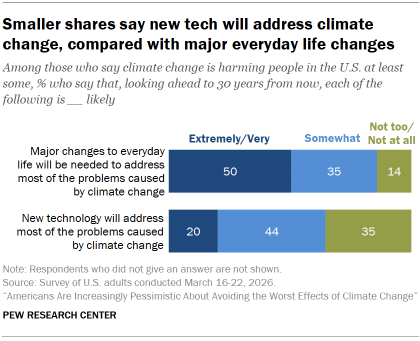
Among U.S. adults who recognize at least some climate change impact, half foresee the necessity for significant lifestyle adjustments to address most issues.
Only 20% consider it highly probable that new technology will resolve most climate-related challenges. Meanwhile, 35% doubt technological solutions will be effective within the coming decades.
Democrats are more likely than Republicans to anticipate major lifestyle changes (58% vs. 38% among those recognizing climate change’s impact). However, both parties largely agree on the improbability of technology addressing most climate issues.
How much is the federal government doing on environmental protection?
The second Trump administration has taken steps to reduce environmental safeguards. Since 2025, actions have included loosening air pollution controls, proposing restrictions on waterway protections, and increasing fossil fuel and mining access on federal lands.
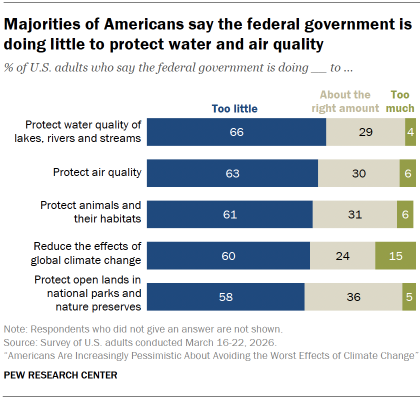
Most Americans believe the federal government is inadequately addressing various environmental protections, including water and air quality preservation and mitigating climate change effects.
These sentiments have slightly increased compared to the Biden administration, with growth mainly due to a rising number of Democrats who feel more needs to be done.
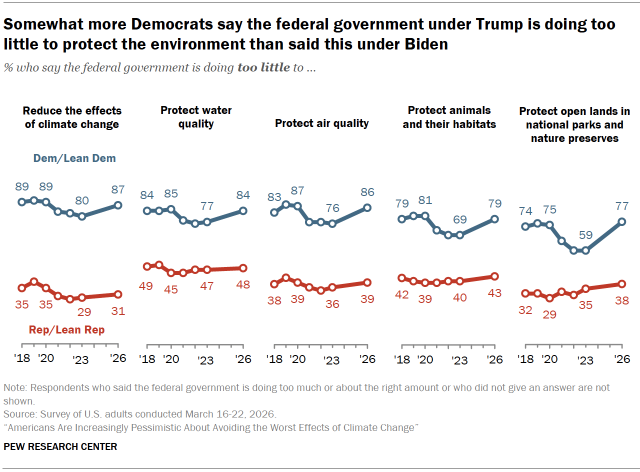
Democratic opinions regarding the current federal role in environmental protection are comparable to sentiments during Trump’s first term. (Democratic majorities also criticized insufficient government action under Biden.)
Republican views remain consistent with the first Trump administration, although they now slightly favor more government action to safeguard national parks and nature reserves.
Original Story at www.pewresearch.org