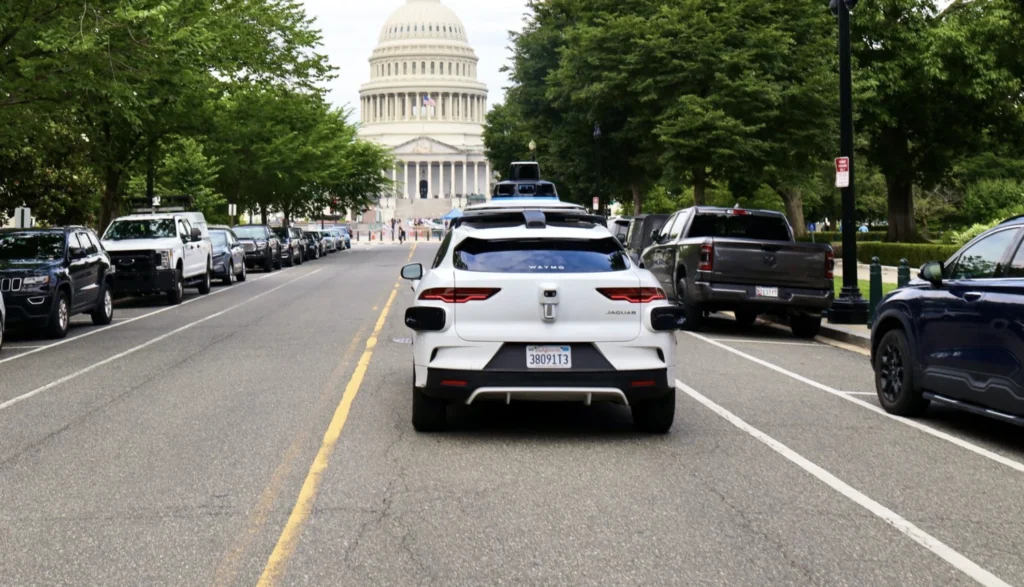
In a recent Senate hearing, Waymo’s operational strategies faced scrutiny after revealing that some of its remote assistance operators for self-driving vehicles are stationed in the Philippines. This disclosure has sparked debates about the safety and security of autonomous driving technologies.
Mauricio Peña, Waymo’s Chief Safety Officer, addressed the committee, explaining that while these operators provide guidance during complex driving situations, the vehicles maintain control over all dynamic driving tasks. “They provide guidance. They do not remotely drive the vehicles,” Peña clarified. “The Waymo vehicle is always in charge of the dynamic driving tasks, so that is just one additional input.”
However, when asked about the number of overseas operators, Peña was unable to provide specific figures, which led to frustration among the senators. One senator remarked, “It just seems kind of curious that you don’t know that answer,” and pressed for details on the countries involved, to which Peña replied, “The Philippines.”
Safety and Security Concerns
The revelation about overseas operators has prompted concerns from lawmakers regarding potential cybersecurity risks and the reliability of information relayed to these operators. “Having people overseas influencing American vehicles is a safety issue,” a senator expressed. “The information the operators receive could be out of date. It could introduce tremendous cybersecurity vulnerabilities. We don’t know if these people have US driver’s licenses.”
There was also a discussion on the impact on local jobs, as Waymo’s autonomous vehicles are gradually replacing traditional taxi and rideshare roles in the U.S. “It’s one thing when a taxi is replaced by an Uber or a Lyft. It’s another thing when the jobs just go completely overseas,” the senator further criticized.
The hearing included testimonies from both Waymo and Tesla representatives, highlighting the companies’ efforts to prove the safety of their autonomous systems. Despite some recent incidents, both companies argue that their technology surpasses human driving capabilities in safety.
Tesla’s Take
Tesla’s Vice-President of Vehicle Engineering, Lars Moravy, attended the hearing and cited CEO Elon Musk’s past concerns over potential security threats to autonomous vehicles. “Since that day, we’ve been committed to making sure that never happens,” Moravy assured. Tesla has incorporated multiple security layers to prevent external access to critical vehicle functions.
As part of its expansion, Tesla has been deploying robotaxis in Austin, utilizing modified Model Ys, and plans to extend this service to more states. The company has even removed safety operators from its vehicles in Austin, reflecting CEO Musk’s bold expansion goals.
Meanwhile, Congress is exploring legislative measures to develop uniform federal safety standards as self-driving vehicles become increasingly prevalent in American cities.
Santa Monica Accident
In related news, an investigation is underway into a recent incident involving a Waymo robotaxi that struck a child near a Santa Monica school. The National Highway Traffic Safety Administration (NHTSA) reports that the collision took place during school drop-off hours and involved a child running across the street.
Waymo contends that its technology reduced the impact speed more effectively than a human driver could have, stating, “To put this in perspective, our peer-reviewed model shows that a fully attentive human driver in this same situation would have made contact with the pedestrian at approximately 14 mph.” The company considers this a testament to the safety benefits of its autonomous systems.
This incident follows another where a Waymo vehicle became stuck on light rail tracks in Phoenix, necessitating passenger evacuation before an oncoming train hit the car.
Original Story at eletric-vehicles.com