The global shift towards a lower-carbon economy, pivotal to the ongoing energy transition, faced numerous obstacles last year. As 2026 begins, a significant overhaul desired by climate-focused stakeholders seems unlikely. Despite these hurdles, it remains crucial to comprehend the evolving global landscape and the reasons energy transition will persist amid persistent challenges.
Regional Priorities and Diverging Paths
Reflecting on a year ago, the narrative of the low-carbon transition has shifted significantly from opportunity to competition. Today’s major economies appear to be pursuing different objectives, leading to fragmentation in their approaches.
In the United States, the pursuit of AI dominance has overshadowed the clean energy race, boosting the demand for both clean and fossil energy due to rapid data center expansion. On the global front, American diplomats emphasize the country’s role as a leading oil and gas producer, while also seeking new LNG markets and intervening in decarbonization efforts within the shipping sector. The US’s recent actions in Venezuela further highlight this shift in priorities.
China, meanwhile, aligns energy security with clean energy leadership, both as strategic priorities and economic growth drivers. The nation’s success in electric vehicles (EVs) has already peaked domestic oil demand, reducing its dependency on fuel imports. The strength of China’s renewable energy sector hints at a potential peak in coal and emissions. However, challenges like tariff barriers and project delays persist.
Europe continues to lead on climate issues despite easing regulations on sustainability disclosures and vehicle emissions. The EU and UK see clean energy and electrification as means to enhance energy security and reduce dependency on international oil and gas markets. Yet, the key challenge is boosting economic competitiveness against Chinese products and American technology, with lower energy costs being a vital component.
These diverse priorities among major economies indicate a shift away from a unified climate mitigation strategy. The varied Nationally Determined Contributions (NDCs) submitted before COP30 last year illustrate this divergence. The UK and EU have set ambitious Paris-aligned emissions goals for 2035, requiring considerable effort. China’s new target marks progress, but lacks quantitative ambition. In contrast, the US’s NDC under the Biden administration is now void as the country exits the Paris Agreement. India, another key player, has yet to submit its own NDC. This mixed approach highlights the waning focus on climate progress.
Progress in Renewable Energy
Despite these challenges, the energy transition continues to advance. Last year saw a record-breaking installation of over 800 gigawatts of solar and wind energy globally, tripling the deployments from 2021. Although growth rates will slow, installations are expected to increase modestly through 2030. The favorable economics of renewable power offer resilience against geopolitical instabilities. Increasing power demand from AI data centers and electric vehicles will further drive the deployment of wind, solar, and storage technologies.
The forecast for the next five years includes 4.5 terawatts of new wind and solar installations globally, a 67% increase from the previous five-year period. Even in the US, where policy momentum has shifted away from clean energy, 336GW of wind, solar, and energy storage installations are anticipated for 2026-2030, marking a 24% increase over the preceding period.
In the realm of energy storage, promising developments are underway. Global storage installations are projected to surpass 100GW in 2026 and continue to grow beyond 200GW over the next decade. Equipment prices have dropped to $117/kWh, less than a third of what they were three years ago, supporting further renewable energy expansion.
Electric Vehicle Growth and Market Disruption
Declining battery costs and improved electric vehicles are accelerating electrification in the transportation sector. Electric vehicles now account for over a quarter of global car sales, a notable milestone, with projections indicating a rise to 40% by 2030. China leads the market with over 50% EV share, followed by Europe at over 25%. Other markets remain below the global average.
China’s dominance in EV sales correlates with lower EV purchase prices compared to internal combustion engines. In other markets, while an EV premium persists, sales are expected to rise as this gap narrows. Emerging markets, including Southeast Asia, Latin America, and Ethiopia, are experiencing significant growth.
The rapid development of EVs in China poses challenges for Western and Japanese automakers, whose market share in China has decreased from two-thirds in 2020 to below 40% today. Chinese automakers now hold an 18% share of EV sales outside China, with Europe as a key destination.
While US policymakers appear to have conceded the global EV market to China, European leaders and automakers are determined to compete. Collaborations with Chinese companies are accelerating battery and EV technology development, exemplified by partnerships such as Stellantis with CATL and Leapmotor, and Volkswagen with Xpeng.
The European Commission’s recent decision to soften its 2035 vehicle emissions policy allows internal combustion engines to continue being sold in the EU, yet over 80% of new car sales are expected to be pure battery-electrics by then, signaling robust growth for the sector.
Disruption in global oil markets is also anticipated, with oil demand projected to peak in 2032 as EVs continue to reduce demand. This contrasts with the IEA’s projection of rising oil demand until 2050. Despite shifts in US climate policy, the milestone for peak oil demand has only been delayed slightly.
Advancements in Hard-to-Abate Sectors
While clean power and vehicle electrification are progressing, other sectors like industry, building heat, shipping, and aviation face challenges. These sectors require advancements in technologies like electrification, hydrogen, carbon capture, and renewable fuels, coupled with robust carbon pricing, subsidies, and mechanisms to create demand.
This year will provide valuable insights into implementing these measures effectively. The EU’s carbon border adjustment mechanism (CBAM) is a critical component aimed at encouraging net-zero-aligned industrial production without compromising competitiveness. China’s expanded carbon market and efforts to scale up hydrogen production, along with Japan’s forthcoming carbon market, signal progress in decarbonizing industrial sectors.
Although policy changes have slowed investment in the US, it remains a leader in carbon capture projects. Global carbon capture capacity is expected to increase fourfold by 2030, while clean hydrogen production is projected to reach 5Mtpa. Sustainable aviation fuels are anticipated to experience a tenfold increase by 2030, meeting 3.8% of global jet fuel demand.
Climate Race: Winners and Losers
The energy transition is characterized by varying speeds and priorities among regions, leading to relative winners and losers in the clean energy race. However, the physical impacts of climate change continue unabated. Bloomberg Intelligence estimates that climate damages amounted to $1.4 trillion in 2024, a figure doubling each decade and likely underestimated.
In 2025, severe storms, floods in Southeast Asia, heatwaves in Europe, and extreme weather events in the US highlighted the escalating impact of climate change. Despite this, the energy transition offers a pathway to a better future, with the potential to achieve a global peak in emissions if clean energy technologies are deployed cost-effectively.
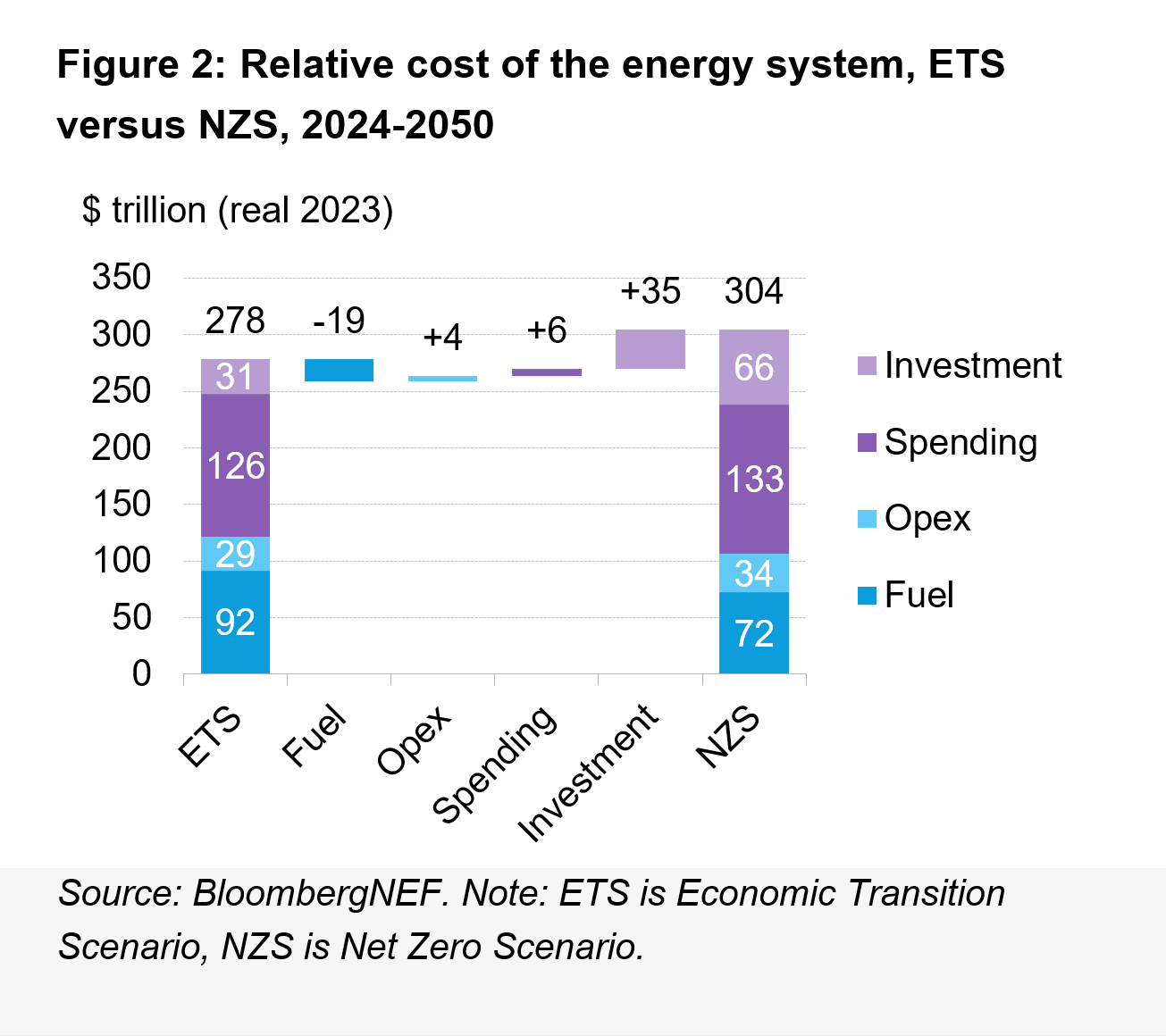
The New Energy Outlook suggests that a faster, net zero-aligned transition would incur only a 9% higher cost for the energy system by 2050 compared to the base case, with significant benefits in reduced climate damage, improved air quality, and enhanced human wellbeing.
Original Story at about.bnef.com