This story was originally published by Capital & Main.
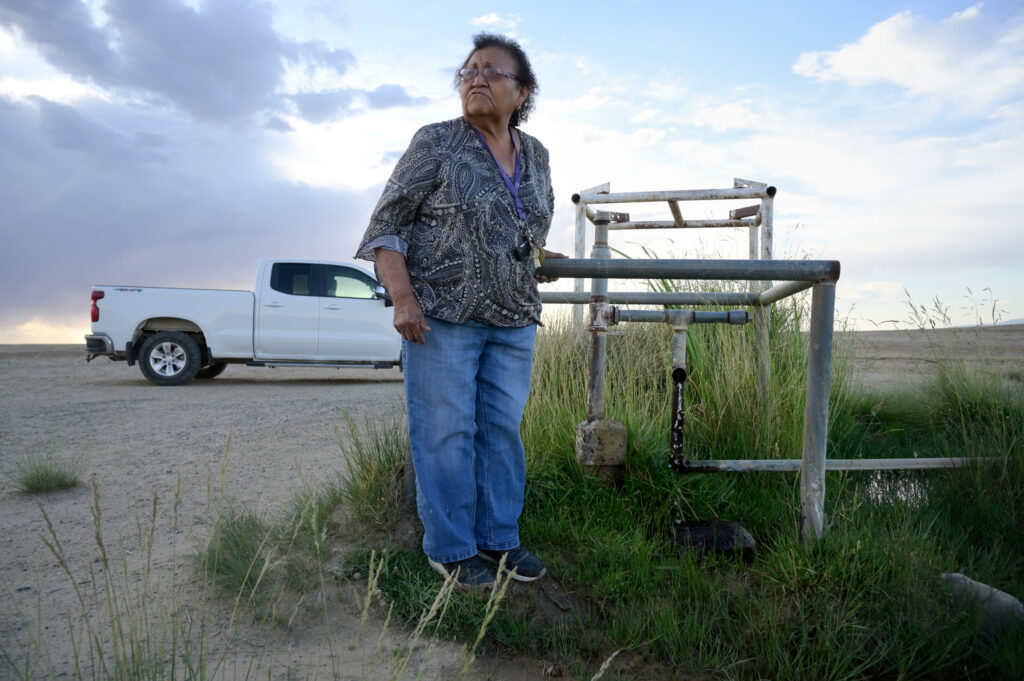
In early June, Loretta Johnson, a retired nurse, drove her white Chevy Silverado out of Shiprock, New Mexico. As she traveled, dust storms swept across the landscape, reminiscent of scenes from Road Runner cartoons. Johnson, a Diné woman, narrated stories, her speed decreasing as she journeyed past other vehicles.
Johnson grew up near Shiprock on the Navajo Nation, the largest Native American reservation in the U.S. A water well she frequently visited played a crucial role in her life. Previously, she and her husband would fill barrels with water from this well for their cattle in Red Valley, 30 miles away. Unbeknownst to her, this well produced saltwater, which their cattle drank.
The well, now surrounded by an unmarked fence, has a murky history and few records. Its rust-covered wellhead and adjoining water tank still serve people today. Johnson learned later that the water was polluted when tests revealed high levels of sulfates and benzene, a carcinogen exceeding federal and tribal standards.
This well is just one among dozens of old, unplugged wells on the Navajo Nation, leftovers from a century of oil and gas drilling. Many wells produce water, some emit oil or smell like gasoline. These abandoned wells contribute to contaminated water sources, a legacy of industrial activity.
In 2018, the Environmental Protection Agency (EPA) tested 46 wells across the Navajo Nation, documenting findings in a report released in 2019. The study identified numerous wells with pollutants like lead, arsenic, and benzene surpassing safe drinking standards.
One well, labeled NM-013, showed benzene levels at 7.9 parts per billion, exceeding the EPA’s safe maximum of 5 parts per billion and far surpassing the European Union’s limit of one part per billion. Despite high contamination levels, the well remains in use.
Many in the Navajo Nation depend on these wells for livestock, as Johnson once did. With worsening drought conditions, tribal President Buu Nygren declared a drought emergency in June, as stock ponds and wells lost capacity. The lack of alternatives forces reliance on potentially contaminated water sources.
The Navajo Nation EPA, led by Steve Austin, oversees water quality within the reservation. The agency operates independently from the federal EPA, adhering to the same standards. With a small team, Austin’s office tackles water-quality issues, from septic systems to mystery wells.
The Navajo Nation EPA identified 49 flowing wells, later tested by the EPA, revealing severe contamination. The federal government has a trust responsibility to manage such issues, yet few wells have been addressed.
Settlement funds from the Gold King Mine spill and the Water Infrastructure Improvement for the Nation Act will help plug three wells, but numerous others remain unfixed.
In the Rattlesnake Oil Field, Austin finds unplugged wells spilling water, remnants of early oil activities. Efforts to locate and assess these wells often face challenges, with records frequently missing or inaccurate.
Johnson reflects on the impact of contaminated water, drawing parallels to uranium mining that has left lasting health impacts. She recalls her father using uranium ore for their home’s foundation, unaware of its danger.
Many residents, like those with Tó Nizhóní Ání, advocate for better communication and action on water contamination issues. Without intervention, the Navajo Nation faces ongoing threats to its water resources and public health.
Original Story at insideclimatenews.org