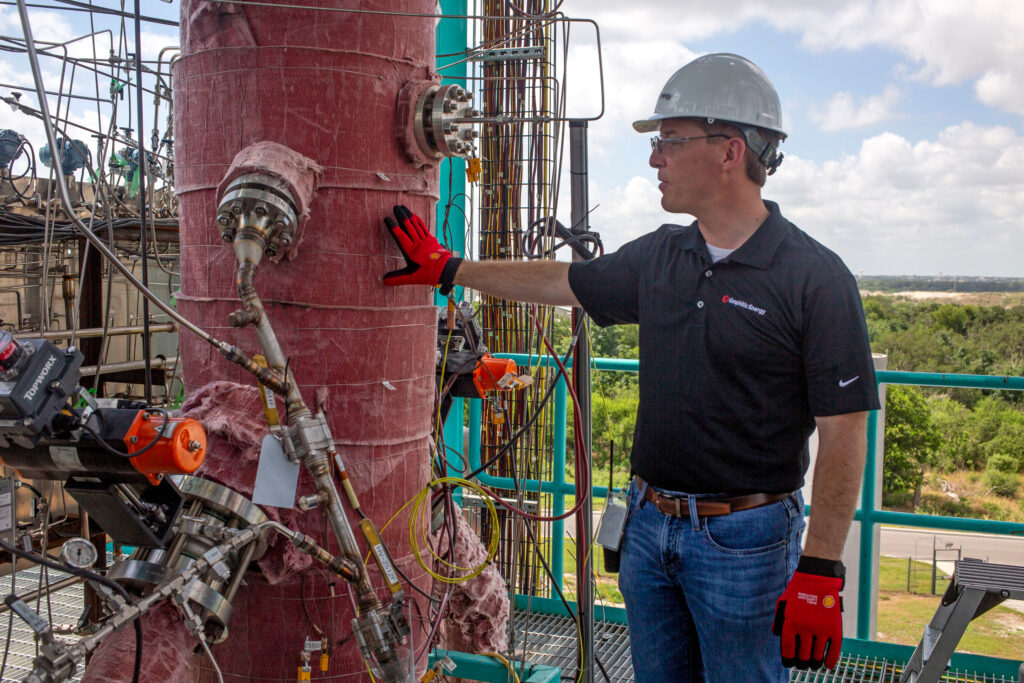
At a research campus in San Antonio, a four-story device disassembles Texas shale gas molecules to create hydrogen and carbon.
The carbon emerges not as CO2 gas but as black powder, which can be stored, transported, and potentially used for commercial materials.
“It’s easier to manage solid carbon than CO2,” said Zach Jones, CEO of Graphitic Energy, which launched a pilot project in San Antonio this year.
Graphitic is part of a group of startups innovating ways to use the massive amounts of carbon in fossil fuels that are typically released as waste. The company employs pyrolysis to separate carbon from methane gas, a process traditionally seen as too energy-intensive. They claim a new chemical catalyst decreases power needs by 90%.
The firm aims to profit from selling hydrogen, a clean fuel, and transforming carbon soot into graphite, a mineral chiefly sourced from China.
In San Antonio, Carbon Free has developed technology to convert CO2 emissions into calcium carbonate. In Houston, Cemvita uses engineered microbes to recycle CO2, while Dexmat creates carbon nano-materials as metal substitutes.
Currently, these projects contribute minimally to reducing global greenhouse gas emissions, despite rising temperatures and fossil fuel use. Long-term, these technologies may shift perceptions of carbon from waste to a valuable resource.
“Economics are crucial,” said Frederic Clerc of the Carbon to Value Initiative at New York University. “In the U.S., it’s about economics, not environmental benefits.”
The accelerator has supported 35 companies since 2020. Their success depends on achieving profitable large-scale production, Clerc explained.
The energy demand for these technologies is significant, potentially hampering efforts to decarbonize. “Energy from renewables should not be used inefficiently,” warned James Tour from Rice University.
Most carbon tech startups aim to collaborate with industrial emitters, handling carbon emitted from their operations. Companies like enaDyne and Mars Materials are exploring methods to transform CO2 into viable products through different processes.
Air Company uses a high-energy process to convert water and CO2 into ethanol, producing products like vodka and sanitizer.
Carbon Capture
If successful, these innovations could bolster the deployment of carbon capture systems, which remain underused despite their potential to reduce emissions. In 2024, global CO2 emissions were estimated at 38 billion tons.
“Without demand for captured CO2, it’s hard to justify its capture,” said Sravanth Gadikota of Carbon to Stone, which mineralizes CO2 for use in construction materials.
Oil companies have long used naturally occurring CO2 for enhanced oil recovery, now incorporating captured emissions with government backing. However, limited commercial usage exists outside this sector.
The Biden administration has promoted CO2 disposal methods, but adoption is slow due to infrastructure needs and financial challenges.
Critics, including climate groups, argue against carbon capture, advocating for investment in renewable energy as a more effective climate solution. Fossil fuels still dominate global energy, despite renewable growth and ongoing demand pressure from sectors like artificial intelligence.
“Decarbonizing needs a holistic approach,” said Charles McConnell, formerly of the U.S. Department of Energy. Carbon capture has limited bipartisan support, primarily from the fossil fuel industry.
In Europe, stringent climate policies continue to drive corporate compliance, influencing Texas-based companies with international operations.
Where the Magic Happens
Patrick Hanks, chief technology officer at Graphitic Energy, describes the carbon formation vessel, a key component of their San Antonio pilot plant. It operates continuously at high temperatures to produce hydrogen and carbon from methane.
Graphitic plans to supply hydrogen to industrial partners while selling the resulting graphite, aiming for energy independence from foreign sources like China.
The process generates three times more graphite than hydrogen, targeting a market for lower-grade graphite used in various industries.
According to Marek Locmelis from the University of Texas, the U.S. is seeking to establish a domestic graphite supply chain, with the country’s first graphite mine starting production in Louisiana.
“Using methane for graphite saves time and resources compared to mining,” Locmelis noted.
Original Story at insideclimatenews.org