The Maltese government has received three submissions during the pre-qualification period for the nation’s first offshore wind tender, awarding a concession for a floating wind project with an approximate installed capacity of 300 MW.
On 22 July, the Ministry for the Environment, Energy, and Public Cleanliness announced the conclusion of the Preliminary Qualification Questionnaire (PQQ) submission phase, launched in December 2024. Three entities submitted entries: Code Zero Consortium, led by SEP (Malta) Holding; Atlas Med Wind, led by GreenIT SpA; and MCKEDRIK Sole Member from Greece.
The PQQ period began last December, aiming to pre-qualify developers to build Malta’s first floating wind farm, targeting a capacity between 280 MW and 320 MW.
The submission deadline was extended by the Energy Ministry from 28 March to 6 June. Further details on the extension are available.
Malta’s wind tender is divided into three stages: the ongoing PQQ, the Invitation to Participate in Dialogue (ITPD), and the Best and Final Offer (BAFO).
Currently, the evaluation process is progressing. Selected candidates will be invited for the ITPD stage, followed by the BAFO stage for final proposals.
The next stage is scheduled for early next year.
“InterConnect Malta is concurrently preparing the technical and financial criteria for candidates advancing past this stage”, stated the Energy Ministry on 22 July.
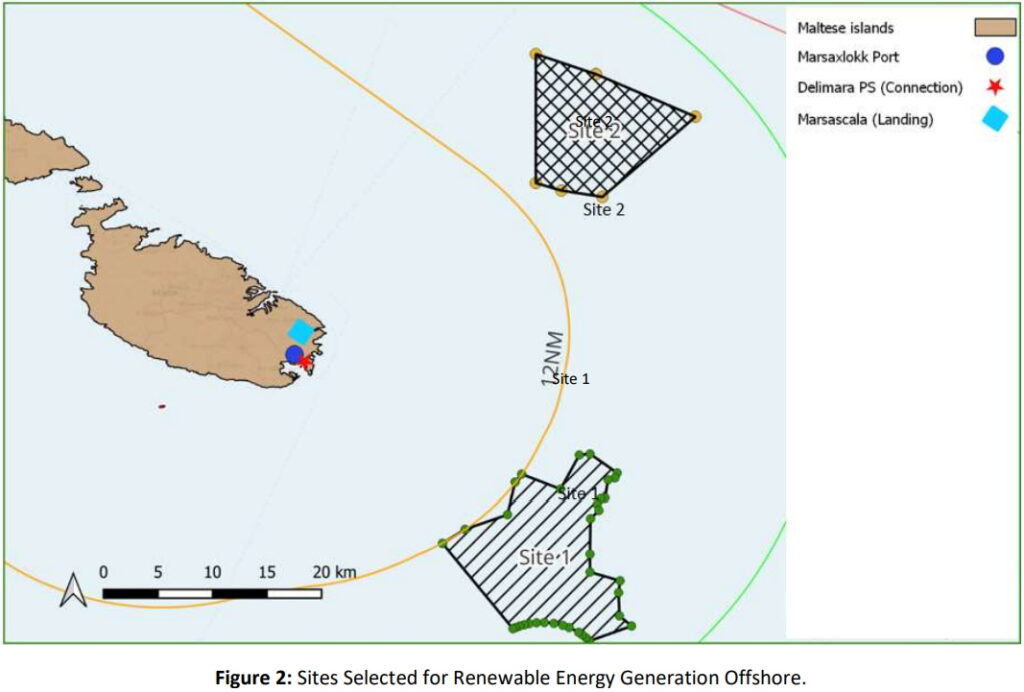
The project includes designing, constructing, operating, and eventually decommissioning the floating wind farm, located beyond Malta’s territorial waters in the Exclusive Economic Zone (EEZ). Two sites have been identified for development, allowing developers to choose and specify portions for development.
The project also involves operating and maintaining an offshore substation and export cable system, which remains government-owned, integrating electricity into Malta’s high-voltage grid.
“Malta’s efforts to boost indigenous renewable energy take a significant step as we advance in this competitive process. This project marks a crucial milestone in diversifying Malta’s renewable energy portfolio. It’s a core part of Malta’s National Energy and Climate Plan (NECP), guiding the shift to a sustainable, decarbonised energy mix,” said Ismail D’Amato, CEO of Interconnect Malta.
Original Story at www.offshorewind.biz