In the world of motorsport, few rivalries are as legendary as Ford versus Ferrari. Ford’s GT nameplate, born out of the desire to outpace the Italian giant at Le Mans, has seen remarkable victories, including a historic 1-2-3 finish in 1966 and a class win half a century later. As Ford recalibrates its electric vehicle strategies, the potential of a GT designed for the electric age sparks curiosity among automotive enthusiasts.
Ford’s Historic Triumphs with the GT
Ford’s legacy at Le Mans is deeply intertwined with its GT series. The original triumph came in 1966 when the GT40 swept the podium, securing a 1-2-3 finish that solidified its place in racing history. Fast forward to 2016, and Ford once again stood victorious at Le Mans, with the GT clinching the GTE Pro class win. The #68 car, driven by Sébastien Bourdais, Joey Hand, and Dirk Müller, emerged triumphant after a gripping duel with a Ferrari 488.
The road version of the Ford GT that accompanied this victory was powered by a twin-turbo 3.5-liter EcoBoost V6, generating 660 hp and 550 lb-ft of torque. Ford limited production to 1,350 units, each priced around $500,000, concluding the series with the GT LM Edition in late 2022.
The Track-Only GT Mk IV
The GT Mk IV, a track-exclusive marvel, closed the GT chapter with a twin-turbo 3.8-liter V6 engine delivering over 820 hp. Ford planned to manufacture just 67 units, each with a staggering price tag of approximately $1.7 million.
Meanwhile, Ford’s GT41 model integrates a renowned 5.4 Coyote-based V8 with hybrid technology, marking a step towards electrification. Yet, the prospect of a fully electric GT remains a tantalizing possibility.
The 2028 Ford eGT Concept: A Glimpse into the Future
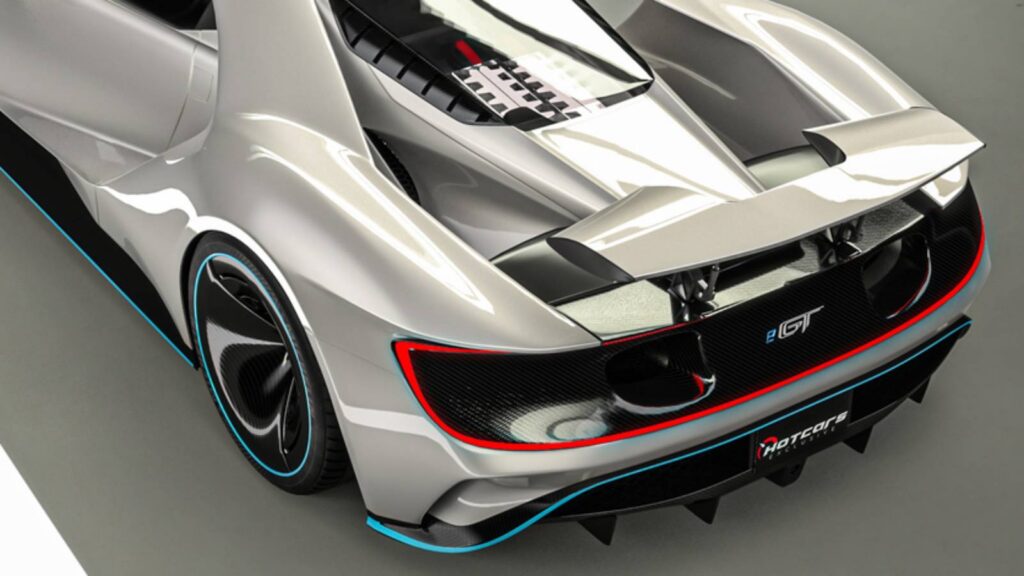
The 2028 Ford eGT concept retains the iconic teardrop cabin and intricate design elements of the last GT, with the addition of glowing cyan accents that define its electric persona. These strips accentuate the car’s futuristic appeal, outlining various components like the front panel and side sills.
Designed with performance in mind, the concept includes a prominent rear wing and other aerodynamic features reminiscent of its Le Mans heritage. The sleek LED headlights and turbine-style wheels further enhance its cutting-edge aesthetic.
While Ford has yet to release official specifications for the concept, the company’s recent developments in electric performance technology make the eGT’s potential hard to ignore. Ford’s SuperVan 4, equipped with four motors producing 1,972 hp, and the 1,400-hp SuperVan 4.2, which set a Pikes Peak class record, underscore the brand’s capabilities.
Exploring the Potential of an Electric GT
Ford’s financial journey with electric vehicles has been challenging, with losses amounting to $13 billion since 2023 and projected to reach $19.5 billion. The discontinuation of the all-electric F-150 Lightning in favor of a gas-extended variant marks a significant pivot in the company’s strategy.
As Ford looks to the future, smaller and more affordable electric models are on the horizon. However, the introduction of a flagship electric GT could inject excitement into the lineup, much like the GT did for the Mustang. In light of the competitive landscape, particularly with Chinese automakers like BYD, an electric GT could serve as a formidable contender.
For now, the eGT remains a digital concept, prompting enthusiasts to ponder whether an electric GT should become a reality or if the storied badge should remain tied to its gasoline roots.
Original Story at www.hotcars.com