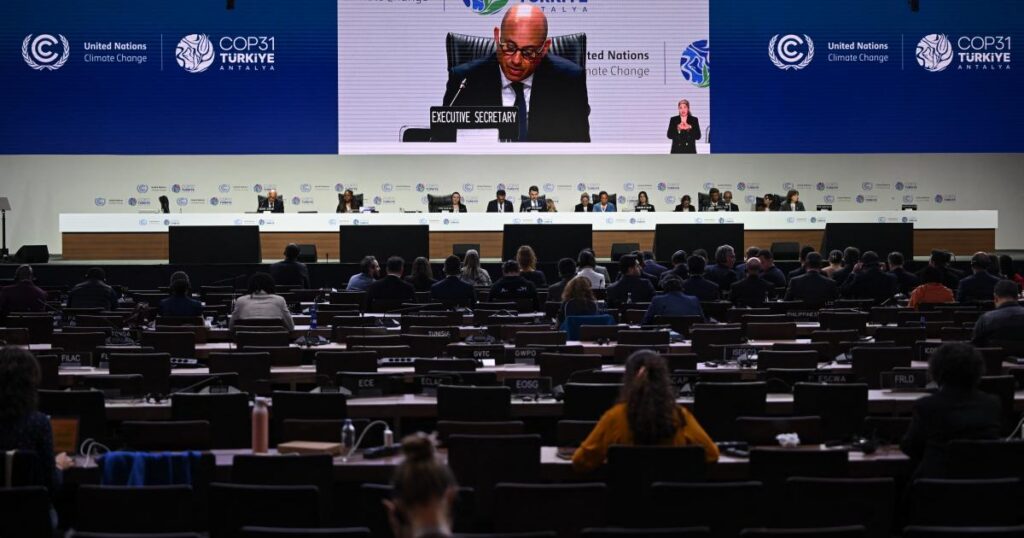
As the curtain fell on the United Nations Climate Change Conference (COP31) after more than two weeks of intense negotiations and an extended closing session, no final agreement was reached. Contentious debates over fossil fuels and climate finance led to a stalemate, leaving the UN Secretary-General with a sense of “frustration.”
Despite the lack of a comprehensive deal, there were strides made towards addressing the climate crisis. Governments and businesses focused on actionable measures such as expediting the clean energy transition, slashing methane emissions, and safeguarding communities from extreme heat.
“Given the deepening climate crisis, it is certainly disappointing that countries were not able to reach a final agreement,” said Martin Krause, Director of the Climate Change Division at the United Nations Environment Programme (UNEP). “But that doesn’t mean there wasn’t any progress. Seeing businesses here in Antalya ready to invest in clean energy and nature-based solutions makes me especially hopeful.”
The urgency of the discussions was underscored by recent findings indicating the world is nearing a critical temperature increase outlined in the Paris Agreement, with potential consequences including extreme heat, drought, and sea level rise.
Outlined below are eight significant insights from COP31.
Climate action must be grounded in science
Amidst debates over the timing of the Intergovernmental Panel on Climate Change’s Seventh Assessment Report, the role of scientific evidence in shaping international climate policy came under scrutiny. Nonetheless, countries repeatedly emphasized that effective climate action must be based on the best available science.
Overshoot dominates climate conversation
This conference marked the first since UNEP’s Limiting Overshoot report concluded that exceeding a 1.5°C temperature rise is nearly inevitable. Discussions pivoted towards strategies to minimize its impact and duration.
“What was once a politically sensitive discussion has now moved firmly into the mainstream of climate diplomacy,” Krause noted. “I believe this is a key development because it takes us to practical solutions in a time where every fraction of a degree makes a difference.”
Methane and super pollutants remain the fastest climate win
Reducing emissions of methane and other short-lived climate pollutants is among the swiftest ways to curb warming, offering immediate health, air quality, and food security benefits. At COP31, over US$480 million was pledged to aid efforts in cutting these emissions. Progress was also highlighted in improving methane monitoring and mitigation.
“Reducing methane emissions is like pulling an emergency brake on climate change,” said Krause. “It can significantly slow global warming.”
Extreme heat and sustainable cooling were high on the agenda
Extreme heat emerged as a pivotal climate challenge at COP31. Governments endorsed the Global Heat Resilience and Sustainable Cooling Roadmap, stressing the need to adapt to rising temperatures while minimizing emissions from increased cooling demands.
Innovative cooling solutions, smarter buildings, and nature-based approaches like tree planting illustrate how adaptation and mitigation can be pursued in tandem.
Better buildings and waste management gain momentum
Focus on sectors such as buildings and waste management yielded notable advancements at COP31. The conference highlighted waste prevention and circular economy methods, emphasizing their role in reducing emissions and conserving resources.
Food waste reduction also took center stage, underlining the connection between waste, methane emissions, and sustainable development.
From ambition to implementation: the rise of the three roadmaps
While disagreements persisted, there was a collective push towards implementing practical pathways that translate climate ambitions into tangible outcomes. UNEP experts stressed the importance of managing trade-offs, particularly the risks that the clean energy transition might pose to forests.
Climate finance remains a major sticking point
Despite the progress made, climate finance continued to be a contentious topic. Many nations urged for increased adaptation funding and easier access to financial resources for developing countries facing climate impacts.
UNEP projects that developing nations may need hundreds of billions of dollars annually by 2035 to adapt to climate change, far surpassing current financial flows.
“We must prepare for a warmer world and reaching an agreement on climate finance is key,” Krause emphasized. “Helping vulnerable communities adapt to a changing climate is one of the defining challenges of our time and it should bring the world together.”
The Global Stocktake and the Periodic Review mark a new chapter
COP31 initiated the second Global Stocktake, a crucial process assessing progress towards the goals of the Paris Agreement, which will shape future climate action. This runs alongside the Periodic Review, a scientific and political analysis of long-term climate objectives, addressing whether countries are moving quickly enough and what additional measures are necessary.
Original Story at www.unep.org