Climate Talks End in Discord as Fossil Fuels Go Unmentioned
The Cop31 UN climate summit in Turkey concluded without reaching an agreement, as the EU, UK, and several developing nations rejected a proposed deal that omitted crucial references to fossil fuels. The discord highlighted deep divisions over how to address climate change effectively.
Irish Environment Minister Darragh O’Brien, representing the EU, criticized the proposed agreement for failing to meet scientific and global action needs. He stated, “We will not endorse a decision that does not respond to the science and that actually risks deepening the chasm between global commitments and the action required. [It] does not even mention fossil fuels.”
The summit, the longest in history, extended into Sunday, with the “Antalya pact” drafted by Turkey and Australia unable to secure the necessary consensus for approval. The pact encouraged nations to transition to electrified economies and urged wealthy countries to support poorer ones in adapting to climate impacts. However, it did not support the demanded shift away from fossil fuels by over 130 countries and controversially included provisions for “carbon capture and storage” (CCS) technologies.
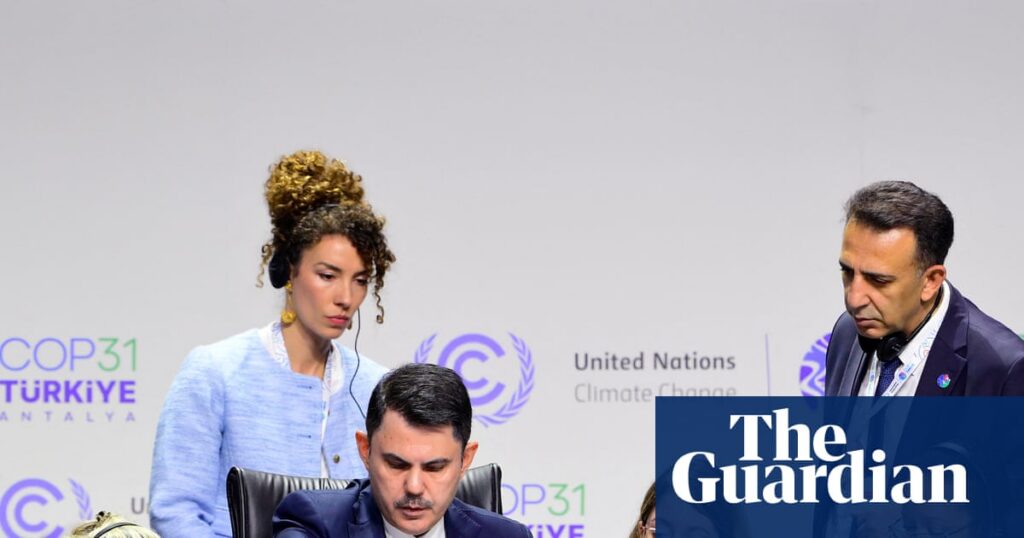
Despite avoiding a complete collapse by passing decisions on other issues, such as the “just transition” for workers in high-carbon industries, Turkish Cop president Murat Kurum acknowledged the failure to secure agreement on the draft “cover decision” text. “We have done our utmost; ultimately, we have not imposed this text on anyone, nor have we issued an ultimatum such as a ‘take it or leave it’ demand,” he said, recognizing the lack of consensus.
Significant opposition came from the EU, UK, and developing nations, including small island countries, who could not support the Antalya pact. In a striking statement, O’Brien reiterated the EU’s stance, emphasizing the pact’s inadequacy due to the absence of fossil fuel references. “It fails to meet the moment… We will not endorse a cover decision or an Antalya pact that does not even mention fossil fuels, which is the key driver of climate change,” he said, receiving applause and similar objections from nations like Panama, the Marshall Islands, and Norway.
Bill Hare from Climate Analytics described the situation as a pivotal moment where countries opposed fossil fuel interests. However, Mohamed Adow of Power Shift Africa criticized the EU’s action, calling it “the worst Cop ever” and accusing wealthy nations of abandoning those most affected by climate change.
Not all countries rejected the pact. Saudi Arabia defended the inclusion of CCS, while nations like China, Pakistan, and the Africa group showed no objection, despite reservations. Pakistan argued that not all parts of the pact should be discarded due to some objections. “Climate action is not a menu from which we can select only what suits us,” they stated.
Ghana, while critical of the process, chose not to reject the text. “Africa has always chosen to build multilateralism rather than walk away from it,” they commented.
Close to 200 nations gathered in Antalya under Turkey and Australia’s leadership, but the talks faced prolonged deadlocks as countries struggled to reach mutual understanding. Australian climate change minister Chris Bowen defended his leadership, citing “unbridgeable” red lines despite full efforts.
Reflecting on the consensus-based system’s breakdown, Simon Stiell of the UN framework convention on climate change admitted it fell short but noted progress on some agenda items. For many, the summit exposed the rich world’s collective failure to address climate urgency, especially as extreme weather events devastate lives worldwide.
UN Secretary-General António Guterres expressed his disappointment at the lack of consensus, underscoring the necessity of science-based action: “There may be no consensus in the negotiating room. There is no ambiguity in the science.”
Original Story at www.theguardian.com