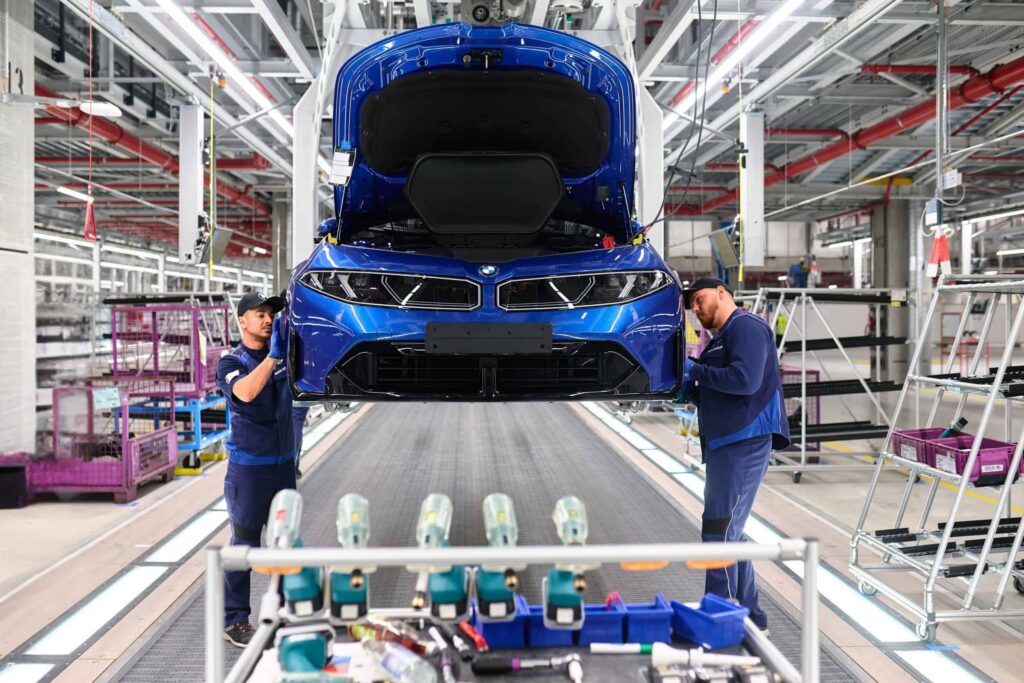
BMW’s future-focused strategy is gaining momentum as its Neue Klasse vehicles see stronger-than-expected demand, prompting the automaker to boost production capabilities and accelerate the introduction of new models in the lineup.
Article Summary
- BMW is accelerating the Neue Klasse production ramp-up as demand for its next-generation electric vehicles exceeds expectations.
- Faster Neue Klasse production could help BMW transition away from older electric models without leaving gaps in its EV lineup.
- Faster production growth could allow BMW to retire some existing EVs ahead of schedule.
As BMW navigates the dynamic landscape of electric vehicles, its Neue Klasse architecture stands at the forefront of transformation. Surpassing initial forecasts, the demand for BMW’s next-gen electric models is prompting a strategic shift. The German automaker is now expediting production timelines across various manufacturing sites, leveraging the successful launch of the iX3 as a catalyst for broader efficiency.
At the core of this initiative is BMW’s factory in Debrecen, Hungary, where the first Neue Klasse model has already amassed over 100,000 orders since its debut in September 2025. This robust market reception has emboldened BMW to enhance production at additional facilities, as noted by Raymond Wittmann, BMW’s head of production.
“We are not only meeting our targets but, in some cases, exceeding them,” Wittmann told Automotive News. “That is why we have decided to accelerate the production ramp-up at certain locations beyond our original plans.”
Debrecen’s Role as a Prototype for Efficient Production
The Debrecen plant is pivotal for BMW, serving as a testbed for optimizing production techniques. Establishing a new plant with advanced technologies and supply chains was challenging, but the insights gained are now being applied to enhance operations at other sites.
BMW has standardized approximately 90 percent of the equipment across its Neue Klasse facilities. This standardization allows for rapid knowledge transfer between plants, streamlining the production process globally.
“Once we have brought a production line up to its target output, we can transfer that knowledge very quickly across our global network,” Wittmann explained.
Transitioning to Profitable Neue Klasse Models
The accelerated production also means BMW can phase out older electric vehicles ahead of schedule. CEO Milan Nedeljković highlighted that ramped-up Gen6 production enables BMW to retire models featuring Gen5 battery technology sooner. While specific models haven’t been named, this shift points to a quicker shift to the Neue Klasse lineup.
The i4, for instance, could be among the first to be replaced by the newly introduced i3. Similarly, the iX1 might give way to a new rear-wheel-drive crossover by 2027, and the iX is anticipated to be succeeded by the iX6 and iX7 by 2028.
Beyond meeting consumer demand, this strategic shift is financially motivated. Nedeljković noted that the Neue Klasse models offer superior profit margins due to enhanced cost structures and updated technologies, making them a wise business choice.

Maintaining Flexibility in Production
Despite significant investments in electric-vehicle production facilities in Debrecen and Munich, BMW continues to embrace production flexibility. The Spartanburg plant epitomizes this approach, efficiently producing vehicles with combustion engines, plug-in hybrids, and full electric powertrains on the same lines.
Wittmann explained that dedicated EV factories are economically viable in markets with sufficient demand for electric vehicles. Meanwhile, plants in Dingolfing, Regensburg, and Leipzig will maintain the versatility to produce varied powertrain models, allowing BMW to adapt production to evolving market demands.
This strategy is essential as electric vehicle adoption varies globally, ensuring that BMW remains responsive to regional market conditions and demand fluctuations.
Source: Automotive News
Original Story at www.bmwblog.com