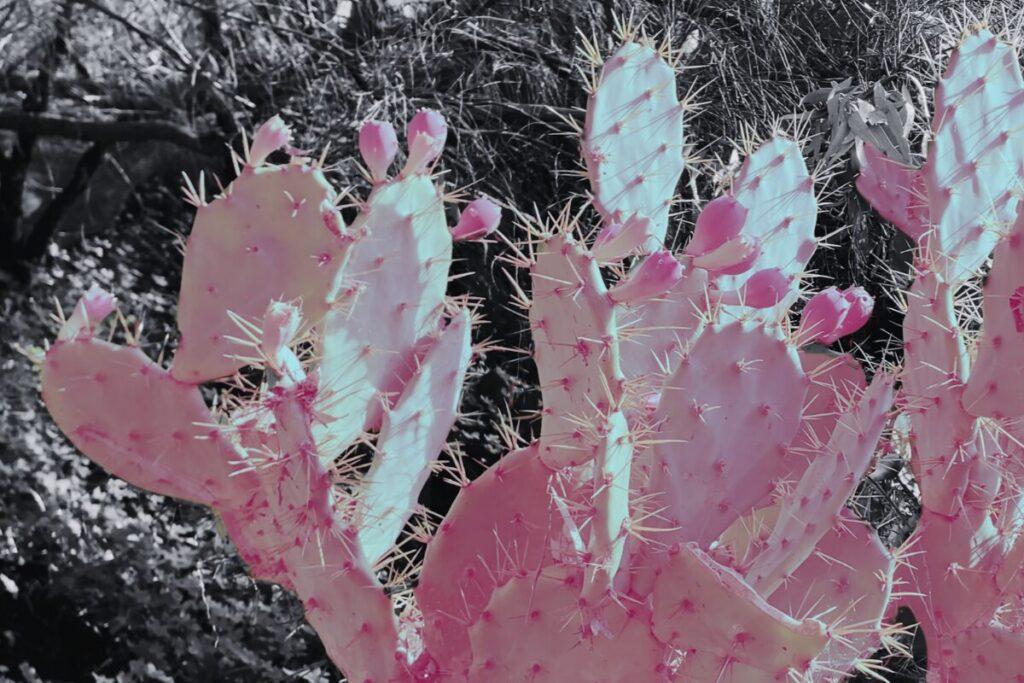
As the American West faces intensifying drought and growing pressure to find sustainable food and fuel sources, one scientist at the University of Nevada, Reno is quietly working toward a solution that might seem unlikely at first glance: the humble cactus.
John Cushman, a professor in the Department of Biochemistry, Molecular Biology & Biotechnology at UNR, has spent nearly four decades studying how plants survive with minimal water. His current focus — the spineless pear cactus, known scientifically as Opuntia — could reshape how the driest state in the country feeds its livestock and even powers some of its energy needs.
Nevada agriculture relies entirely on irrigation. Every acre of crops grown in the state requires water drawn from an increasingly strained supply. Drought conditions have deepened across the region, and global warming predictions suggest the Western United States could become roughly 15 percent drier than it already is. For a state that already sits at the arid edge, that forecast carries serious consequences for farming.
Alfalfa has long been the dominant feed crop for livestock across the West, dating back to the Gold Rush era. But growing it demands a lot of water — between 8 and 12 acre-feet per year. Cushman and his colleagues have found that Opuntia requires only about two acre-feet annually, a reduction of roughly one-sixth.
Cushman puts it plainly:
“We are focused on the development of alternative crops that are going to do well in the driest state in the United States, and also the fact that 100 percent of all agriculture in the state requires irrigation. That means we want to work on plants and crops that use less water. That’s what I’ve been working on all my career.”
His interest in plant water efficiency began during postdoctoral research at the University of Arizona and continued through additional work in Oklahoma. Now in his 26th year at UNR, Cushman views Nevada as an ideal setting for this line of study — a living field laboratory that stretches in every direction.
Matching Alfalfa’s Output at a Fraction of the Water
A common assumption about cactus is that it grows too slowly to be practical for agriculture. Cushman acknowledges the perception but draws an important distinction.
“This is the common view. In their natural environment, people look at that and see they’re very slow-growing, which is true. However, we focus on an agricultural setting, and that’s very different.”
In a managed agricultural setting, researchers have found that Opuntia produces the same annual volume of biomass as alfalfa — but with six times greater water efficiency. To identify the best-performing strains, Cushman and his team have planted replicated fields with 240 varieties of pear cactus across Nevada, California, Arizona, Texas, and Florida, allowing them to compare which varieties thrive in different climates.
The plant’s applications extend beyond livestock feed. The fruit and paddle-shaped stems, called cladodes, are increasingly appearing in grocery stores. Opuntia also produces methane and ethanol, opening the door to its use as a biofuel feedstock — which is part of why the U.S. Department of Energy has provided funding for the research, alongside the Western Sustainable Agriculture Research & Education program and the Nevada Agriculture Experiment Station.
“We’re pretty limited right now in the expansion of biofuel production. It’s going up slowly, but if we really want to switch over to biofuels, we need to expand the feedstock. And the only way to do that is to start looking at these arid regions. And Opuntia is really a good choice for that because it requires so much less water. The Western United States is predicted to get about 15 percent drier than it is now, and we’re already seeing that with the extended drought episodes that we’re experiencing.”
Cushman has also flagged an additional environmental benefit: the pear cactus uses a form of photosynthesis that actively draws carbon dioxide from the atmosphere, making it a potential carbon sequestration crop as well.
“We’re really interested in water-saving, but also, can we use this as a carbon sequestration crop?”
Cushman has filed patents on several of his findings, reflecting the long-term nature of his work. No one expects the millions of acres currently planted in alfalfa across the United States to be replaced by spineless pear cactus in the near term. But the research lays the groundwork for a more water-efficient approach to agriculture in a region where every drop increasingly counts. Those interested in supporting independent science journalism covering this kind of research can learn more about membership at the Nevada Independent.