Chinese automakers are no longer just eyeing the European market; they have firmly established themselves as significant players. At the recent Paris Auto Show, 11 out of 21 automakers exhibiting were Chinese brands, highlighting their growing influence. In August, nearly 12% of new vehicle sales in the European Union and the U.K. were attributed to these brands, with projections indicating that sales could exceed 1 million units this year.
Unlike their Japanese and Korean counterparts who gradually moved up the market ladder, Chinese automakers are aggressively targeting the luxury segment right from the start. The Paris Expo Porte de Versailles displayed this shift, as Chinese brands presented vehicles that rival traditional luxury automakers like Mercedes-Benz, BMW, Audi, and Range Rover. These vehicles offered premium features and technology at prices European carmakers find difficult to compete with.
The commoditization of luxury was evident at the show, as Chinese brands showcased their ability to deliver opulent interiors and advanced powertrains at competitive prices. Designer Fabrizio Guigiaro remarked, “It’s incredible,” following the unveiling of the Zeekr 9X—a luxury SUV with a hybrid powertrain and interiors akin to a Bentley, yet priced below a Cadillac Escalade IQL. He noted, “That is last century. This is next century,” pointing to the Zeekr stand.
Despite the strong presence of Chinese brands, notable European automakers like BMW and Jaguar Land Rover were absent. BMW’s CEO, Milan Nedeljkovic, cited cost-cutting measures due to a profit warning and declining sales in China as reasons for skipping the show. Jaguar Land Rover opted out in favor of direct marketing strategies, missing the chance to highlight their Jaguar Type 01.
However, some European brands did rise to the occasion. Volkswagen introduced the ID.Tiguan, a new electric SUV, while Audi showcased its retro-inspired A2 E-Tron. Ford presented a lineup of historic rally cars alongside a replica of Max Verstappen’s Formula 1 car, promoting their new marketing tagline, “Ready, Set, Ford,” and promising new models by 2029.
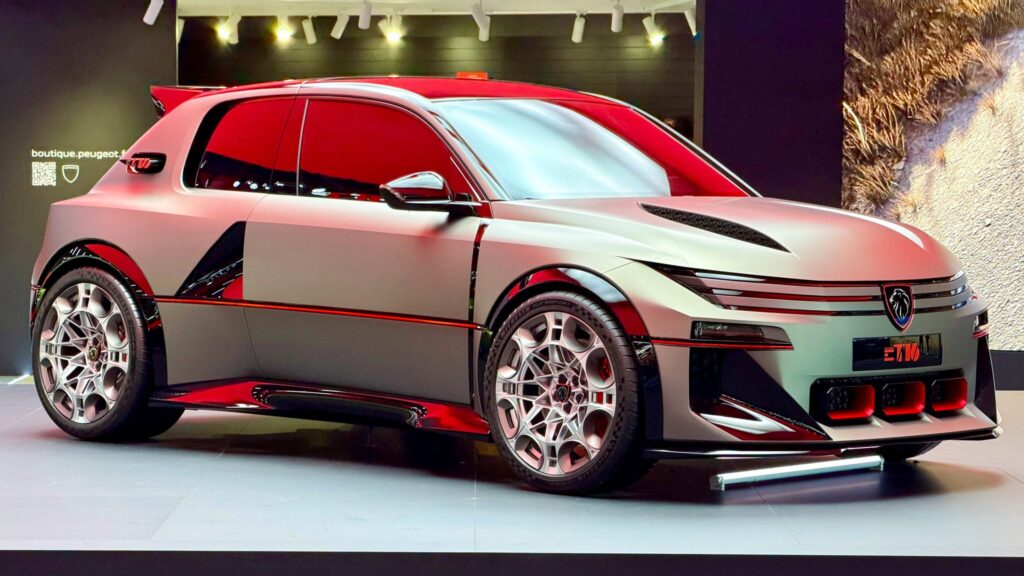
Ford’s strategy aims to differentiate its products from Chinese competitors like Geely, BYD, and SAIC by emphasizing “rally-bred” performance. Meanwhile, Stellantis exhibited a range of concept cars from brands like Alfa Romeo, Citroën, DS, Fiat, Lancia, Opel, and Peugeot, signaling a serious response to the competition. Stellantis’ design chief, Ralph Gilles, emphasized building vehicles with unique design and character, saying, “We’re really focused on reigniting that passion, that love affair with cars.”
The 2026 Paris auto show may go down in history as the moment when European automakers began to counter the Chinese presence, marking a new chapter in the automotive industry.
Alfa Romeo Cuorerosso
The Alfa Romeo Cuorerosso, designed by Alejandro Mesonero, represents the future of the brand with its focus on passion and performance. Built on a revised Giorgio Sport platform, known for underpinning Maserati’s GranTurismo, the Cuorerosso promises a driver-focused experience without interior screens. A potential production model could feature a twin-turbo hybridized version of Alfa’s 2.9-liter V-6, according to Stellantis design boss Ralph Gilles. “The Giorgio Sport’s a great chassis, and this was about how lean of a vehicle could we make on top of that chassis,” Gilles added.
Original Story at www.motortrend.com