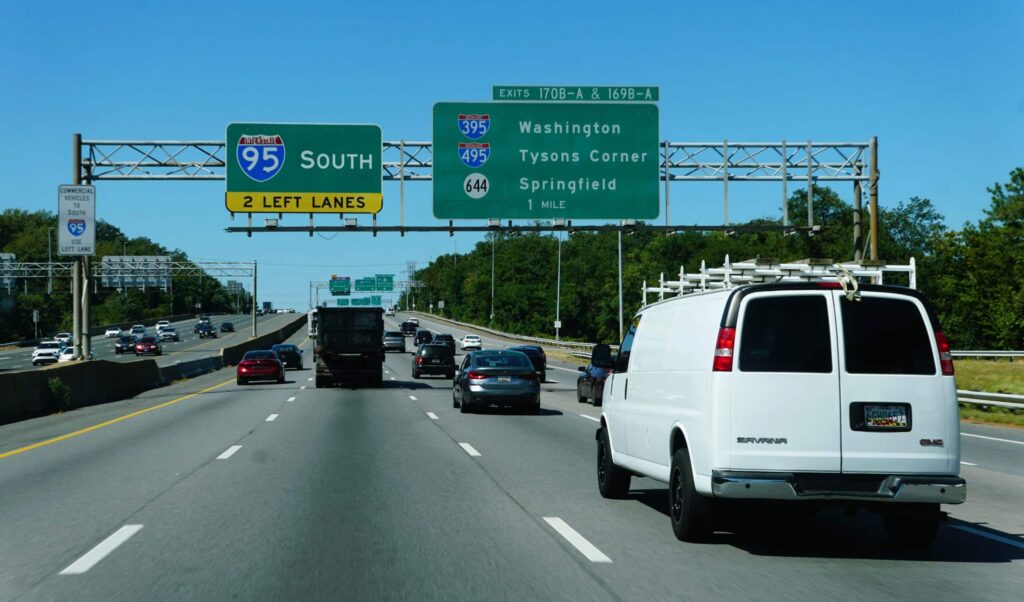
Virginia’s I-95 Express Lanes Set for Major Expansion
Public Works Financing has reported that a significant expansion is in the works for Virginia’s I-95 express toll lanes south of the I-495 Beltway. The collaborative effort between the Virginia Department of Transportation (VDOT) and Transurban aims to enhance the lane capacity by 140%. This plan will transform the current reversible lanes into a bi-directional system along the entire corridor and extend the lanes by 10 miles to the Spotsylvania Parkway.
Some characterize the original reversible lane design as flawed. Scott McCaffrey, writing for FFX Now, highlighted a statement by Jeff McKay, chairman of the Fairfax County Board of Supervisors, who said it was “probably the biggest mistake ever made in Virginia’s Interstate highway system.”
Transurban, the original partner for the design-build-finance-operate-maintain (DBFOM) agreement with VDOT, has first rights to any expansions. The bi-directional upgrade and additional lanes will significantly benefit commuters by more than doubling the express lanes’ capacity. The $4.5 billion project involves reconfiguring the lanes from three reversible express toll lanes (ETLs) to three lanes each way.
In 2020, Transurban sold half of its interest in the ETL concession to a group of pension-fund infrastructure investors, including AusSuper, the Canada Pension Plan Investment Board (CPPIB), and UniSuper.
North Carolina’s I-77 Express Lanes Gain Momentum
The North Carolina Department of Transportation’s (NCDOT) proposal to add express toll lanes on I-77 is moving forward following a 64-5 vote by the Charlotte Regional Transportation Planning Organization (CRTPO). This decision was influenced by the Charlotte City Council reversing its previous opposition, largely due to NCDOT’s commitment to invest at least $300 million in community benefits in the affected areas.
The decision follows a state budget provision that requires jurisdictions rescinding support for the project to repay NCDOT for previously incurred expenses. This development clears the path for NCDOT to proceed with a public-private partnership (P3) for the express toll lanes, which will encourage similar developments in South Carolina.
Alabama’s Mobile River Bridge Project Begins
The Alabama Department of Transportation has secured financing for the first phase of the Mobile River Bridge project, primarily funded through tolls despite initial opposition. The $3.2 billion project, including a $2.52 billion TIFIA loan, will begin this month and aims to build the new bridge and re-stripe the parallel Bayway.
Various toll options will be available for users, with prices varying based on payment method and frequency of use. The Bayway will remain toll-free until its replacement in phase 2, projected for 2036. Despite opposition, toll revenue remains essential for funding this infrastructure.
Florida’s Turnpike Expansion Raises Questions About Tolls
Florida is undergoing a $20 billion expansion of its Turnpike, with a controversial proposal to eliminate tolls for residents and only charge tourists. Governor Ron DeSantis suggested this idea without detailing its feasibility, leaving questions about its impact on the Turnpike’s $1.4 billion annual revenue.
The Turnpike, crucial for linking Miami with Orlando, is well-maintained and expanding to accommodate three lanes each way. The proposal has raised concerns about its potential impact on tourism and state revenue.
Brightline Florida’s Bankruptcy Raises Concerns
Brightline Florida has filed for bankruptcy, yet its train operations continue. Fitch Ratings has downgraded its bonds, signaling financial distress. Despite initial optimism about its passenger rail service between South Florida and Orlando, the venture struggled to attract sufficient ridership.
Many initially viewed the service as a viable alternative to driving or flying, but the bankruptcy filing suggests otherwise. It highlights the challenges in sustaining such niche transportation ventures.
Feasibility of In-Road EV Charging Under Scrutiny
In-road electric vehicle (EV) charging, or dynamic wireless charging, has been a topic of interest but faces economic feasibility challenges. Research in Europe and the U.S. suggests that high costs and maintenance issues present significant barriers.
Technological advancements have not yet overcome these hurdles, and as state departments of transportation focus on maintaining existing infrastructure, in-road charging remains a distant possibility.
Original Story at reason.org