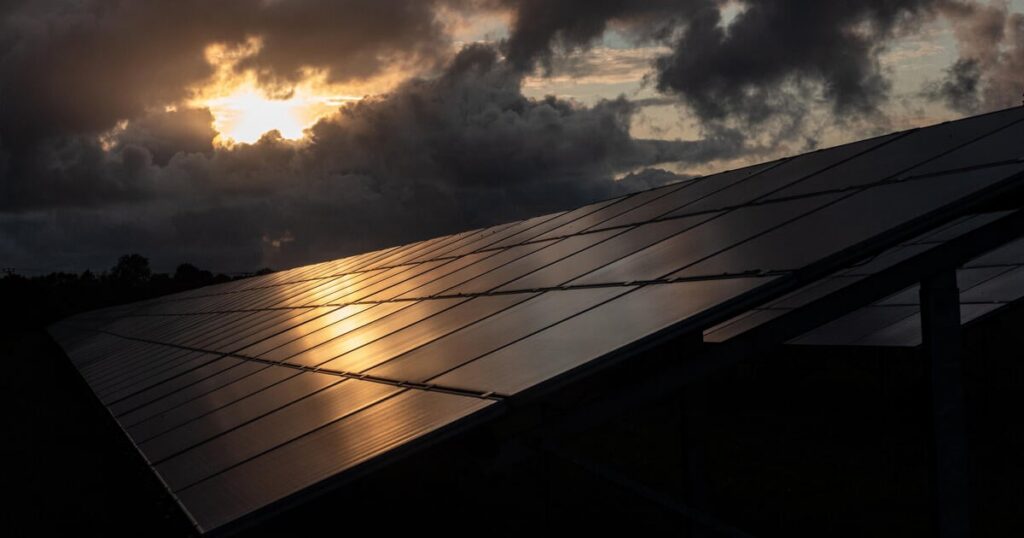
China Sets Ambitious Renewable Energy Targets for 2030
China’s new renewable energy plan for 2026-2030 aims to boost its domestic renewable energy capacity to approximately 3.5 terawatts (TW) by 2030. This ambitious goal includes over 2.8TW of wind and solar energy, and a significant investment in storage, transmission, and offshore wind infrastructure.
Mohammed Talib, a construction and infrastructure expert at Pinsent Masons, commented on the plan: “China’s new renewable energy plan is about far more than building additional solar and wind capacity.” He emphasized that the country seeks to enhance its leadership across various aspects of the clean energy value chain, such as generation, storage, transmission, and critical supply chains.
Talib also noted potential repercussions for global markets: “The knock-on effects could be significant. Greater domestic demand may absorb more renewable equipment production, potentially slowing the long-term decline in solar panel prices and creating periodic supply constraints.” This shift could mean that developers outside China might encounter increased competition for equipment and face price pressures, particularly if they continue relying on Chinese supply chains.
By the end of 2025, China’s installed renewable energy capacity was approximately 2.3TW, according to the National Energy Administration. The country dominates more than 80% of global manufacturing capacity in key solar power production stages, including polysilicon, ingots, wafers, cells, and modules. Moreover, China produces nearly 95% of the global solar wafer manufacturing capacity, a crucial component in renewable energy.
Alice Wang, another expert from Pinsent Masons, highlighted China’s potential to bolster its position in essential minerals, batteries, electrical equipment, and grid infrastructure. “Importantly, China could further strengthen its position in critical minerals, batteries, electrical equipment, and grid infrastructure,” she stated.
Wang indicated that developers and energy-intensive industries outside China might increasingly face challenges in securing affordable equipment and resilient supply chains. “From a contractual perspective, these supply chain pressures heighten the risk of price escalation disputes, delay claims, and force majeure arguments across EPC and equipment supply agreements,” she explained. She advised project developers to carefully review procurement and risk allocation provisions.
Wang also mentioned that while countries like India, Vietnam, and Malaysia are expanding their manufacturing capacity, the concept of China+1 strategies—which diversify supply chains by involving an additional country alongside China—may prove more costly than anticipated. This diversification introduces legal and regulatory complexities, such as different trade remedy regimes and varying local content requirements, which must be managed during contract negotiations.
Other regions are also striving to enhance their domestic clean energy manufacturing capacities. The US Inflation Reduction Act and the EU’s Net Zero Industry Act aim to promote local production of solar panels, batteries, and other vital components. Meanwhile, countries throughout the Middle East and Asia-Pacific are investing in upstream processing capabilities. Despite these efforts, the ability to significantly lessen reliance on Chinese supply chains in the near term remains uncertain due to China’s scale and integrated production ecosystem.
Wang concluded by noting: “For infrastructure and energy projects with long investment horizons, the interplay between geopolitical supply chain shifts and contractual risk allocation will be a defining issue over the coming years.”
Original Story at www.pinsentmasons.com