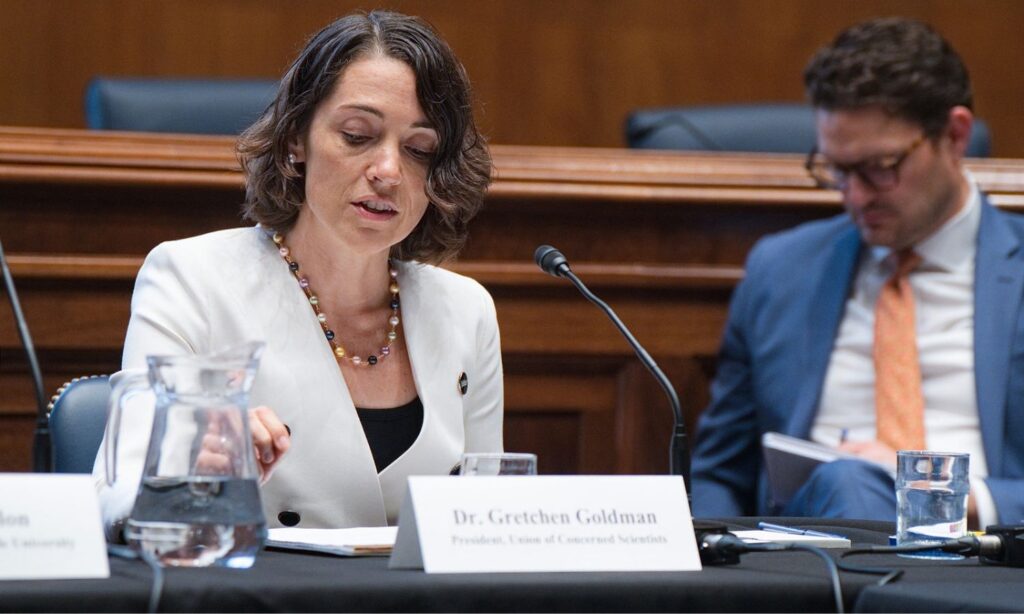
In a significant move to underline the impact of political and industrial influence on climate science, Senator Sheldon Whitehouse, as the ranking member of the US Senate Environmental and Public Works Committee, organized a “spotlight” hearing on September 29. Attended by key figures including Senate Democratic Leader Chuck Schumer and Senator Jeff Merkley, the hearing aimed to shed light on the consequences of recent governmental actions affecting climate research. Dr. Gretchen Goldman, President and CEO of the Union of Concerned Scientists, provided testimony at the event. Her full written testimony can be found here, and the oral testimony is also available to watch.
Adding to the ongoing discourse, the Supreme Court is set to hear oral arguments on October 5 in the case of Suncor v Boulder, which questions the accountability of the fossil fuel industry for climate deception. Dr. Goldman is also scheduled to speak at the People vs Big Oil rally to support justice for Boulder, Colorado, and others affected by the industry’s alleged deceptions.
The hearing emphasized the need for Congress to resist granting liability shields to major oil companies. Citizens are encouraged to contact legislators to voice their opposition to such immunities.
Testimony Highlights
Dr. Goldman, representing a vast network of scientists through the Union of Concerned Scientists, underscored the importance of independent science in the US’s achievements in various fields. She highlighted the role of federal funding in breakthroughs like the internet and MRI technology.
She detailed how federal agencies, such as the CDC, FDA, and NOAA, play crucial roles in safeguarding public health and safety through scientific research and policy-making. These institutions, funded by taxpayer dollars, have historically served the American populace by ensuring safety and innovation.
However, recent policies pose significant challenges.
The Trump administration’s actions have reportedly undermined these science agencies, affecting their ability to function effectively by reducing their workforce and influencing policy decisions that favor industrial profits over public welfare.
Impact on Federal Scientists
Since 2025, nearly 95,000 science professionals have reportedly left their positions, including 10,000 with doctoral degrees. This exodus has significantly impacted agencies like NOAA, which has seen the departure of over 1,800 employees, equating to a loss of over 27,000 years of expertise.
Other critical agencies, including the CDC, EPA, and NSF, have also experienced substantial staff reductions, impairing their operational capabilities.
Regulatory Challenges
The administration’s focus on climate science has been particularly intense, as it has repealed regulations like the 2009 Endangerment Finding, which mandated the EPA to regulate harmful emissions. This move has been criticized for undermining established science on greenhouse gas emissions and public health risks.
The National Academies’ recent report supports the continued validity of these scientific claims, emphasizing the increasing evidence of harm from emissions.
Additional actions have reportedly stripped federal scientific integrity structures and disrupted essential climate research activities, raising concerns over political interference in science-based decision-making.
Fossil Fuel Industry’s Influence
The administration’s actions appear aligned with fossil fuel interests, potentially aiming to suppress scientific findings that could lead to industry accountability. This alignment is evident in efforts to secure legal protections for fossil fuel companies against climate-related harm claims.
Agencies like FEMA, NOAA, and the EPA have faced coordinated efforts to obscure climate change evidence, allegedly prioritizing industry profits over public good.
Concluding Thoughts
Dr. Goldman stressed the importance of maintaining independent scientific inquiry and expertise to uphold democratic principles. The ongoing challenges highlight potential corporate influence over governmental decisions, with significant implications for public welfare.
Original Story at blog.ucs.org