With the long-term storage of used nuclear fuel posing significant challenges, scientists are exploring innovative solutions to mitigate its hazardous nature. Advanced physics tools are under investigation to transform nuclear waste into materials that decay more rapidly, potentially revolutionizing nuclear waste management.
A promising approach involves integrating a particle accelerator with a subcritical nuclear reactor. Unlike traditional reactors, which require a self-sustaining chain reaction, these innovative systems rely on an external “spark” provided by a particle accelerator.
The standard nuclear reactors leave behind transuranic isotopes, such as Plutonium-239 or Americium-241, which remain radioactive for thousands of years. However, in a subcritical reactor driven by an accelerator, the instability of the chain reaction is mitigated, offering a potential solution to effectively “burn” these isotopes.
The U.S. Department of Energy’s ARPA-E has granted $8.17 million to the Thomas Jefferson National Accelerator Facility for two projects focused on such technologies. This funding is part of the NEWTON program, which aims to both reduce nuclear waste longevity and extract additional energy from it.
“Based on our own success in developing cutting-edge accelerator technologies to enable scientific discoveries, we believe that there is a contribution we can make with the experience we have gained over the last few decades,” stated Rongli Geng, a principal investigator on both projects, in a Jefferson Lab press release.
Transforming Waste
Nuclear waste remains hazardous for extensive periods, with some components posing threats for over 100,000 years. ARPA-E suggests that by separating and recycling the most harmful elements, this could be reduced to approximately 300 years, significantly shortening the required storage time.
Accelerator-driven systems initiate a process called spallation by firing high-energy protons into a heavy target, releasing neutrons. These neutrons then interact with the nuclear waste isotopes, converting them into shorter-lived materials.
“These neutrons will interact with these unwanted isotopes and convert them into more manageable isotopes that you can either try out for some beneficial use or bury underground,” Geng explained. “Instead of having a lifetime of 100,000 years in storage, for example, you can shorten the storage years down to 300.”
Additionally, these reactions produce heat, which can be harnessed to generate electricity, turning a portion of the waste problem into an energy opportunity.
Affordable Accelerator Solutions
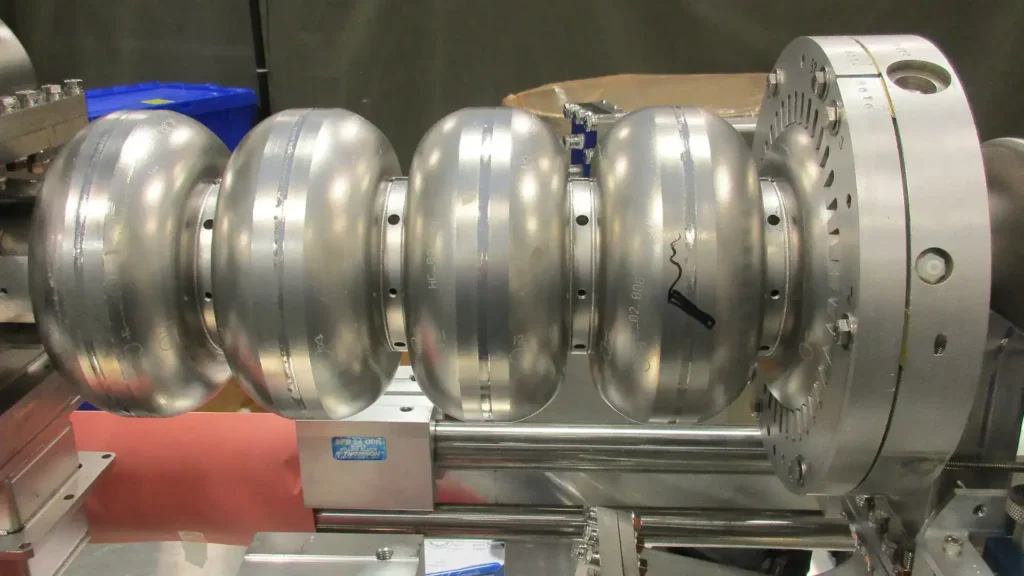
The concept of particle accelerators for nuclear waste management has been long-standing, but the cost has been a major barrier. Traditional large accelerators require niobium superconducting cavities, which necessitate complex and costly cooling systems.
At Jefferson Lab, researchers are exploring an alternative by coating niobium cavities with tin, allowing operation at higher temperatures and reducing the need for specialized cooling systems.
“Those are based on the mature Spallation Neutron Source cavity design, but we will add the new tin material on this existing design,” Geng said. “So that will be tested together with our partners at Oak Ridge National Lab.”
Furthermore, the team is developing a new cavity geometry, known as a spoke cavity, to enhance efficiency.
Another focus area is improving the power source for accelerators. Advanced magnetrons, similar to those in microwave ovens, are being investigated to meet the high energy demands of particle beams, aligning their output with the accelerator’s operating frequency.
Industry partners, such as Stellant Systems, General Atomics, RadiaBeam, and Oak Ridge National Laboratory, are collaborating on these advancements to transition the technology from the lab to practical application.
“The challenge is to really translate the accelerator science from where we are right now in terms of technology readiness to where the technology needs to be for this application,” Geng noted.


Original Story at www.zmescience.com