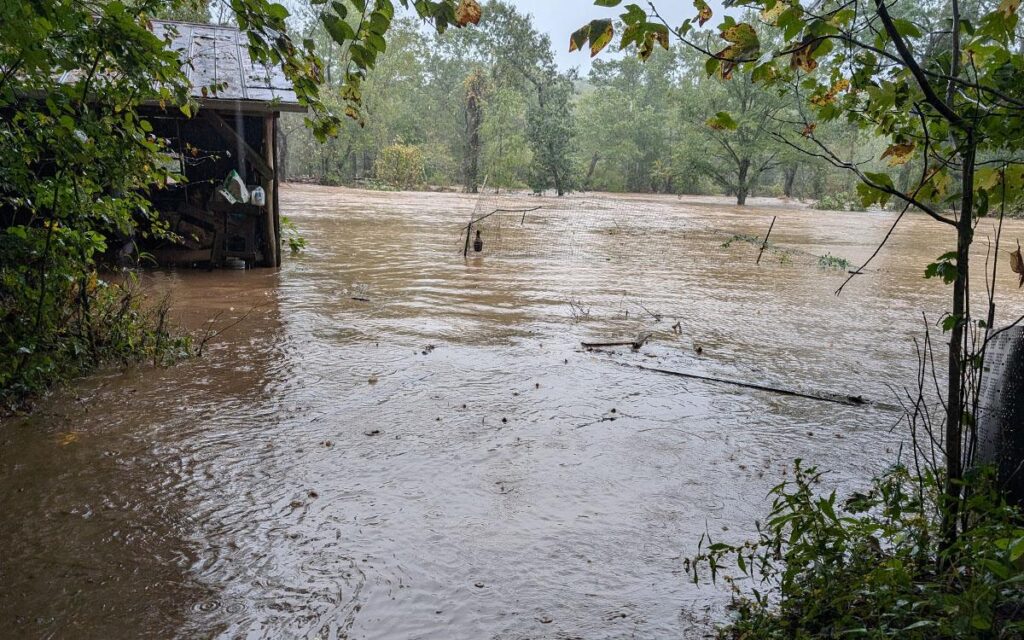
Western North Carolina is still not finished recovering from Hurricane Helene. The storm killed at least 107 people and caused nearly $60 billion in damage across the state, and mountain communities are still rebuilding roads, water systems, and homes two years later. That timeline matters, because it’s the backdrop against which disaster aid just got treated as a campaign chip.
At a Wednesday rally in Gastonia for Senate candidate Michael Whatley, President Trump told the crowd that more than $2 billion in FEMA funding has already gone to North Carolina, then said the remaining money Whatley has been asking him for won’t be sent if Whatley loses his Senate race. He then attempted to walk it back as a joke, but he was referring to a real precedent, not a hypothetical one. Reporting from July found the administration had blocked $227 million in disaster relief for New York, New Jersey, Rhode Island, and Massachusetts — all states that didn’t back Trump in 2024 — after those states sought help recovering from last winter’s storms, with one former FEMA official calling the move unprecedented. This isn’t a one-off rhetorical slip; it’s a pattern of treating federal disaster response as a tool of electoral reward and punishment.
That pattern should alarm anyone working on climate resilience, independent of how anyone feels about the underlying campaign. Disasters like Helene are exactly the kind of extreme weather event that a warming climate is making more frequent and more destructive, and FEMA is the backbone of how the country currently absorbs that shock. In January, during a visit to Asheville, Trump floated fundamentally reforming or getting rid of FEMA entirely, suggesting states receive direct payouts instead — a proposal that, paired with this week’s rally comment, raises the question of what “direct” payouts would actually mean for a state that votes the wrong way. If disaster funding can be withheld from blue-leaning states after a winter storm and joked about withholding from a swing state over a Senate race, the same lever is available every time the next hurricane, flood, or wildfire hits somewhere the administration doesn’t like politically.
Effective climate adaptation requires predictable, needs-based disaster response — insurers, state emergency managers, and rebuilding communities all plan around the assumption that federal aid will show up according to damage, not according to vote share. Every data point suggesting that assumption no longer holds makes it harder for local governments to plan recovery, harder for residents to trust that help is coming, and harder to build the long-term resilience infrastructure that reduces the human and financial cost of the next disaster.
A few places to direct that concern:
- Push for statutory guardrails. Congress can write clearer standards into FEMA’s disaster-declaration and fund-release process that make politically conditioned aid explicitly prohibited, not just norm-violating.
- Track the pattern, not just the headline. Advocacy and watchdog groups should be logging every disaster-aid decision against the state’s recent electoral history to document whether this is becoming a durable practice.
- Connect this to the broader climate-funding fight. FEMA politicization doesn’t happen in isolation — it’s part of a larger conversation about whether climate adaptation funding generally will be distributed on need or on loyalty.
- Support North Carolina’s ongoing recovery directly. Organizations still doing Helene rebuilding work need resources that don’t depend on who wins in November.