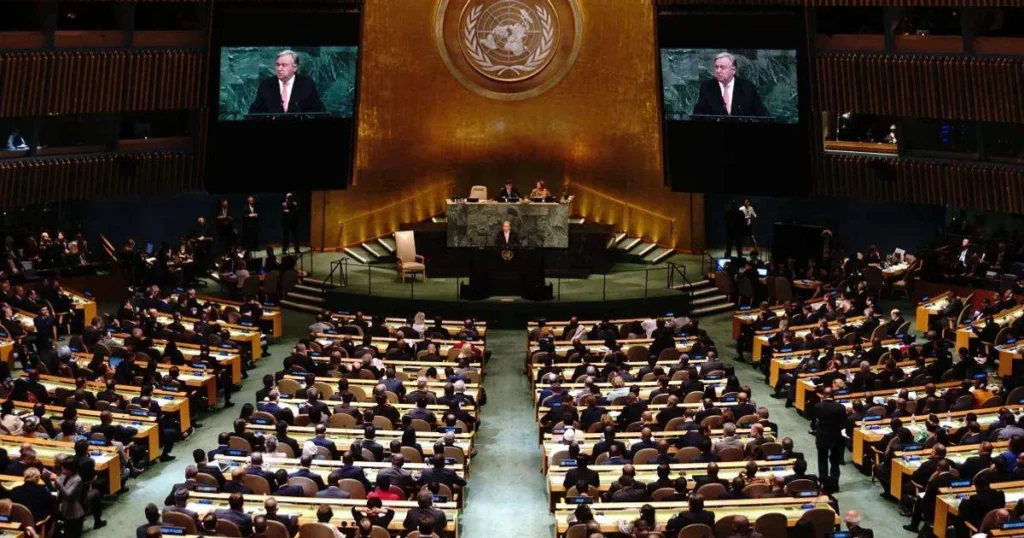
As September unfolds, a significant congregation of world leaders takes place at the United Nations Headquarters for the General Assembly’s High-Level Week. This year, the event focuses on the theme “Restoring trust, managing transformation: A United Nations that delivers for all.” Among the numerous discussions, three critical moments for the Intergovernmental Oceanographic Commission (IOC) emerge.
The SDG Moment
Before the commencement of the General Debate, a pivotal gathering occurs on September 18 for the annual SDG Moment. This meeting evaluates the progress of the 2030 Agenda, with many sustainable development goals (SDGs) reportedly advancing at a sluggish pace. The IOC recognizes this as an opportunity to bring attention to SDG 14: Life Below Water. As the custodian agency, the IOC is responsible for two indicators: 14.3.1, which focuses on ocean acidification, and 14.a.1, which tracks national investment in ocean science via the Global Ocean Science Report. These indicators underscore the essential role of science and data in ocean protection and in achieving the 2030 Agenda, demonstrating the direct link between ocean observation and global accountability.
The OceanEye International Alliance for GOOS
Coinciding with the High-Level Week on September 24, a gathering of governments marks the launch of the OceanEye International Alliance for GOOS. This initiative aims to bolster political and financial backing for the infrastructure essential to comprehending oceanic changes. Ocean observation is crucial for national security, global trade, early warning systems, disaster response, and marine protection worldwide. The Global Ocean Observing System (GOOS), co-sponsored by the IOC, World Meteorological Organization (WMO), UN Environment Programme, and the International Science Council, facilitates approximately 120,000 near-real-time daily ocean observations from 64 countries. These observations are vital for climate modeling and forecasting services. However, chronic underfunding poses a threat to the system’s efficacy.
The European Union has responded by launching the International Alliance for GOOS as part of its OceanEye initiative. This effort is co-chaired by European Commission President Ursula von der Leyen and Canadian Prime Minister Mark Carney, aiming to unite countries in securing sustained investment and promoting open ocean data. Governments are encouraged to make concrete pledges of support at this initiative’s launch.
The High-Level Meeting on Sea Level Rise
Another significant event on September 24 is the High-Level Meeting on Sea Level Rise. This forum seeks to build political leadership and international cooperation to address the existential threat posed by sea level rise, particularly to coastal communities and Small Island Developing States. The meeting anticipates the adoption of the UN Declaration on Sea Level Rise, emphasizing that actions “must be based on the best available science and knowledge.” The Global Sea Level Observing System (GLOSS), coordinated by the IOC since 1985, is identified as pivotal in this effort. GLOSS integrates a global network of tide gauges and GNSS with satellite altimetry to deliver the most dependable long-term records of sea-level changes.
Sea level rise, which has accelerated from about 1.5 mm per year during most of the 20th century to approximately 3.4 mm per year today, threatens around one billion people living below 10 meters of elevation. Despite this, the IOC’s recently released GLOSS Implementation Plan 2026 reveals that the observing network is under pressure, with only 210 out of 294 core stations currently operational. This represents a “key concern” that the plan aims to address by reinforcing the network and expanding real-time monitoring capabilities.
Collectively, these three events underscore the crucial role of science and data in understanding and addressing oceanic changes, forming the foundation of discussions at UNGA81.
Original Story at ecomagazine.com