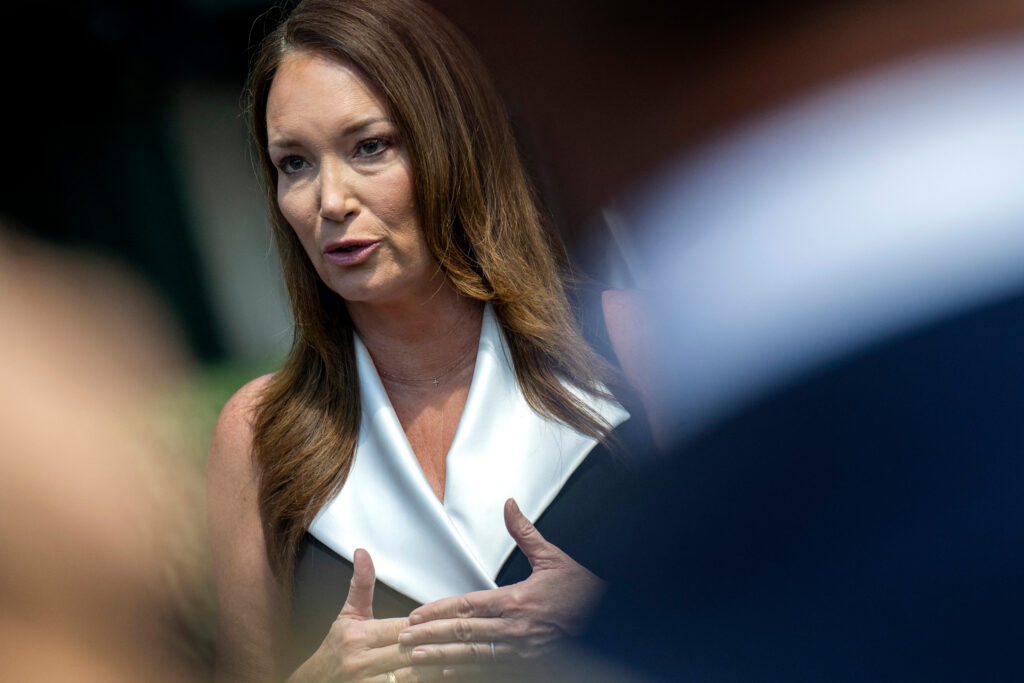
Farmers are facing challenges as diesel and fertilizer prices surge, compounded by the Department of Agriculture’s withdrawal of support for renewable energy. Meanwhile, the agency’s head, Brooke Rollins, possesses significant oil and gas investments.
In July, disclosure reports revealed that Rollins and her husband hold up to $2.5 million in fossil fuel investments. Notably, about $1 million is in HKN II, with interests in Iraq’s Kurdistan, and another $1 million in Hillwood Energy New Ventures in Texas. Rollins also reported owning $250,000 to $550,000 in Texas-based oil and gas assets.
This year, oil and gas prices have soared following President Trump’s war with Iran, leading to record diesel costs and rising fertilizer prices, heavily impacting the agriculture sector already strained by tariffs and extreme weather.
“Farmers have spent $1.5 billion just on additional diesel costs due to the Iran war,” said Jay Inslee, former Washington governor and climate policy advocate. “American farmers are financially burdened by this.”
Inslee collaborates with Climate Power, which promotes climate and clean energy policies.
A Climate Power analysis indicates that Jay Clayton, another top Trump official, held up to $320,000 in oil and gas stocks by late 2025.
A report from the Joint Economic Committee-Minority reveals that Trump’s oil and gas holdings potentially earned him about $15.5 million amid price hikes. The report states Trump owned up to $45.6 million in stocks, now valued up to $61.1 million.
The administration promised favorable conditions for the oil and gas industry, contingent on a $1 billion campaign donation. As the war restricted the Strait of Hormuz, companies reported over $125 billion in profits.
Inslee criticized the administration for corruption and self-dealing, impacting Americans financially. The increase in Rollins’ or Clayton’s holdings’ value wasn’t calculated, but Climate Power analysts expect similar profitability.
Rollins, a climate skeptic, opposed the Clean Power Plan and the Paris Agreement. Despite her agricultural background, she primarily practiced law before leading an agency with diverse responsibilities. Before her USDA appointment, she led the America First Policy Institute, backing Trump’s second term.
Under her leadership, the USDA has curtailed climate-focused initiatives, including redirecting funds from the Inflation Reduction Act. The department stopped funding wind and solar projects and ended the Climate-Smart Commodities program, labeling it a “slush fund.” Efforts to revoke national forest land protections have also been initiated.
The USDA declined to comment on Rollins’ actions.
The American Farm Bureau Federation forecasts that inflation, low commodity prices, and high production costs, including diesel and fertilizer, will cost farmers $31 billion in 2026 and $32 billion in 2027.
Farmers, historically strong Trump supporters, voted overwhelmingly for him in 2024. However, support is waning due to rising bankruptcies and declining profits.
An April survey indicated 94% of farmers were worried about rising costs linked to the Iran conflict, with 40% reconsidering their midterm election choices.
Original Story at insideclimatenews.org