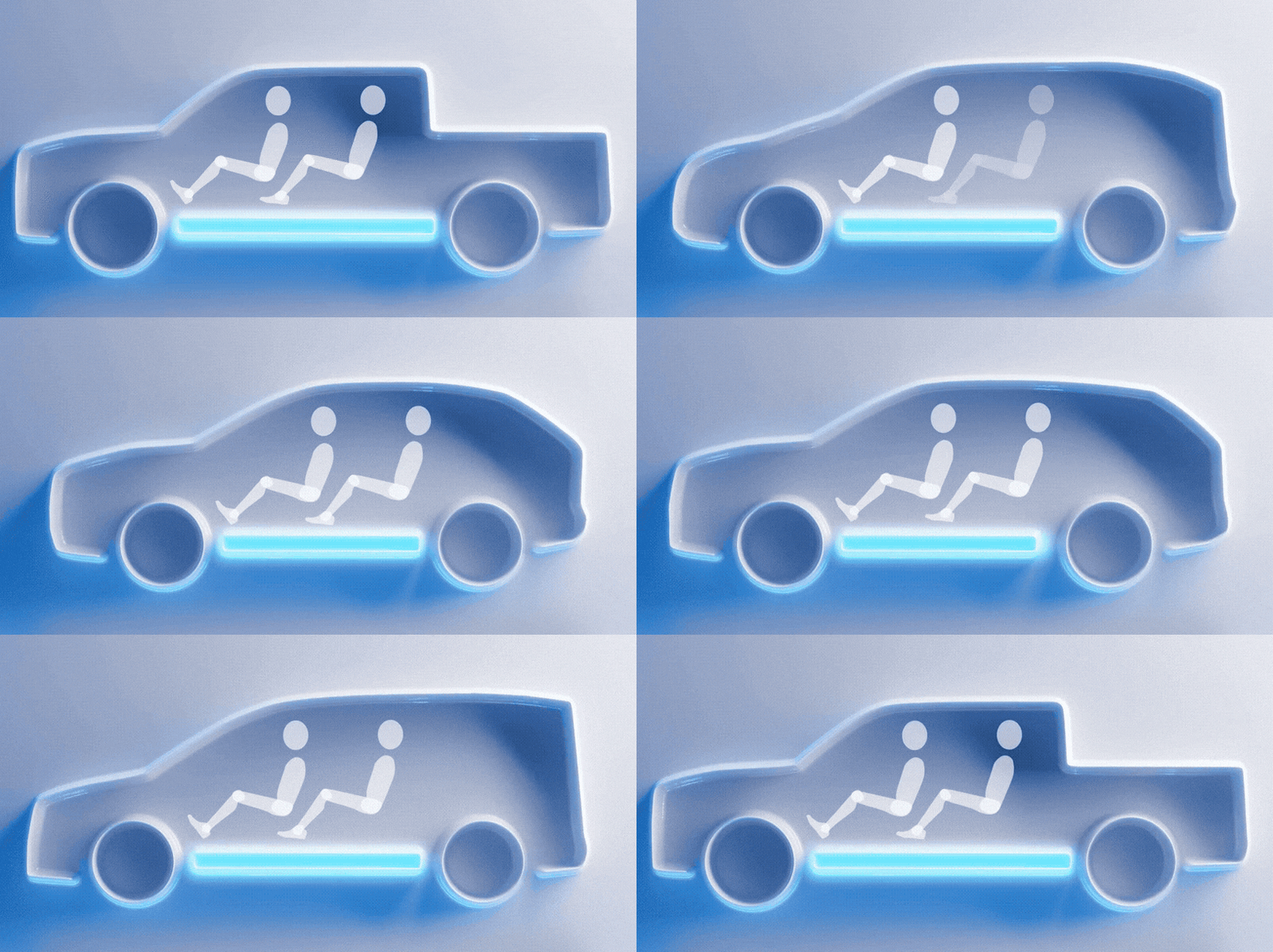
In a strategic update that hints at the future of Ford’s electric vehicle (EV) lineup, CEO Jim Farley disclosed new information about the company’s upcoming EV pickup. This announcement was made during Ford’s second-quarter earnings call for 2026, offering a glimpse into what the automaker has planned for next year.
The forthcoming EV pickup, rumored to be named “Ranchero” by external sources, will feature more cabin space than the popular Toyota RAV4, as well as bi-directional charging capabilities. Despite its spacious interior, the vehicle will maintain a traditional pickup bed. Farley emphasized the vehicle’s entry-level price point of “around $30,000” and noted that it will be “fun to drive.”
While these details may not be groundbreaking, they counter recent critiques suggesting that U.S. automakers are ceding EV innovation to China. Recent industry reports have pointed out that major American manufacturers, including Ford and General Motors, have scaled back their ambitious EV expansion plans following substantial financial setbacks. Stellantis, for example, wrote down $26 billion, while Ford reported $19 billion in losses within EV development. This retrenchment followed the elimination of a $7,500 EV tax credit.
Despite these challenges, Farley remains steadfast in Ford’s EV strategy, which is now more focused on affordable commuter vehicles, rather than high-end models like the F-150 Lightning and Mustang Mach-e. The aim is to target cost-conscious consumers, offering more accessible pricing as nascent EV technology becomes more widespread.
Ford’s Model e unit reported a $919 million loss in Q2, a reduction from the $1.3 billion loss during the same period the previous year. Special item write-downs included $0.5 billion for EV program cancellations and $3.6 billion related to the dissolution of Ford’s joint venture with SK On of South Korea. Earlier, Ford had taken a $0.2 billion write-down for its share of this venture.
The upcoming product lineup, according to Farley, will showcase significant advancements in manufacturing and design, reflecting a comprehensive overhaul of Ford’s portfolio over the next three years. “What I’m most excited about seeing is improvements in next-generation products,” Farley shared during the call.
When queried about the potential expansion of Ford’s partnership with Apple Maps, Farley responded, “For sure, it could,” although no formal announcements have been made.

A Ford engineer works in the automaker’s California-based Electric Vehicle Development Center.
As Ford prepares for upcoming product launches, including new F-Series and Super Duty models, it faces competition from General Motors’ fresh offerings like the Chevrolet Silverado and GMC Sierra. Despite the competition, Farley proudly highlighted the Ford F-150’s longstanding dominance as the “number one truck brand” for nearly half a century.
In addition to consumer vehicles, Ford is vying for a Pentagon contract with prototypes based on the Super Duty model for military applications. The company has also resolved previous aluminum supply issues, allowing for increased production capacity at its Oakville Assembly plant in Ontario, which is now set to manufacture up to 100,000 Super Duty trucks annually.

Ford has also purportedly built three Super Duty-based prototypes aimed at military use.
As the company navigates supply chain recovery and trade negotiations, it aims to boost its vehicle inventory to meet demand. Ford’s Oakville Assembly facility is gearing up to resume operations amidst ongoing trade tensions, with Farley advocating for a revised US-Mexico-Canada trade agreement to bolster the U.S. industrial base.
Financial Performance
Ford reported a 4% drop in revenues to $48.3 billion for the second quarter, but adjusted earnings before interest and taxes (EBIT) rose by 17% to $2.5 billion. The company’s Blue business unit, which includes civilian models like Mustangs and Explorers, saw a $1.1 billion EBIT, while its Pro commercial truck unit experienced a decrease to $1.7 billion.
On a positive note, Ford’s stock surged over 5% in mid-afternoon trading following the earnings announcement.
Original Story at www.autoweek.com