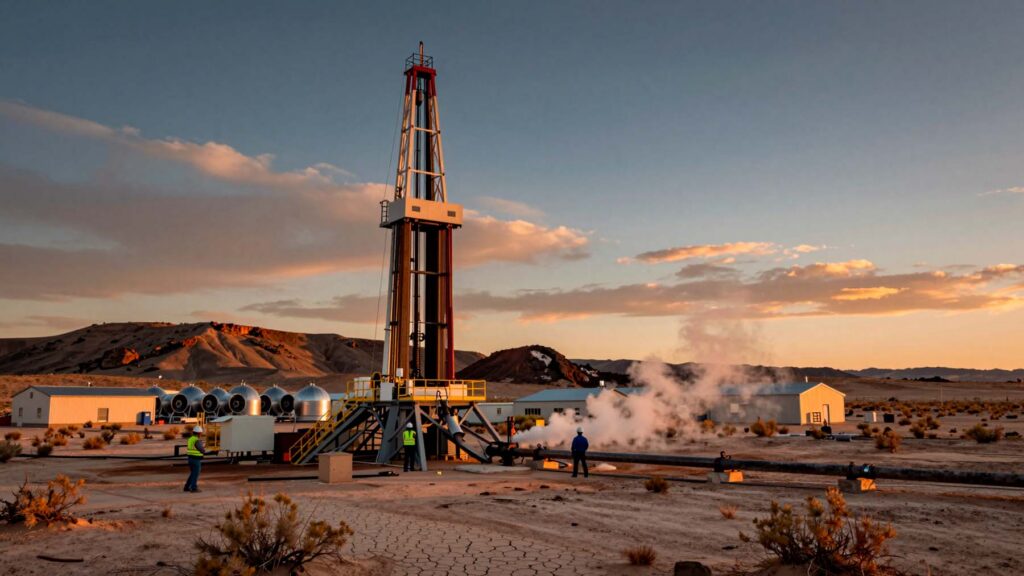
Beneath the surface of the American West lies a colossal heat source with the potential to power entire cities, yet the geothermal industry has remained largely dormant for years. The tide may be turning as past experiments now serve as harbingers of a clean energy future.
A Dormant Potential: The Geothermal Story
In Nevada, a company initiated a groundbreaking project over two decades ago, drilling into a seemingly barren landscape to test geothermal energy. Despite its potential, the project garnered little attention at the time, reflecting the industry’s long-standing stagnation.
Currently, the U.S. operates around 93 geothermal plants with a collective capacity of 3.9 gigawatts, primarily in California. This accounts for just 0.4% of the nation’s electricity, a figure that has seen minimal growth over the years.
The limited geographical scope of traditional geothermal plants, which rely on natural hydrothermal reservoirs near tectonic boundaries, has been a major constraint. Additionally, the high costs and risks associated with exploratory drilling have been deterrents.
Breaking Through: New Drivers of Change
The landscape is shifting due to three transformative forces. The surge in electricity demand, driven by tech companies building large data centers and states promoting electrification, has renewed interest in reliable energy sources. Additionally, rising power prices have made previously risky projects more attractive.
Technological advancements, particularly in drilling, have also played a crucial role. Fervo Energy, a startup, has revolutionized drilling by adopting techniques from the oil and gas industry, significantly reducing costs and time. This has spurred investment, with Fervo securing $244 million in funding.
Ormat Technologies: Reclaiming Its Legacy
Ormat Technologies, a pioneer in geothermal energy, is re-entering the fray with renewed vigor. After stepping back from enhanced geothermal systems (EGS) due to market conditions, Ormat is now partnering with industry leaders like SLB and Sage Geosystems, backed by a $17 million investment. The company has also launched a 100-MW unit designed for extreme temperatures and secured approvals for a new project in Nevada.
Startup Surge: A New Era of Innovation
Alongside established companies, startups are pushing the boundaries of geothermal technology. Fervo’s Cape Station project in Utah aims to achieve significant EGS scalability by 2028, while Quaise Energy is exploring superhot geothermal technology using innovative drilling methods. Other startups like Zanskar are leveraging AI to locate hidden geothermal resources, and XGS Energy is testing new closed-loop systems.
The Future of Geothermal Energy
According to the U.S. Department of Energy, geothermal energy could reach 90 gigawatts of capacity by 2050, a dramatic increase from current levels. However, challenges remain, particularly in terms of permitting, as most resources are on federal land, creating bureaucratic delays. Success will depend on reducing costs, achieving commercial scale, and streamlining regulatory processes.
The geothermal sector stands at a pivotal moment, with the possibility of fulfilling its potential and becoming a cornerstone of America’s energy landscape. The latent heat beneath the West, as exemplified by the historic Desert Peak site, has been waiting for its moment to shine.
Original Story at energiesmedia.com