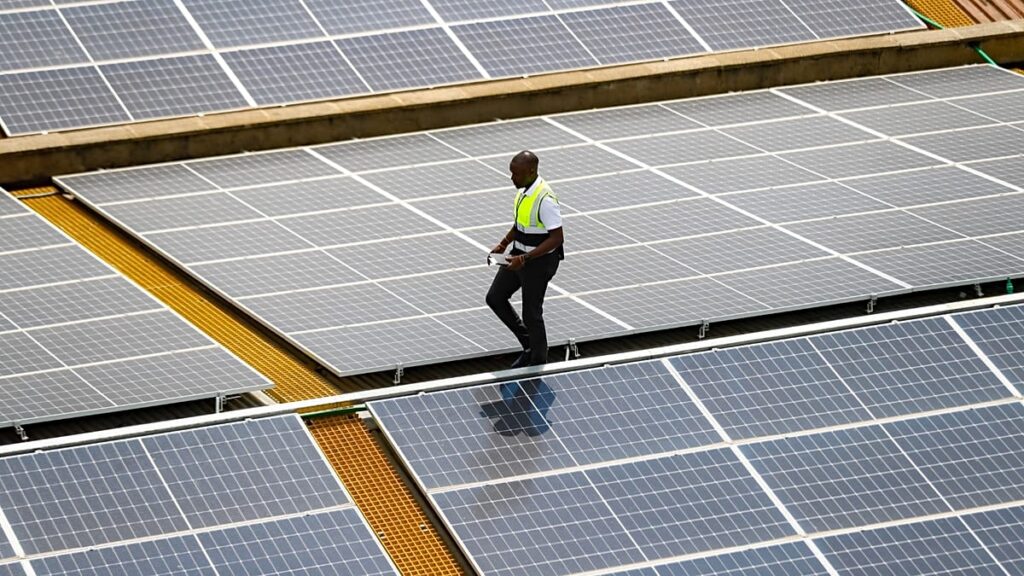
Europe is increasingly turning to solar power to mitigate the financial strain caused by high fossil fuel import costs, a consequence of ongoing tensions in the Middle East.
The global oil market remains unstable, with Brent crude trading at $85 per barrel, a notable increase from pre-war levels. This volatility is largely due to Iran’s control over the Strait of Hormuz, a critical channel for a significant portion of the world’s oil supplies.
As fossil fuel prices soar, Europe’s investment in solar energy has proven beneficial. According to SolarPower Europe, the continent saved €20 billion between March 1 and July 15 by reducing its reliance on gas imports. This translates to daily savings of €146 million, surpassing France’s daily defense expenditures.
Solar as a Path to Energy Independence
Walburga Hemetsberger, CEO of SolarPower Europe, emphasized the importance of solar energy, stating, “Every megawatt-hour generated by solar power reduces our dependence on imported fossil fuels and makes Europe safer.” In June, solar power became the EU’s largest electricity source, supplying 25% of the bloc’s energy. Hemetsberger advocates for greater electrification and renewable energy expansion to enhance Europe’s energy security.
The Role of Renewables in Reducing Gas Dependency
Several European countries are already reaping the benefits of transitioning to renewable energy. Spain, for instance, has significantly increased its wind and solar capacity since 2019, adding over 40 GW. This expansion has cut the influence of costly fossil fuels on electricity prices by 75%, according to energy think tank Ember.
The decline in gas-dependent electricity pricing in Spain outpaces that of other countries like Italy and Germany. As renewable energy sources expand, they increasingly set the hourly electricity price, reducing the impact of fossil fuels.
In the UK, record wind energy production has further demonstrated the potential of renewables. On March 26, wind generation hit a new peak of 23,880 megawatts, providing power to 23 million homes. RenewableUK’s Tara Singh highlighted the significance of this achievement, noting the reduced reliance on gas for electricity generation.
EU Leaders in Renewable Energy
In 2025, the EU achieved a milestone where wind and solar energy production surpassed fossil fuels for the first time, as reported by Ember. Wind and solar accounted for a record 30% of EU electricity, slightly overtaking fossil fuels.
Austria led the EU in renewable energy use in 2024, with 90% of its electricity coming from green sources, primarily hydroelectric power. Sweden and Denmark followed closely, with renewable shares of 88% and 80%, respectively. Other nations like Spain and Portugal also reported significant renewable energy contributions, while Malta lagged with just 10.7%.
Original Story at www.euronews.com