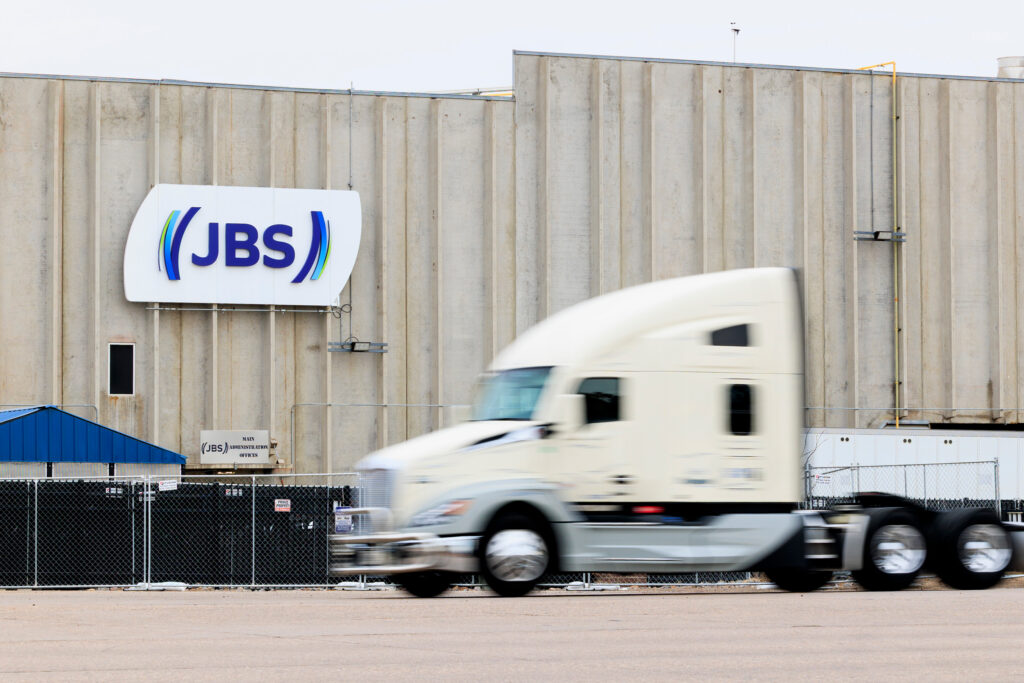
The world’s largest meat producer has retracted its climate and deforestation pledges, after years of emphasizing greenhouse gas emission reductions as a key objective.
In its latest sustainability report, JBS has withdrawn its goal to achieve net-zero emissions by 2040 and omitted references to its previous commitment to eliminate deforestation in its Brazilian supply chains. This shift aligns with other livestock and grain companies reducing climate ambitions, including leaving a deforestation moratorium in the Amazon.
“They have removed any reference to their net-zero 2040 targets and the time-bound deforestation commitment,” said Gemma Hoskins of environmental group Mighty Earth. “It’s very disappointing.”
JBS’s chief sustainability officer, Jason Weller, noted in a statement accompanying the report that mapping emissions from its supply chain is complex, as it involves diverse agricultural practices.
Weller explained that achieving a net-zero goal across vast territories and numerous independent producers with varied practices and lack of standardized measurement is challenging. The company aims to refine its framework to focus on areas where direct action is possible.
JBS plans to address emissions from direct operations, which constitute about 2-3% of its emissions, rather than its supply chain. A spokesperson stated that the updated sustainability framework aims to enhance operational fundamentals and align with customer expectations, while emphasizing efficiency and transparency.
JBS, initially based in Brazil and now in the Netherlands, has a greenhouse gas footprint comparable to Spain’s. Its expansion could significantly increase its impact. Operations span the U.S., Latin America, Europe, the Middle East, and Asia, with a planned project in Nigeria, its first in Africa.
In 2019, JBS claimed minimal climate impact from its global meat production but reversed this stance in 2020 with the 2040 net-zero commitment. This and other pledges became integral to its listing on the New York Stock Exchange, achieved in 2025.
The listing was approved following campaign disclosures showing Pilgrim’s Pride, a JBS subsidiary, was a major contributor to Trump’s inauguration.
Billionaire Brazilian brothers Joesley and Wesley Batista, major shareholders of JBS, have been involved in international diplomacy, including in Brazil, according to Reuters.
Critics argue the company is retreating on climate objectives after enhancing its image for financial gain. “These claims were about legitimizing an illegitimate business,” said Hoskins. “They used net-zero to portray climate leadership and attract capital for expansion.”
Globally, meat production accounts for over 16.5% of greenhouse gas emissions, from livestock and deforestation for feed production. Supply chain emissions, labeled Scope 3, are distinct from Scope 1 (direct operations) and Scope 2 (energy use) emissions.
JBS intends to limit the “emissions intensity” of its Scope 1 and 2 emissions, a measure that does not capture total emissions. “These were always empty promises,” noted Daniela Montalto of Greenpeace UK. “JBS appears to have given its supply chain free rein over ecosystems, from the Amazon to sub-Saharan Africa.”
Original Story at insideclimatenews.org