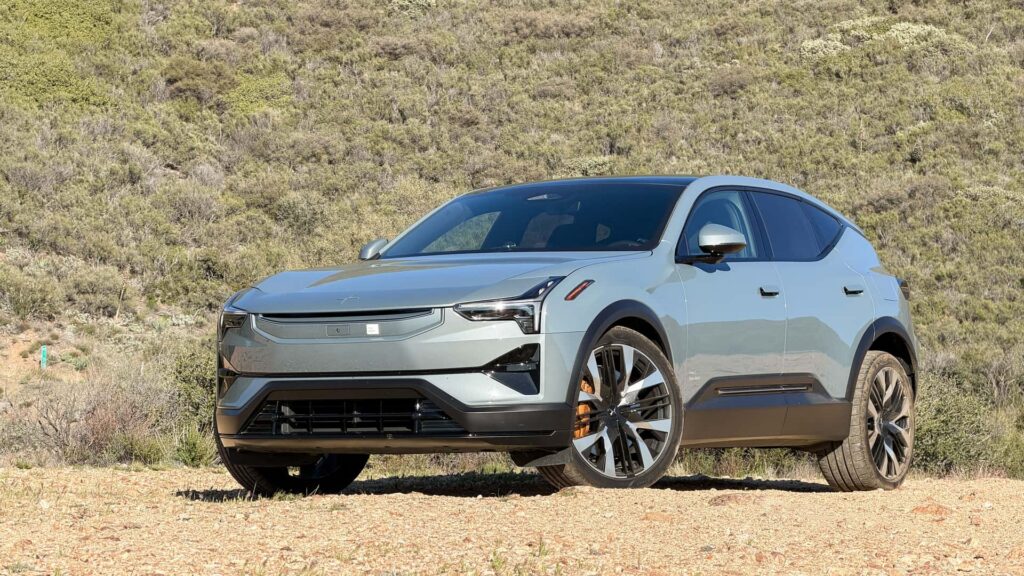
Polestar Faces U.S. Market Exit Due to Regulatory Challenges
In a significant move impacting the electric vehicle market, Polestar, a Swedish automaker under China’s Geely Group, has been barred from selling new vehicles in the U.S. starting with the 2027 model year. This decision by the U.S. Department of Commerce comes as part of the implementation of the Connected Vehicle Rule, which targets vehicles with technology linked to Chinese entities.
The decision effectively means Polestar will withdraw from the American market once its current stock of the Polestar 3 and Polestar 4 models is sold. These models, the Polestar 3 assembled in the U.S. and the Polestar 4 manufactured in South Korea, will continue to be available for sale and service until the end of the current inventory.
“We will continue to sell current stock, just as today,” a Polestar spokesperson told InsideEVs in an email. “Moving forward, customers will enjoy the same access to service stations and customer service, but from MY 2027 onwards, we will stop marketing and sales of our cars in the U.S.”
The Connected Vehicle Rule, finalized towards the end of the Biden administration, restricts the sale of vehicles with Chinese-linked software beginning with the 2027 model year. Hardware restrictions are set to be enforced by 2030. This rule aims to address national security concerns surrounding Chinese technology in automated driving and connectivity systems.
Polestar had previously expanded its manufacturing capabilities outside of China. While the Polestar 3 is assembled in Charleston, South Carolina, the Polestar 4 is produced in Busan, South Korea, at a facility owned by Renault. In contrast, Volvo Cars, also majority-owned by Geely, received authorization to bypass the rule and continue U.S. sales.
Despite this setback, Polestar views this as a strategic shift rather than a retreat. The company reports that European markets already account for nearly 80% of its sales, rising to 94% in the first quarter of the year when considering all markets outside the U.S.
“The automotive industry is entering a new phase, based on regional dynamics,” Polestar CEO Michael Lohscheller commented. “Our strategy reflects that, with Europe being our largest growth engine, and our plan to manufacture Polestar 7 in Europe. We will continue to invest in markets where we have opportunities to continue to grow, like Southeast Asia, Eastern Europe, Latin America, and Canada.”
Polestar had ambitious growth plans in both the U.S. and international markets. The company achieved its best-ever first quarter sales globally this year, driven by growth in Europe, Australia, and South Korea. Upcoming models include the next-generation Polestar 2 crossover and the Tesla Model Y competitor, Polestar 7. The Polestar 3 has recently been upgraded with an 800-volt architecture, enhanced fast-charging capabilities, and a more advanced Nvidia Drive AGX Orin computer.
Original Story at insideevs.com