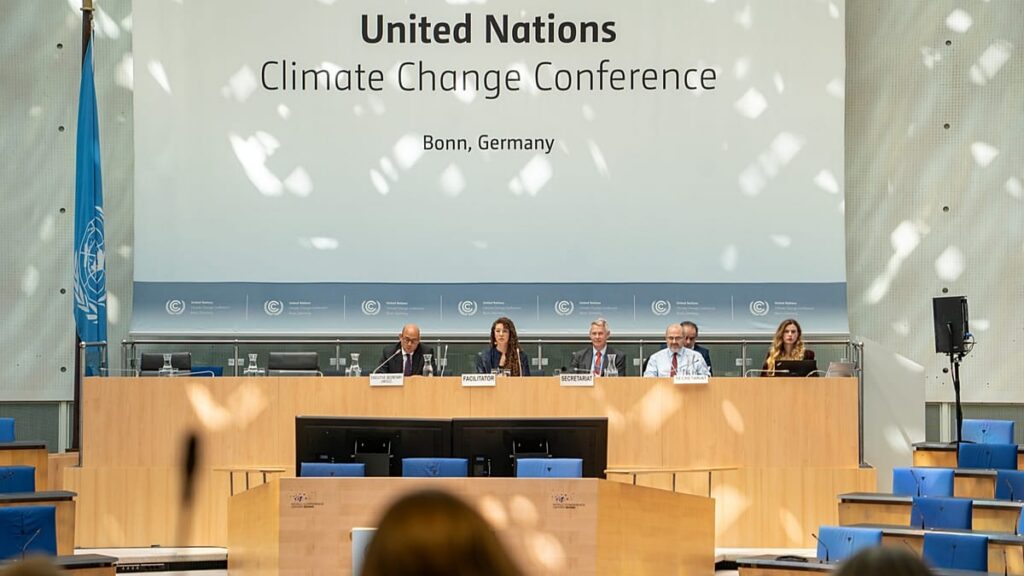
Climate Negotiations in Bonn Extend as Financing Deal Stalls
Efforts to secure a financing agreement for developing nations to combat climate change faced significant hurdles at the United Nations mid-year climate talks in Bonn. The discussions extended beyond the scheduled timeline, highlighting the challenges in reaching consensus.
Simon Stiell, Executive Secretary of the United Nations Framework Convention on Climate Change (UNFCC), criticized the reluctance of countries to fulfill commitments without reciprocity. He remarked on the persistence of “you-first-ism,” noting, “There remain significant divides, and significant work for the intersessional period ahead.”
Progress was noted on the ‘Just Transition’ initiative, aimed at equitably distributing the benefits of a shift from fossil fuels. However, this was overshadowed by scrutiny over participation rights and allegations of interference by fossil fuel interests, as reported by the French news agency AFP.
Allegations of Fossil Fuel Influence in Climate Talks
The negotiations were reportedly hindered by a minority group of fossil fuel advocates who challenged climate science. This claim was supported by delegates from the EU, Switzerland, and numerous developing countries. Fiji’s delegation head, Sivendra Michael, stated, “We are seeing certain countries holding the process hostage as vulnerable people suffer heat stress, king tides, and storms, drought and famine.”
Countries can include non-governmental representatives in their UN climate delegations, which sometimes comprise industry figures, including those from the fossil fuel sector. Manjeet Dhakal, an advisor to the Least Developed Countries bloc, described “coordinated attacks across the negotiation rooms by the small number of fossil fuel interests.”
The Earth Negotiations Bulletin noted opposition from India and the Arab Group to empower scientific bodies like the UN’s IPCC to combat misinformation, arguing it might hinder legitimate scientific debate.
Furthermore, India challenged references to “irreversible changes” and was against proposals to limit the “overshoot” beyond the 1.5°C target of the Paris Agreement, despite broad support for these measures from entities like the EU.
CAN Europe emphasized that reducing emissions swiftly remains crucial and beneficial across various sectors. The Alliance of Small Island States (AOSIS) expressed concern over attempts to undermine scientific consensus, with Shiva Gounden from Greenpeace highlighting a “war on climate science” seeking to dilute warming targets.
Looking Ahead: COP31 and the Potential for Change
The consensus-driven nature of UN climate discussions often leads to dissatisfaction, as seen at last year’s COP30 in Brazil, which concluded without a clear strategy to phase out fossil fuels. This has spurred initiatives like the Santa Marta conference in Colombia, aimed at facilitating an equitable transition away from fossil fuels, explicitly excluding fossil fuel lobbyists.
David Waskow of the World Resources Institute commented on the growing momentum for a fair transition, citing recent efforts and the Brazilian COP Presidency’s upcoming roadmap. Countries are expected to devise national plans to reduce reliance on fossil fuels.
A Call for Action at COP31
AOSIS has expressed concerns about the groundwork laid for COP31, scheduled for November in Türkiye. Marshall Islands climate envoy Tina Stege emphasized the urgency of the situation: “We came here to negotiate a better future. We’re in the midst of an energy crisis, risking an overshoot of 1.5°C with continued fossil fuel dependence that hurts us all, but especially the most vulnerable.”
She added, “Here in Bonn we’ve seen attacks on science, and we’ve seen a push to counter those attacks – from the islands, but also from so many others. The science tells us we need 1.5°C; it tells us we need to close the finance gap; it tells us the future will be safer, healthier, and more liveable if we take bold decisions. It’s time we listen.”
Original Story at www.euronews.com