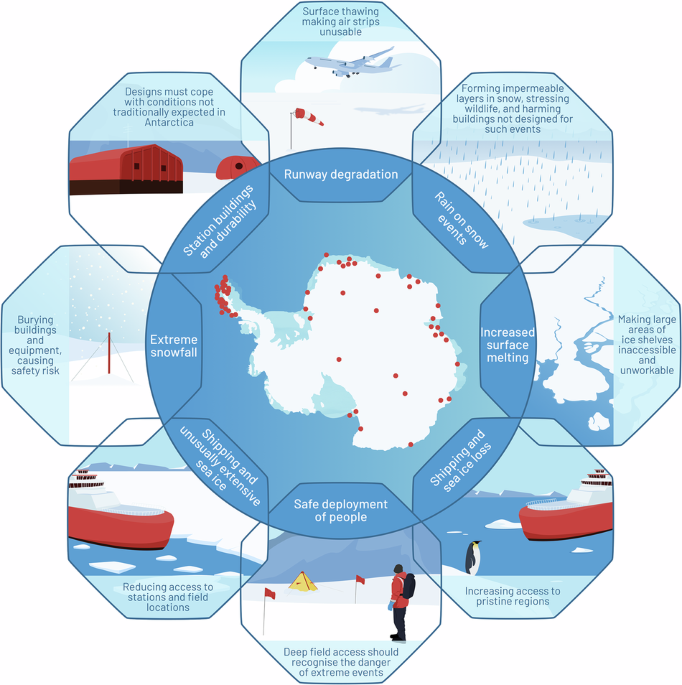
While Antarctic science has generally been resilient to severe disruptions, the impact of extreme environmental events is becoming increasingly apparent. Previously, only the COVID-19 pandemic significantly affected operations15. However, the ongoing effects of climate change suggest that future disruptions could become more frequent and severe.
Antarctic Station Infrastructure at Risk
The first major construction of Antarctic stations began around the International Geophysical Year (1957/58). Since then, over 80 stations have been established by 31 Antarctic Treaty Parties, with 50% of these located in more accessible regions like the Antarctic Peninsula16. As climate change continues to evolve, governments are increasingly considering its impacts on the construction and modernization of these stations. In 2018, a survey indicated that 73% of Council of Managers of National Antarctic Programs (COMNAP) members were modernizing stations, with 22% citing climate change as a primary driver17.
The evolving climate introduces new challenges for station infrastructure. Increased temperatures and changing weather conditions necessitate construction materials that resist rot and can handle snow loads and potential flooding. Coastal stations may also need protection against lightning strikes, a previously rare consideration in Antarctica19. Coastal erosion is also prompting modernisation, with eco-friendly measures being adopted to reinforce beaches18.
Challenges Facing Airstrip Operations
Aircraft are essential for accessing Antarctica, with airstrips constructed on either solid ground or ice. Extreme environmental events (EEEs) such as snow accumulation and strong winds can severely impact these airstrips. At the Rothera Research Station, for example, ice formation on the runway delayed aircraft operations by weeks, prompting an environmental assessment for de-icer use28.
Other stations have faced challenges as well. McMurdo Station has shifted from its sea ice runway to Pegasus airstrip due to ice instability, and Wilkins Aerodrome has experienced frequent closures due to excessive summer melt29. As climate continues to change, the reliability of these critical infrastructures is likely to decrease.
Impact on Surface Water and Field Operations
Melting snow and ice present further challenges for Antarctic operations. Sudden ‘ponding’ of water on ice shelves can complicate ground travel and air-supported field operations. The closure of the Damoy Point transit facility in 1993 exemplifies how extensive melting limits aircraft access to support field activities31.
As the British Antarctic Survey’s Mars Oasis site shows, the combination of snow melt and slush formation can severely hinder scientific research, prompting the abandonment of long-term monitoring programs32.
Navigating Through Changing Sea Ice
Sea ice changes are affecting Antarctic shipping, with implications for research and tourism. While reduced sea ice can extend access to certain locations, it also poses environmental risks such as increased pollution and the introduction of non-native species35,36.
The variability in sea ice conditions impacts the timing and feasibility of research station resupply and access. For instance, the UK’s RRS Sir David Attenborough and Chile’s Almirante Viel have conducted research in previously inaccessible winter months due to reduced sea ice45.
Ensuring Safety Amidst Environmental Changes
Extreme environmental events pose significant risks to those involved in Antarctic operations, including researchers and tourists. The unpredictability of sea ice requires enhanced monitoring to ensure safety, while changes in temperature and precipitation increase the risk of crevasses and avalanches. This has had a direct impact at Rothera Research Station, where crevasse formation has rendered some travel routes impassable52.
Maintaining Deep Field Research
Conducting research in remote Antarctic locations is becoming more challenging due to environmental changes. Safety and logistical complexities are increasing, but mitigations such as using longer-range aircraft, drones, and remote technologies are being considered to maintain research capabilities. International collaboration is also a potential solution to overcome these challenges, though it introduces additional logistical considerations15.
Original Story at www.nature.com