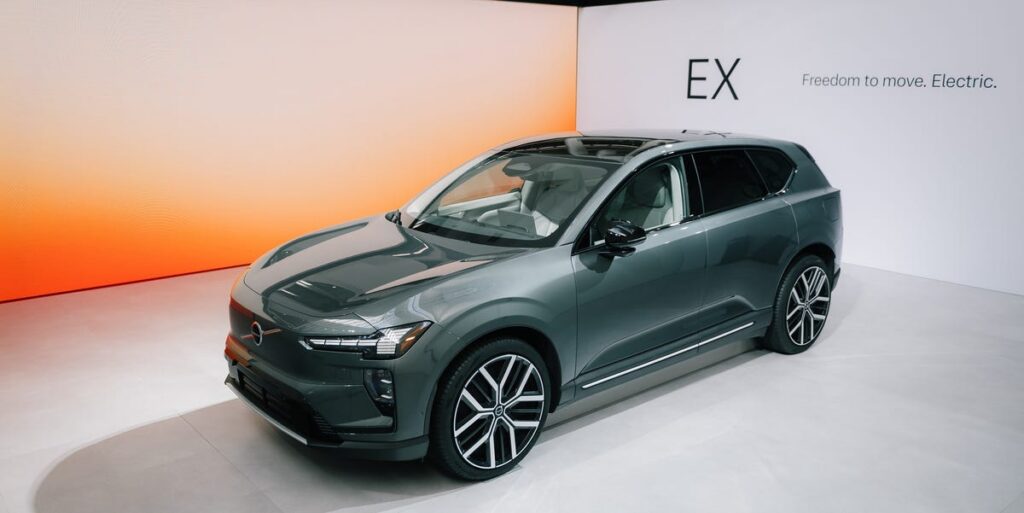
The Volvo EX60: A New Era for Electric SUVs in North America
Volvo made a significant splash in the electric vehicle market with the North American unveiling of its EX60 electric SUV, showcased at New York’s iconic Oculus World Trade Center. This marks the vehicle’s entrance into a market aimed at affluent consumers, with the starting price set at $58,400 for the single-motor P6 model, which is above the United States’ average vehicle price of $50,000.
For those looking to explore more options within the EX60 lineup, the dual-motor P10 model begins at $60,750, with the Ultra version priced at $67,350. The top-tier P12 model remains unpriced and unavailable, though orders for other versions are currently open. Production is expected to commence in late summer, with deliveries anticipated in early fall.
The EX60 is designed to replace the XC60, boasting an additional four inches in length, benefiting rear passengers significantly. While the vehicle will be manufactured in Sweden for both North American and European markets, it won’t be produced at Volvo’s South Carolina facility, which is reserved for a future family-sized vehicle. Interestingly, no plans for EX60 production or sales in China have been announced.
The EX60 is a two-row SUV designed with a focus on range and rapid charging capabilities. Although the vehicle’s off-road and performance specifications were not heavily emphasized by Volvo, the P12 model can accelerate from zero to 60 mph in just 3.8 seconds, while the P10 takes 4.4 seconds. The P6 model, meanwhile, relies on a single motor.
Volvo has prioritized range in the EX60’s design. The P12 model is expected to achieve 400 miles on a single charge, with the P10 AWD reaching 322 miles, and the P6 achieving 306 miles. A notable feature is the 16-minute charging time from 10 to 80 percent at fast-charging stations, reflecting Volvo’s commitment to efficiency.
While Volvo has not extensively discussed its relationship with the Geely-owned Polestar brand, the EX60 shares the SPA3 platform with the forthcoming Polestar 7. The vehicle’s design incorporates aerodynamic elements such as frameless doors and a grille-free front.
During a discussion about the EX60, Volvo Cars President and CEO Håkan Samuelsson suggested that the current dominance of SUVs might be excessive, indicating a potential return to more aerodynamically designed vehicles like station wagons. “We are looking into it,” Samuelsson said. “We may not have only SUVs five years from now.”
Despite this, Samuelsson emphasized the EX60’s suitability for the US market, asserting that electric vehicles will gain popularity not through subsidies but by offering desired features such as fast charging, long range, and competitive pricing comparable to gas models. The EX60’s luxury features distinguish it from more affordable competitors like the Tesla Model Y and Chevy Equinox EV.
Luis Rezende, president of Volvo Car Americas, highlighted the vehicle’s quality over pricing, stating, “It’s about the quality of the car, not just the price.” The EX60’s interior reflects this, featuring muted earth tones, recycled textiles, a natural wood dashboard, and advanced technology, including a 15.03-inch main screen and Google integration.
Rear passengers can enjoy reclining seats, and top trims offer features such as heated booster seats, Nappa leather, and a 28-speaker Bowers & Wilkins stereo system. Volvo’s engineering chief, Anders Bell, expressed the potential for the EX60 to become a global model, although it currently lacks plans for the Chinese market.
As the EX60 enters the market, it will be interesting to see what steps Volvo takes to address the challenges faced by its previous models like the EX30, particularly concerning manufacturing locations and tariffs. The EX60 represents a significant step for Volvo in the electric SUV segment as it prepares to enter American households this fall.
Original Story at www.autoweek.com