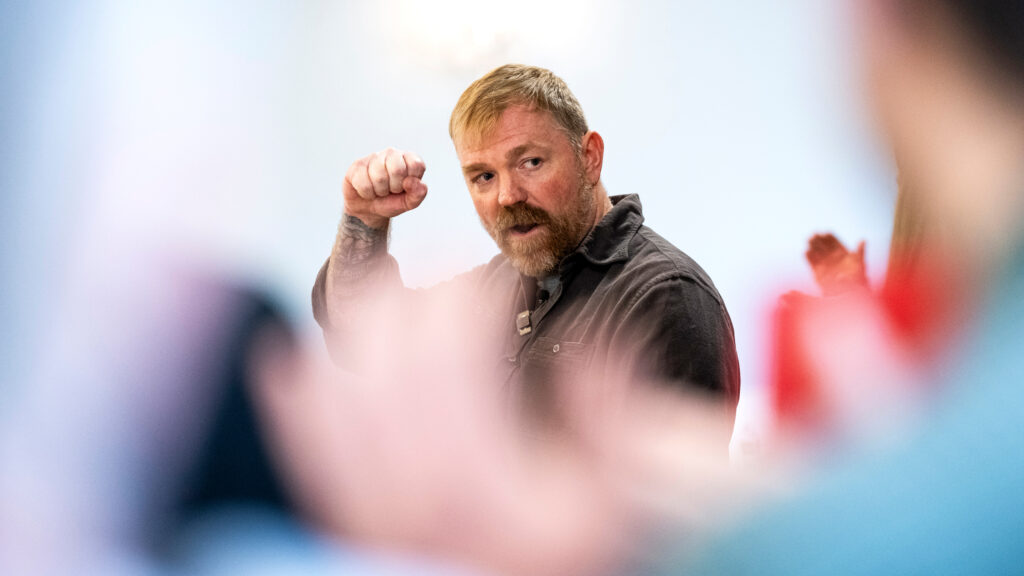
Graham Platner, the likely Democratic candidate for U.S. Senate from Maine, is recognized for his progressive stance resembling Bernie Sanders, his background as a Marine Corps veteran and oyster farmer, and his controversial online history.
Recently, Platner, who has shared experiences of finding solace in the Gulf of Maine, has introduced a message focused on environmental and economic protection, including an energy plan.
“We need to get off fossil fuels, not only for environmental reasons,” Platner told Inside Climate News. “Fossil fuels make us dependent and less self-sufficient.”
With Maine’s Governor Janet Mills exiting the race, Platner is poised to be the Democratic nominee, although David Costello, another environmentally focused candidate, remains in the primary.
Platner has aimed to balance immediate affordability with progressive environmental goals. His approach has gained early support from climate advocates.
A Boat’s-Eye View
Platner has witnessed climate change impacts in Maine, noting destructive storms that broke high-water marks twice in three days, destroying lobster piers. “It’s hard not to see things are changing,” he expressed.
When questioned about his climate focus, Platner emphasized urgency in addressing immediate national challenges before climate change. His stance contrasts with incumbent Republican Sen. Susan Collins, whom environmental advocates criticize.
Emma Conrad from the Maine Sierra Club highlighted Platner’s alignment with the group’s priorities on corporate responsibility.
Relief at the Pump and the Meter
Platner’s energy policy provides relief from high energy costs, especially significant for Maine, where electricity prices are among the highest. His plan proposes state-incentivized electricity rate freezes, similar to New Jersey’s approach.
It also suggests abolishing federal gas taxes, replacing them with taxes on wealthy Americans, and offering rebates funded by taxes on oil companies’ profits, an idea backed by U.S. Rep. Ro Khanna and Sen. Sheldon Whitehouse.
Regarding data center regulations, Platner proposes requiring energy generation co-location to shield consumers from new costs, though specific energy source restrictions remain undecided.
Build, Baby, Build
Platner’s detailed energy plan advocates federal investments in transmission lines and clean energy via low-interest loans, citing cost obstacles. It suggests utilizing the Defense Production Act to manufacture essential project components, as done during the COVID-19 pandemic.
However, past misuse fears persist. Ari Peskoe from Harvard Law supports the infrastructure fund, while Stephanie Kelton encourages deficit spending for essential needs.
Naming an Enemy
Platner targets Big Oil and Gas as climate adversaries, advocating for heavy taxation on fossil fuel companies profiting at the planet’s expense. This strategy aims to clarify industry roles in climate issues.
While transitioning from fossil fuels exceeds merely blaming producers, Platner’s plan includes a “Whole Home Repair Program” to modernize homes, aiding heat pump efficiency. Additional climate proposals are expected later this year.
Forging Alliances
Platner’s campaign focuses on housing, reflecting a broader climate movement strategy. The Maine Labor Climate Coalition supports local housing issues, gaining trust among residents alienated from political and climate discussions.
Platner’s tribal sovereignty support resonates with younger climate-conscious voters, emphasizing learning from Indigenous environmental perspectives. Roz O’Reilly, from JustME for JustUS, appreciates Platner’s relatable messaging.
Contrasting Approaches
David Costello, running against Platner, supports tribal sovereignty and proposes carbon pricing—a classic environmentalist approach. While politically contentious, Costello argues it’s increasingly viable.
Platner’s campaign taps into progressive outrage and working-class concerns, weaving a labor-climate-social welfare agenda. His focus on union labor in infrastructure projects garnered applause at recent events.
Original Story at insideclimatenews.org