This story was originally published by Grist. Sign up for Grist’s weekly newsletter here.
By Matt Simon, Grist
The legacy of Johnny Appleseed, known for planting apple trees that provided much-needed shade, seems more relevant than ever as cities struggle with rising temperatures and insufficient tree cover. Modern urban areas face increasing heat stress, but recent studies indicate a simple solution: planting more trees.
Research highlights the benefits of expanding urban tree canopies, which can mitigate the urban heat island effect by up to 50%. This phenomenon causes cities to be significantly warmer than surrounding rural areas. Another study analyzing 65 U.S. cities found that neighborhoods with sparse tree cover could experience up to 40% more heat compared to those with rich greenery.
Cities like New York, Atlanta, and Los Angeles must prioritize not only traditional infrastructure like roads and buildings but also their green infrastructure. “Heat is already a major public health threat. It kills 350,000 people a year by some estimates, and it’s worse in cities,” stated Robert McDonald, lead scientist for nature-based solutions at The Nature Conservancy.
Urban areas without sufficient tree cover suffer from more intense heat as concrete and asphalt absorb and release heat, keeping temperatures high even at night. This poses serious risks, especially for vulnerable populations like the elderly. It’s noteworthy that extreme heat is the deadliest weather-related hazard in the U.S., surpassing all other extreme weather events combined.
Lower-income neighborhoods are often the most affected, with significantly less tree cover than wealthier areas. These neighborhoods endure excessive heat due to expansive concrete surfaces and a lack of green spaces, unlike suburban areas with plenty of parks and trees.
The temperature disparity between neighborhoods with varying tree canopies is notable, with differences reaching up to 4 degrees Fahrenheit. Areas with abundant trees can experience a reduction in excess heat by 20 to 40 percent.
“I think what maybe was surprising is that there was a dramatic amount of consistency,” commented Steve Whitesell, executive editor at the Healthy Green Spaces Coalition.
Planting trees isn’t just about quantity; it’s crucial to select the right species. Larger trees provide more shade, while some species excel in evaporative cooling. Urban planners might also consider trees that offer fruit, supporting both shade and food production. Native species can further support local wildlife.
Climate change is complicating tree planting strategies. Native plants are shifting northward to avoid increasing temperatures. Urban trees must be chosen not only for their current suitability but also for their ability to withstand future climate conditions.
“I think that for us to use trees as a type of living infrastructure, that can counter those increased temperatures, is paramount,” said Edith de Guzman, a researcher at the University of California, Los Angeles.
However, trees alone cannot solve the heat issue. McDonald’s study indicated that even a maximum tree-planting initiative would only counteract 20% of the expected temperature rise due to climate change. Additional methods, such as reflective rooftops, are necessary to manage urban heat, especially in rapidly growing cities in developing nations.
“It’s just to say that climate change is a big enough challenge that while planting more tree cover helps with temperatures, it won’t do the job by itself,” McDonald said.
Historically, cities have faced similar challenges. During the Industrial Revolution, urban residents sought refuge in the countryside for greenery, with exceptions like London and Paris creating significant public green spaces. Today, urban planners aim to integrate more green areas within cities, bridging the gap between urban and rural environments.
“We know how to increase tree cover, if we put our minds to it,” McDonald said. “But it takes effort and time.”
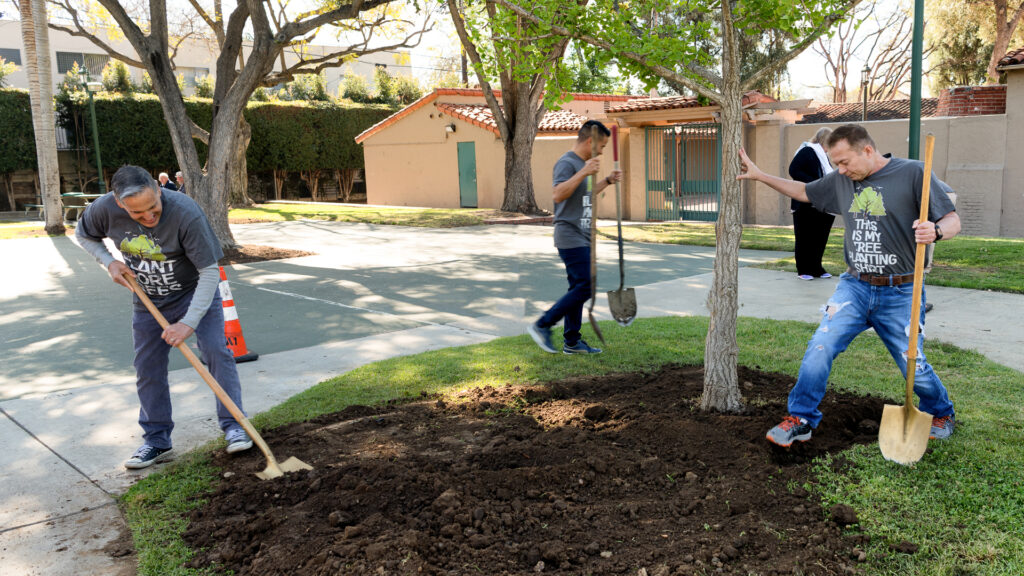
This article originally appeared in Grist at https://grist.org/cities/the-solution-to-urban-heat-is-much-much-simpler-than-you-think/. Grist is a nonprofit, independent media organization dedicated to telling stories of climate solutions and a just future. Learn more at Grist.org. Banner photo: Trees are planted at an Arbor Day event in Los Angeles (Jon Viscott/West Hollywood, CC BY-SA 2.0,via flickr).
Sign up for The Invading Sea newsletter by visiting here. To support The Invading Sea, click here to make a donation. If you are interested in submitting an opinion piece to The Invading Sea, email Editor Nathan Crabbe. To learn more about the urban heat island effect, watch the short video below.
Original Story at www.theinvadingsea.com