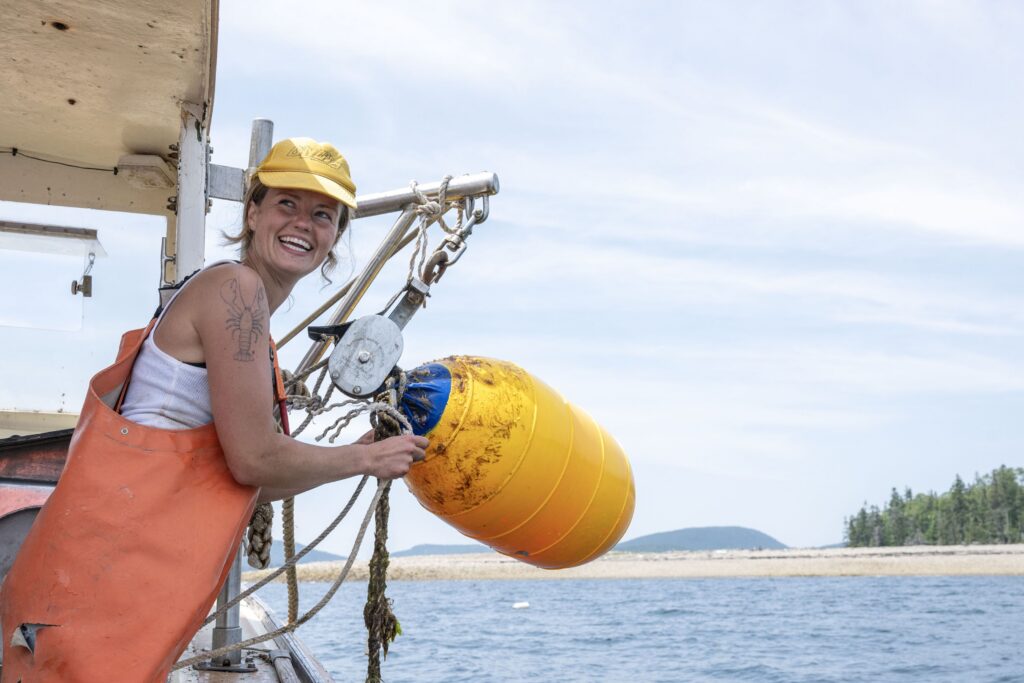
Women along Maine’s coast are ingeniously transforming their marine livelihoods as they face rapid environmental and economic shifts. The new season of the Island Institute’s podcast From the Sea Up, titled Everyday Adaptation, delves into these unnoticed but crucial adaptations. This four-episode series is informed by a NOAA Climate and Fisheries Adaptation–funded project in collaboration with the College of the Atlantic, the University of Maine, and Maine Sea Grant.
In the series’ debut episode, “Diverse Species,” listeners meet Emma Fernald, a seventh-generation fisherman from Bay Lady Scallops on Little Cranberry Island, and Krista Tripp, a former lobsterwoman who now farms oysters at Aphrodite Oysters in Owls Head. Both women illustrate the growing trend toward diversification within the fishing industry, a necessary response to the warming waters and changing species dynamics in the Gulf of Maine.
This podcast stems from a multi-institutional effort to study the responses of coastal communities to environmental changes. Dr. Hillary Smith, who is the principal investigator of the project, collaborates with co-investigators Dr. Josh Stoll from UMaine, Dr. Todd Little-Siebold from COA, Natalie Springuel from Maine Sea Grant, COA adjunct faculty Galen Koch, and Dr. Laurie Baker from Bates College. Koch also serves as the executive producer, while Smith is the assistant producer of the podcast.
The series aims to highlight the resourcefulness emerging in Maine’s fishing communities. “People hear a lot about coastal issues and fisheries policy, but not the everyday realities of the industry,” Smith explains. “We’re trying to tell a more nuanced story—one that shows how women are adapting in small, creative ways, even without formal climate-adaptation support.”
COA Students and Alumni Drive the Research
Students and alumni from the College of the Atlantic (COA) have been pivotal in shaping the research and narrative of the podcast. Jessica Bonilla, a member of the class of 2024, initiated the interviews during her time at COA and continues her work on the project as a graduate student at the University of Maine. Asy Xaytouthor and Emelia Lakebrink contributed through research support, while Camden Hunt, who graduated in 2022, applied his training in oral-history methods to develop the story materials and data visualizations.
Smith emphasizes the importance of these contributions: “So much of what this project accomplished was possible because of COA students—their field experience, their oral-history training, and their deep familiarity with island communities.”
Exploring Ground-Level Adaptations
The podcast focuses on four themes identified from interviews with women working on the water: diversifying species and fishing practices, creating new markets and value-added products, addressing biophysical threats like biofouling, and trialing alternative economic models such as cooperatives.
By discussing “environmental change” rather than “climate change,” the research team keeps dialogues rooted in real-world experiences. Smith adds, “Our hope is that by documenting these everyday adaptations, we can help inform policy efforts so they reflect what’s already working on the ground.”
This collaboration underscores COA’s dedication to community-based research and student-led initiatives along the Maine coast. To listen to the podcast, visit islandinstitute.org.
Original Story at www.coa.edu