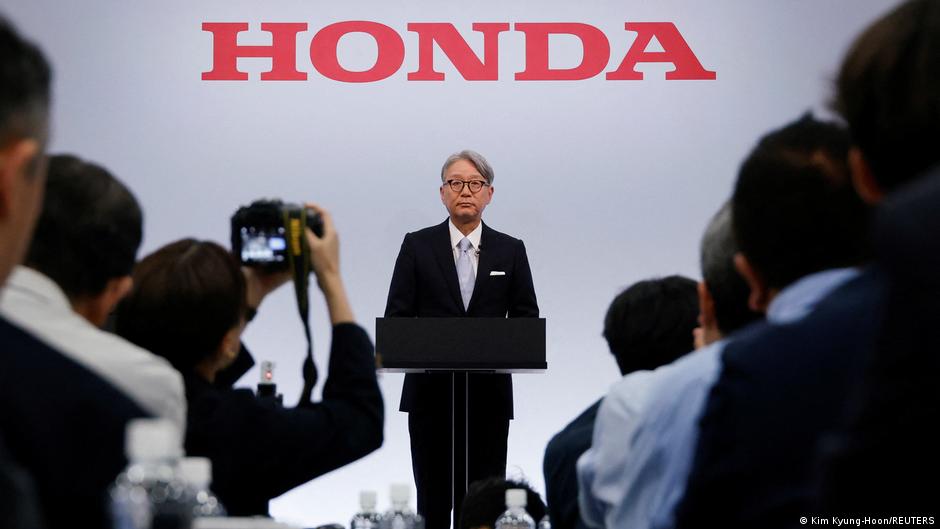
In a significant shift, Honda, Japan’s second-largest car manufacturer, has reported its first operating loss since 1957. This financial setback comes as the company re-evaluates its electric vehicle (EV) strategy, particularly in the U.S., where it had anticipated quicker industry electrification.
Honda had previously alerted stakeholders about the expected financial impact of this strategic pivot, which was reflected in its recent financial disclosures. Despite these losses, Honda’s stock experienced a notable rise, buoyed by forecasts of a return to profitability by 2026.
Details of Honda’s Financial Performance
The automaker disclosed an operating loss amounting to 413.4 billion yen (approximately €2.23 billion or $2.6 billion), primarily due to extensive write-downs in its EV division. The net loss was slightly higher at 423.9 billion yen.
Globally, Honda’s vehicle sales dropped to 3.4 million units in the fiscal year ending in March, a decrease from 3.7 million the previous year. Conversely, the company’s motorcycle segment performed well, with sales rising to 22.1 million units from 20 million, driven by strong performance in markets like India where Honda’s budget-friendly Super Cub continues to dominate.
Honda anticipates regaining profitability by the fiscal year ending in March 2027, which initially spurred an 8% increase in its share price, although gains moderated as trading progressed in Asia.
Contributing Factors to the Loss
Honda attributed part of its losses to policy changes under former U.S. President Donald Trump’s administration, which impacted its sales and strategy in its largest market. The U.S. government’s decision to eliminate tax incentives for EV buyers under the “Big Beautiful Bill” of September 2025 significantly influenced demand.
Additionally, tariffs on imported cars and car parts, even after being reduced from 25% to 15%, further squeezed Honda’s profitability. The company also cited a “decline in competitiveness” in Asian markets, particularly in the face of competition from rapidly advancing Chinese manufacturers.
Geopolitical tensions, including the war in the Middle East, have strained oil and energy supply and pricing, further pressuring the automotive industry. Other Japanese automakers are also facing challenges, with Toyota forecasting a 22% drop in net income and Nissan posting a $3.4 billion loss. In contrast, Suzuki reported an 8% revenue increase, driven by growth in India and Latin America.
Hybrid Vehicles and Future Plans
In response to these challenges, Honda showcased new hybrid models tailored to U.S. consumer preferences, including a family sedan and an SUV. The company acknowledged a decline in EV demand partly due to the rollback of environmental regulations in the U.S.
Honda has also halted the development of two electric vehicles in collaboration with Sony. Despite this, CEO Toshihiro Mibe emphasized the company’s continued commitment to carbon neutrality, recognizing the need to balance EV, hybrid, and internal combustion engine models.
When questioned about his future with the company in light of these losses, Mibe expressed a desire to focus on implementing the revival plan. “We will continue our research to develop future technologies including electric vehicle batteries,” he stated. “We will get back on a growth track.”
“`
Original Story at www.dw.com