Farmers Struggle Amidst Climate Challenges and Economic Pressures
In an era where agriculture faces increasing challenges, the financial strain on farmers is intensifying. The rising costs of essential inputs like fertilizers and pesticides, coupled with dwindling water supplies, are placing farmers in a precarious position. This situation is exacerbated by unpredictable weather patterns, posing a threat to their livelihoods.
According to The Guardian, wheat farmers across Kansas are experiencing devastating crop failures due to erratic weather conditions this spring. Traditionally, Kansas wheat fields yield 40 to 50 bushels per acre, but this year’s harvest has plummeted to less than 2 bushels per acre. This dramatic drop raises concerns about covering the costs of equipment, seeds, and fertilizers.
Merrill Nielsen, a seasoned farmer from a family with roots dating back to 1871, highlights this season as one of the toughest. Similar hardships are reported by farmers in Oklahoma, Texas, Colorado, and Nebraska. The US Department of Agriculture has labeled 44% of Kansas’ wheat and 49% of Oklahoma’s as poor to very poor. Earlier forecasts from the agency suggest that US wheat acreage could hit its lowest point since 1919.
Economic Strain on Agriculture
The rising operational costs are compounded by policy decisions and global events. Tariffs and geopolitical tensions have driven up the prices of critical farm supplies like fertilizer and diesel. As Blake Gendebien, a dairy farmer in New York, explains, “These rising costs are hitting us at the wrong time here in the north country in New York. I use 20,000 gallons of fuel to get my crops in the ground and harvested.” With diesel prices nearly doubling from $2.65 to about $5.00 per gallon, farmers like Gendebien face an additional $50,000 in fuel costs alone.
Most American farms are small family-owned operations, with 86% generating a gross income of $350,000 or less annually. The narrow profit margins, often below 10%, mean that any increase in costs can jeopardize their sustainability. “It’s a massive cost for farmers that are already barely, barely getting by,” Gendebien adds.
Renewable Energy: A Beacon of Hope
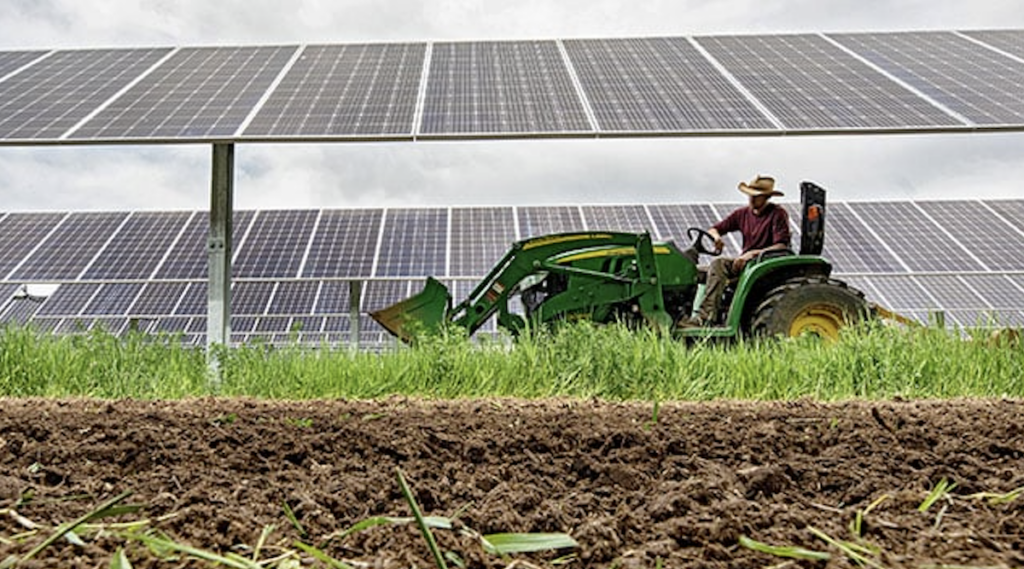
Despite these challenges, renewable energy emerges as a potential savior for struggling farmers. Research from RMI indicates that income from rural solar and wind projects is increasingly significant. In 2024, nine states reported wind and solar revenues surpassing $1 billion, collectively accounting for 63% of national totals.
Hosting renewable energy projects can offer farmers stable, predictable income streams, providing a financial buffer against volatile market conditions. These projects not only support farmers but also contribute to local economies by generating tax revenues that fund public infrastructure and services.
Balancing Energy and Agriculture
With projections suggesting that 90% of future solar infrastructure will be sited on rural lands by 2050, there is optimism about the economic benefits. However, concerns about farmland loss and visual impacts persist. Studies show wind projects generally allow for continued agricultural use, while solar installations can lead to a shift from agricultural activities.
Nonetheless, the economic advantages are clear. For example, in Howard County, Iowa, wind projects contributed significantly to local tax revenues, illustrating the potential for renewable energy to bolster rural economies. As RMI notes, “Wind and solar projects are increasingly contributing to economies in rural America. These projects support financial stability and resilience for farmers and contribute to local tax revenue and employment.”
Original Story at cleantechnica.com